Nov. 22, 2025

A Brightening Market for Florida Real Estate Buyers: October 2025 Update

A Brightening Market for Florida Real Estate Buyers: October 2025 Update

A Brightening Market for Florida Real Estate Buyers: October 2025 Update

Florida’s October 2025 housing report delivered a wave of optimism for Florida real estate buyers . For the first time in several years, buyers are experiencing meaningful relief as inventory expands, sales rise, and median prices show signs of stabilizing. The statewide market appears to be shifting out of the hyper-competitive post-pandemic era and settling into a more balanced environment—one where buyers can make more thoughtful decisions without fear of being outbid instantly.

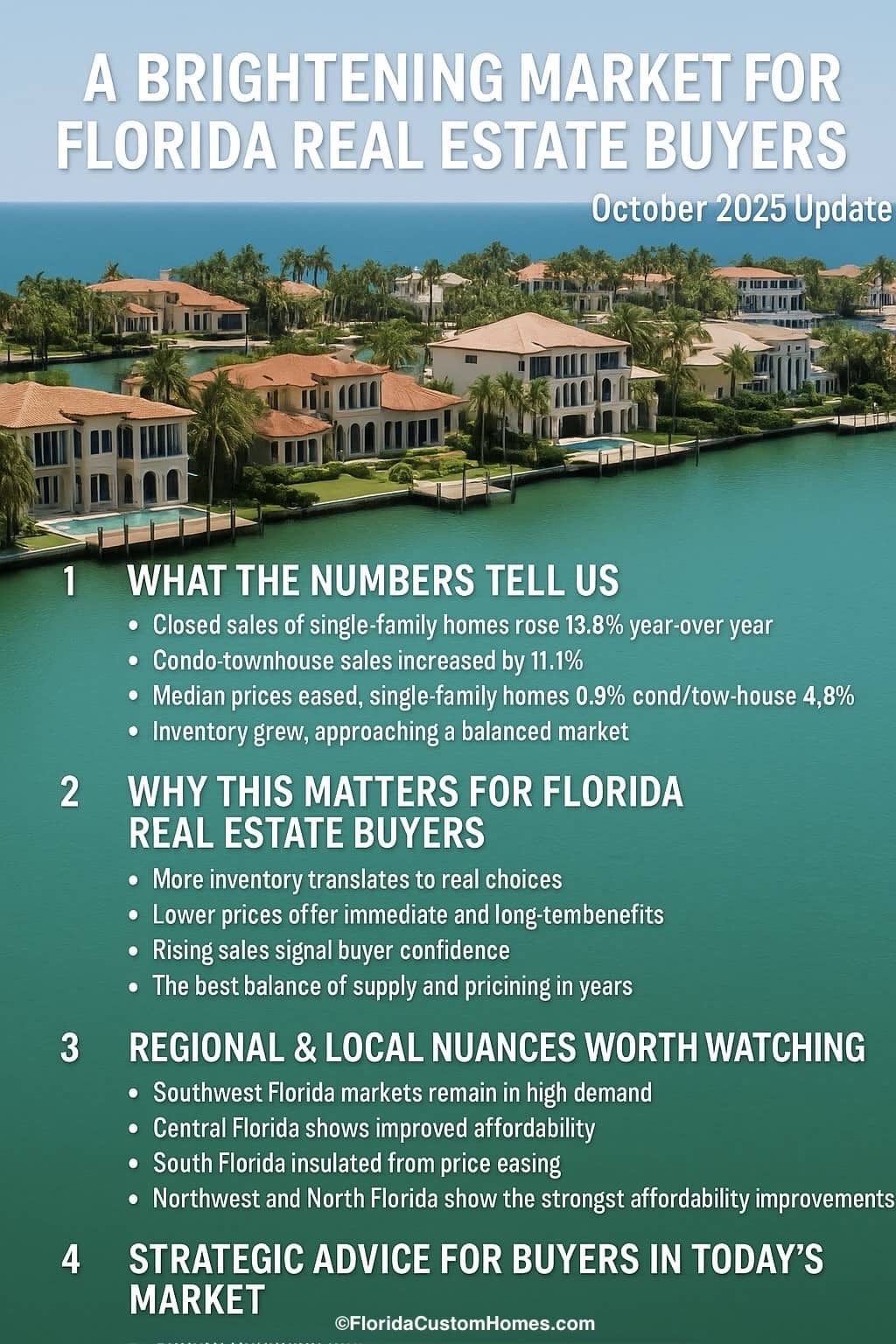
1. What the Numbers Tell Us

The October 2025 data from Florida Realtors paints a clear picture of a market gaining stability. Closed sales of existing single-family homes reached 21,191, representing a 13.8% year-over-year increase. This is not a one-off spike—it's the continuation of several months of steady buyer re-engagement after elevated mortgage rates had previously cooled activity across the state.

Condo and townhouse transactions also rose sharply, hitting 7,223 closed sales, an 11.1% increase from October 2024. This segment is particularly important because condo and multifamily markets tend to adjust faster than single-family homes, offering a window into broader affordability trends.

More striking is the shift in pricing. The statewide median sales price for single-family homes dipped to $411,105, down 0.9% from a year ago. While the decrease is modest, it represents a turning point considering the dramatic price growth Florida experienced between 2020 and 2023.

Condo and townhouse prices fell more substantially—down 4.8% year-over-year to $300,000. This opens the door for first-time buyers, retirees, and seasonal residents seeking a more attainable entry point into the Florida lifestyle.

Perhaps the most important indicator is inventory growth. Single-family homes now sit at 5.1 months of supply, edging closer to what economists describe as a “balanced market.” Condo-townhouse inventory rose to 9.3 months, which technically positions that sector in buyer-market territory.

These numbers collectively signal a market that is cooling but healthy—a far cry from the bidding war environment of 2021–2022 or the sluggish uncertainty seen in 2023–2024.

2. Why This Matters for Florida Real Estate Buyers

For active and aspiring Florida real estate buyers, this shift brings several meaningful advantages. The combination of improving supply and mild price softening gives buyers new leverage that simply did not exist during the pandemic-era feeding frenzy.

More inventory translates to real choices. Buyers now have broader selection across multiple price points, property types, and geographic zones. Waterfront buyers on the Gulf Coast have more listings to compare; inland buyers seeking affordability gain access to more neighborhoods previously constrained by low supply.

Lower prices offer immediate and long-term benefits. A 1% or 5% drop in median pricing may not sound dramatic, but it can be the difference between qualifying—or not qualifying—for a preferred mortgage product. It also lowers property taxes and insurance in some counties.

Rising sales signal buyer confidence. When sales grow at double-digit rates despite elevated mortgage rates, it’s a sign that buyers are adjusting to the “new normal” and no longer waiting indefinitely for rates to collapse. Confidence is a critical ingredient in a healthy real estate cycle.

And perhaps most importantly, this moment may represent the best balance of supply and pricing Florida has seen in years. Buyers can negotiate again: for repairs, concessions, credits, and—in some cases—seller rate buydowns.

3. Regional & Local Nuances Worth Watching

While statewide numbers provide context, Florida is a mosaic of micro-markets, each behaving differently. Factors such as hurricane exposure, waterfront desirability, insurance costs, and migration patterns all play a role in shaping local trends.

Southwest Florida markets, including Cape Coral, Fort Myers, Bonita Springs, and Naples, continue to diverge from broader statewide trends. These areas remain in high demand due to Gulf-access canals, new construction, and post-Hurricane Ian modernization, even as supply increases.

Central Florida—Orlando, Kissimmee, Davenport, Clermont— remains influenced by tourism employment cycles and second-home buyers. Inventory improvements here give entry-level families an opportunity not seen since 2018–2019.

South Florida—Miami, Fort Lauderdale, Palm Beach— continues its luxury-driven trajectory. Despite inventory increases, foreign investment, digital nomads, and corporate relocations insulate this region from the price easing seen elsewhere.

Northwest and North Florida—Pensacola, Tallahassee, Gainesville, Jacksonville— show some of the strongest affordability improvements due to increasing new construction and migration away from denser urban Southern metros.

Buyers should also consider the influence of weather events. Hurricanes Helene and Milton affected October 2024’s numbers, creating a “base effect” that exaggerates this year’s improvements. Still, the upward trend is organic and widespread.

4. Strategic Advice for Buyers in Today’s Market

The shift toward a more balanced market doesn’t eliminate competition—but it does change how buyers should approach their strategy. Here are several high-level and tactical recommendations for buyers entering the Florida market in late 2025:

  • Secure financing early and compare multiple lenders.
    Rates remain volatile. A pre-approval demonstrates credibility and prevents surprises during negotiations. Buyers should explore conventional, FHA, VA, and portfolio loans, along with temporary 2-1 buydown programs gaining popularity. For more guidance, visit the Florida mortgage tips and financing guide .
  • Don’t attempt to time the market perfectly.
    Many buyers lost opportunities between 2022–2024 by waiting for large price corrections that never came. The current environment—rising inventory paired with modest price easing—is highly favorable.
  • Look for motivated sellers.
    Homes lingering 45+ days on market, vacant properties, estate sales, and investor-owned units often provide opportunities for price reductions or credited closing costs.
  • Target value segments such as condos/townhomes.
    With median prices down nearly 5%, buyers can secure Florida lifestyle perks—resort pools, proximity to beaches, security, and amenities—for significantly less than single-family prices. Explore current opportunities in Florida condos and townhomes .
  • Work with a buyer's agent who understands Florida’s insurance and hurricane codes.
    Insurance premiums can make or break affordability. A knowledgeable agent can help identify properties with updated roofs, impact windows, modern elevation, and hurricane-resilient features that dramatically reduce long-term costs. Learn more about working with a buyer’s agent in Florida .
  • Take a long-term perspective.
    Florida remains one of the fastest-growing states for population and job growth. Whether buying for residence or investment, today’s balanced market offers an advantageous entry point. You can review additional Florida housing market trends and forecasts to align your strategy with long-term goals.

5. What to Watch in the Coming Months

Several key factors will influence the Florida real estate landscape heading into early 2026. Buyers monitoring these trends will be positioned to move quickly during favorable conditions.

  • Interest Rates.
    If rates continue to ease, buyer demand could heat up rapidly, reducing negotiating leverage. Rate drops of even half a point can shift affordability dramatically.
  • Inflation and Economic Policy.
    National economic shifts affect construction costs, lending appetite, and inventory pipelines. Florida’s housing is especially sensitive to insurance trends and building material pricing.
  • New Construction Supply.
    Builders in Florida are strategically increasing production, especially inland. A slowdown or surge in starts will influence pricing in 2026. You can track new communities and Florida new construction home opportunities as they come online.
  • Hurricane Season Aftereffects.
    Weather events can cause short-term listing delays or long-term rebuilding, temporarily affecting inventory and buyer psychology.
  • Population Growth and Migration.
    Florida continues drawing new residents from high-cost states. As long as migration remains strong, long-term demand will support pricing.

6. Conclusion

October 2025 marks an encouraging pivot for Florida real estate buyers. The combination of rising sales, expanding inventory, and mild price softening signals a healthier and more accessible market than Florida has seen in years. Buyers who were previously discouraged by fierce competition now have an opportunity to enter the market with confidence, clear options, and negotiation power.

Whether you're seeking a primary residence, vacation home, or long-term investment, the current environment offers a strategic window—one defined by balance, opportunity, and improved affordability. With the right preparation and expert guidance, buyers can secure strong long-term value in one of the nation’s most resilient and desirable housing markets.

If you’re ready to explore opportunities in Cape Coral waterfront homes , Naples luxury real estate , or other Southwest Florida housing markets , connect with a local expert and take advantage of today’s more balanced conditions.

Stay tuned to the Florida Custom Homes Blog for updates on development news and community growth throughout Southwest Florida.

Contact:
Scott Meadows – Broker Associate
Florida Custom Homes / Premiere Plus Realty
📞 239-220-1157
✉️ scottmeadows3@gmail.com
🌐 www.FloridaCustomHomes.com

Nov. 19, 2025

Nine Things to Know Before Moving to Southwest Florida (2025 Guide for Florida Real Estate Buyers)

Nine things to know before moving to Southwest Florida

Nine Things to Know Before Moving to Southwest Florida (2025 Guide for Florida Real Estate Buyers)

Southwest Florida continues to rank among the most desirable places to relocate in the United States. From its world-class beaches to its booming economy and upgraded hurricane-resilient construction standards, more families, retirees, and investors are exploring a move to the region.

Whether you’re considering Cape Coral, Fort Myers, Naples, Estero, Bonita Springs, Port Charlotte, or one of the barrier-island communities, this guide outlines the top nine things every buyer should know before calling Southwest Florida home.

1. Warm Tropical Climate

Southwest Florida is known for its sunny, warm climate year-round, drawing residents who crave outdoor living and consistent sunshine. The region typically experiences:

  • Mild winters in the 70s and low 80s
  • Warm, humid summers averaging in the 90s
  • Over 260 days of sunshine annually

For Florida real estate buyers, the weather influences home features that matter greatly:

  • Covered lanais
  • Oversized pool decks
  • Outdoor kitchens
  • Heated pools (a must during January/February cold fronts)

Many communities also offer resort-style amenities designed around outdoor lifestyles — perfect for seasonal residents, retirees, and full-time families alike.

2. Hurricane Season & Storm Preparedness

While Southwest Florida offers incredible weather most of the year, hurricane season is a major consideration for anyone relocating. From June 1 through November 30, storms in the Gulf of Mexico can impact the region.

Newer Homes Perform Better

Homes built after the 2002 Florida Building Code — and especially after the post-Ian code enhancements — are significantly more resilient. Features often include:

  • Impact-resistant doors and windows
  • Stronger roof-to-wall connections
  • Elevated foundations in flood-prone areas
  • Reinforced garage openings

Know Your Flood Zone

Your property’s flood zone directly affects insurance costs. Many newer Cape Coral, Estero, and Naples communities are engineered to sit above FEMA base flood elevation, reducing premiums for buyers.

Insurance Realities

Insurance markets are stabilizing after recent storms, but buyers should still:

  • Compare multiple insurers
  • Review wind and flood coverage separately
  • Ask about roof age and mitigation credits

Understanding storm preparedness doesn’t mean avoiding Florida — it simply means buying smart.

3. Beautiful Beaches & Coastal Lifestyles

One of the biggest draws to Southwest Florida is access to top-tier beaches and aquatic experiences. Depending on where you settle, you may be minutes from:

  • Sanibel & Captiva
  • Fort Myers Beach
  • Naples Pier Beach
  • Boca Grande
  • Lovers Key State Park
  • Barefoot Beach Preserve

Even inland areas, like Cape Coral and Bonita Springs, offer dozens of freshwater and saltwater access points.

What This Means for Buyers

Water proximity influences:

  • Property values
  • Insurance costs
  • Rental demand
  • Lifestyle (boating, kayaking, beach-going, fishing)

For boating lovers, Southwest Florida is arguably the best boating destination in the U.S., thanks to its canal systems, ICW access, and year-round navigation conditions.

4. Cost of Living Realities

Florida does not have a state income tax, which is a major financial advantage for many new residents. But beyond that, cost-of-living factors vary across Southwest Florida.

More Affordable Areas

  • Cape Coral
  • Lehigh Acres
  • North Port
  • Punta Gorda
  • Bonita Springs (select neighborhoods)

Higher-End Markets

  • Naples
  • Sanibel & Captiva
  • Estero’s luxury communities
  • Marco Island

Other cost-of-living considerations include:

  • Insurances (wind and flood)
  • HOA or CDD fees
  • Utility costs (especially during summer A/C season)
  • Commuting vs. remote-work lifestyles

Working with a local agent can help buyers find neighborhoods that fit both lifestyle goals and financial expectations.

5. A Booming Real Estate Market

Southwest Florida continues to grow rapidly — and with growth comes opportunity. Whether you’re a full-time buyer, seasonal resident, or investor, the market offers long-term stability thanks to strong demand.

Key Trends for 2025–2026

  • Florida remains the #1 inbound-migration state.
  • New construction continues expanding, especially in Fort Myers, Estero, Cape Coral, and Naples.
  • Baby boomer retirements sustain long-term demand.
  • Upgraded building codes post-Hurricane Ian make newer homes more attractive than ever.

Why Buyers Are Still Confident

  • No state income tax
  • Strong rental potential
  • High appreciation in coastal markets
  • Lifestyle benefits that remain unmatched

For Florida real estate buyers, the biggest challenge is inventory in some of the most desirable neighborhoods — making preparation and quick action essential.

6. Outdoor Recreation & Waterfront Living

Southwest Florida is built for people who love the outdoors. Buyers can enjoy:

  • Boating (Gulf-access canals, ICW, back bays)
  • World-class fishing
  • Paddleboarding and kayaking
  • Golf (150+ courses in SWFL)
  • Nature reserves, parks, and preserves
  • Bike paths and boardwalks

Boaters Should Look for Specific Features

If boating is part of your lifestyle, consider:

  • Gulf-access vs. freshwater canals
  • Bridge and lock restrictions
  • Lot orientation (Western exposure is popular for sunsets)
  • Lift capacity (especially for 30'+ boats)

Communities like Cape Coral, Fort Myers Beach, Naples, and Marco Island provide exceptional boating opportunities that attract buyers nationwide.

7. Diverse Wildlife & Natural Ecosystems

The region is home to some of the most vibrant ecosystems in the southeastern United States — including mangroves, estuaries, wetlands, and coastal dunes.

You may encounter:

  • Dolphins
  • Manatees
  • Sea turtles
  • Osprey and bald eagles
  • Gopher tortoises
  • Roseate spoonbills

Living in Southwest Florida means embracing nature as part of daily life. Many communities back up to preserves, offering peaceful scenery and wildlife right behind your lanai.

8. A Long-Trusted Retirement Destination

Southwest Florida has been a retirement hotspot for decades — and for good reason:

  • Warm winters
  • Low taxes
  • Ample medical facilities
  • Active-lifestyle communities
  • Social clubs, golf, dining, and entertainment

However, this is no longer just a retirement market. Remote workers, young families, and investors now make up a growing share of Florida real estate buyers. This diversity enhances the vibrancy and long-term economic foundation of the region.

9. A Laid-Back, Coastal Lifestyle

Life in Southwest Florida is defined by relaxation and sunlight. Residents enjoy:

  • Slower pace of life
  • Waterfront dining
  • Sunset cruises
  • Outdoor markets & festivals
  • Community events
  • A welcoming, friendly culture

Most neighborhoods are designed with outdoor living in mind — shaded lanais, screened pools, wide sidewalks, and community green spaces. Paired with excellent year-round weather, the lifestyle here truly sets Southwest Florida apart.

Conclusion

Whether you’re relocating for the beaches, the weather, the boating, or the steady growth in local real estate, Southwest Florida offers something for everyone. Understanding storm preparedness, cost of living, and community features will help you make a confident and informed decision.

For Florida real estate buyers, this region represents strong long-term value, modern building standards, and an unmatched lifestyle that continues attracting new residents every year.

Nov. 18, 2025

Trump’s Portable Mortgage Proposal: What It Means for the Southwest Florida Housing Market

Portable Mortgages and Southwest Florida Home Buyers

Trump’s Portable Mortgage Proposal: What It Means for the Southwest Florida Housing Market

The Trump administration has announced that the Federal Housing Finance Agency (FHFA) is evaluating a major potential shift in U.S. mortgage policy: portable mortgages. This proposal has the potential to reshape how Americans buy and sell homes—particularly in states like Florida, where migration, retiree mobility, and move-up buyers play oversized roles in the housing ecosystem.

Below is a comprehensive breakdown of what the portable mortgage proposal is, why it matters, and how it could meaningfully impact the real estate markets in Cape Coral, Fort Myers, Naples, Estero, Bonita Springs, Punta Gorda, and Port Charlotte.


Table of Contents


1. What Is Trump’s Portable Mortgage Proposal?

The concept of a portable mortgage is simple: a homeowner would be able to transfer their existing mortgage—interest rate and all—to a new property when they sell their home and purchase another.

For example, if someone in Cape Coral currently holds a 2.75% mortgage, they could move to a newer or larger home and keep that same rate instead of taking a new loan at 6% or higher. The mortgage balance, term, interest rate, and even some closing-cost structures could theoretically follow the borrower from one property to another.

While portable mortgages already exist in countries such as Canada and the U.K., they have never been utilized in the U.S. due to how mortgages are securitized and tied to specific properties through Fannie Mae and Freddie Mac.

The FHFA has stated it is “actively evaluating” the feasibility of allowing portable mortgages within agency guidelines.


2. Why the Proposal Is Being Considered

The U.S. is currently experiencing a historic phenomenon known as the rate lock-in effect. Tens of millions of homeowners refinanced or purchased homes during the 2020–2022 period at interest rates between 2% and 4%. Now that rates have doubled, many simply won’t move.

This creates ripple effects:

  • Lower inventory
  • Higher home prices
  • Stalled move-up markets
  • Fewer new listings across all price tiers

The portable mortgage proposal attempts to free homeowners from being “locked” to their existing homes simply because of their interest rate.


3. How Portable Mortgages Could Impact Southwest Florida

Florida—especially Southwest Florida—would be one of the regions most dramatically affected by portable mortgages. With major populations of retirees, move-up buyers, snowbird-to-full-time transitions, and boaters shifting canal preferences, mobility is essential.

Many of these homeowners have locked-in sub-3% and sub-4% mortgages. Portable mortgages could be the key to unlocking thousands of suppressed transactions across:

  • Cape Coral
  • Fort Myers
  • Estero
  • Bonita Springs
  • Naples
  • Punta Gorda
  • Port Charlotte

4. Inventory Unlocking: Where Movement Could Happen First

Southwest Florida neighborhoods with the highest concentration of low-rate mortgages are most likely to see new listings if portability becomes reality.

High-impact areas:

  • Cape Coral (gulf-access, freshwater canal, and newer construction communities)
  • Fort Myers (McGregor corridor, Gateway, and new developments off Daniels Pkwy)
  • Estero & Bonita Springs (high-demand gated communities)
  • North Naples (mid-priced, newer homes)

These areas have thousands of “frozen” sellers who want to move but refuse to give up their low rates.


5. Who Benefits Most in Florida?

The biggest winners of portable mortgages in Florida would be:

✔ Move-up buyers

Notably in Cape Coral, Estero, and Fort Myers, where families want more space or newer construction.

✔ Retirees shifting between communities

Particularly common in Naples, Bonita Springs, and Punta Gorda.

✔ Boaters

Many want to upgrade canal width, bridge clearance, or move to a lock-free location.

Portable mortgages give these buyers a powerful incentive: they can move within Florida while keeping their ultra-low rate.

🚫 Who benefits the least?

First-time buyers. They don’t have a mortgage to port—so affordability remains unchanged for them.


6. Why Naples Luxury Markets Won’t Be Affected Much

Naples’ ultra-luxury communities—such as Port Royal, Aqualane Shores, Olde Naples, and gulf-front properties—won’t see significant effects.

Why?

  • The majority of purchases in these markets are cash.
  • Many loans exceed conforming limits, making them jumbos not backed by Fannie or Freddie.
  • Buyers prioritize location and lifestyle over rate shopping.

The mid-market segments of Naples, however—such as Golden Gate Estates, North Naples, and Lely—would see meaningful increases in mobility.


7. Cape Coral & Fort Myers: The Epicenter of Change

Cape Coral, in particular, has one of the highest percentages of low-rate mortgages in the state. Thousands of homeowners purchased or refinanced during the 2020–2022 boom.

If portability becomes available, expect:

  • A surge of new listings
  • Higher transaction volume
  • More move-up buyers entering the market
  • A more balanced supply-and-demand environment

Fort Myers—especially in gated communities and newer neighborhoods—would see similar activity.


8. Boater Communities Could See Major Shifts

Southwest Florida is one of the boating capitals of the U.S., and canal properties carry high buyer demand. But mobility has been nearly frozen since rates spiked.

Portable mortgages could reopen movement within:

  • Punta Gorda Isles
  • Cape Coral’s Eight Lakes, Pelican, Surfside, and Unit 64
  • Fort Myers’ riverfront and McGregor area
  • Marco Island canals

Expect more buyers upgrading to homes with better boating access or wider canals.


9. Challenges, Criticisms, and Implementation Risks

While portable mortgages sound simple, they are extremely challenging to implement.

Key issues include:

  • The U.S. system ties every mortgage to a specific property as collateral.
  • Mortgage-backed securities rely on predictable prepayment behavior.
  • Investors may reject loans that change collateral mid-term.
  • Tax, title, escrow, and underwriting rules all need restructuring.
  • Home prices could rise if more buyers bid aggressively with low rates.

Even if approved, implementation would likely be gradual and potentially limited to conforming loans.


10. Market Timeline: What to Expect in 2025–2027

2025

  • Proposal evaluation
  • Regulatory framework discussions
  • No immediate market impact

2026

  • Potential pilot programs
  • Movement begins in Cape Coral and Fort Myers
  • Marketing shifts from builders and lenders

2027

  • Transaction volume increases
  • Inventory improves in mid-priced markets
  • Boater communities see higher turnover

11. Final Thoughts for Florida Buyers and Sellers

Trump’s portable mortgage proposal represents one of the most significant potential changes to the U.S. housing finance system in decades. And if implemented, no region stands to benefit more than Southwest Florida.

From Cape Coral’s canal homes to Naples’ master-planned communities, the ability for homeowners to keep their low rates could dramatically increase mobility and improve inventory levels that have remained historically tight.

While the policy faces many structural challenges, buyers and sellers should keep a close eye on its progress—because the implications for the Florida market could be transformative.


Have questions about how this could impact your selling or buying plans in Florida?
Contact Scott Meadows — your trusted Southwest Florida real estate expert.

Scott Meadows
Broker Associate | Premiere Plus Realty
📞 (239) 220-1157
✉️ ScottMeadows3@gmail.com
🌐 FloridaCustomHomes.com

Nov. 18, 2025

Naples Beach Club Four Seasons

Naples Beach Club Four Seasons

Naples Beach Club Four Seasons: How Southwest Florida’s Newest Ultra-Luxury Resort Is Transforming the Naples Real Estate Market (2026 Update)

Naples has always been synonymous with high-end coastal living, but the debut of Naples Beach Club, A Four Seasons Resort, marks a turning point not just for hospitality—but for the entire luxury real estate landscape of Old Naples and the Gulf-front corridor. Now officially open as of November 17, 2025, the resort represents one of the most ambitious and prestigious beachfront developments ever built on Florida’s west coast.

With global branding, award-winning architecture, a 125-acre master-planned campus, and residences priced well into the tens of millions, the Naples Beach Club Four Seasons is reshaping buyer demand, neighborhood values, and the competitive positioning of Naples as a world-class destination.

Below is a full overview of what’s happening, what’s coming next, and how this resort will influence the Naples luxury housing market throughout 2026 and beyond.

A New Era of Gulf-Front Luxury: What’s Open Now

Although the build-out is phased, the opening of the main resort immediately elevated Naples into a new category of ultra-luxury coastal destinations—on par with Maui, Jackson Hole, Palm Beach, and the top Caribbean resorts that operate under the Four Seasons flag.

As of its grand opening:

  • 220 luxury guest rooms and suites are fully operational
  • The resort features 1,000 feet of direct white-sand Gulf frontage
  • Multiple dining venues—including elevated coastal cuisine, celebrity-chef concepts, and the modern reimagining of HB’s on the Gulf—are serving guests
  • The wellness zone, spa, fitness program, tennis club, and beachfront pools are open
  • High-end concierge services, event venues, and the beach club experience are available for all resort guests

This puts Naples Beach Club instantly into the top tier of Gulf Coast hospitality, and early guests have described the property as “the most polished launch the Gulf Coast has seen in decades.”

What’s Still Coming in 2026

Even though the resort is open, several key components are still under construction or being phased in. These future amenities will only strengthen property values and increase demand for nearby homes.

Tom Fazio Championship Golf Course – Opening Fall 2026

The redesigned 18-hole course, developed in partnership with Discovery Land Company, is expected to become one of the premier members-only golf experiences in Florida. When the course opens, expect an immediate boost in membership demand and prestige pricing.

Expanded Kids & Teen Club Experiences

Four Seasons is known for world-class family amenities. These facilities are scheduled to come online through early 2026, giving the resort an even broader demographic appeal.

Luxury Residences, Market Square & Club Facilities

As residential buildings and the community’s Market Square complete construction, property owners will gain access to elevated retail, upscale dining, exclusive events, and Four Seasons-branded private amenities.

For luxury buyers looking for stability and long-term appreciation, these phased additions create continuous upward pressure on demand—similar to the “multi-year lift” seen in Miami, Vail, and Jackson Hole after Four Seasons developments opened in those markets.

The Residences: Naples’ New Benchmark for Ultra-Prime Real Estate

The residential component of Naples Beach Club might be the single most influential factor reshaping the Old Naples housing market.

Key Residential Highlights

  • Approximately 150 Four Seasons-branded residences
  • Ultra-luxury beachfront and golf-side homes
  • Full access to resort services, concierge, club amenities, dining, wellness, and lifestyle programming
  • Modern coastal architecture with expansive Gulf views, private elevators, and curated interior design

Pricing Anchors

While official inventory releases are limited, available brokerage previews and marketing materials indicate:

  • Beachfront residences: $24 million – $50+ million
  • Golfside residences: $7 million – $22 million
  • Premium penthouses and estate-style layouts: well into mid-eight-figure pricing

These price points set an entirely new ceiling for luxury real estate in Naples, rivaling exclusive enclaves such as Port Royal, Aqualane Shores, and Gulf Shore Boulevard’s most prestigious towers.

How the Four Seasons Is Influencing Naples Real Estate Values

This project has created what many agents describe as a “global luxury halo effect” for nearby properties—something Naples has never experienced at this scale.

1. Increased Prestige for Old Naples & Gulf Shore Blvd.

Buyers now view the area surrounding the resort as “Four Seasons-adjacent,” which automatically raises expectations—and willingness to pay—for homes and condos within walking, biking, or short-drive distance of the resort campus.

2. Surge in High-Net-Worth Buyer Interest

UHNW and billionaire-level buyers who frequent Four Seasons destinations have placed Naples firmly on their radar. Private jet arrivals, luxury yacht slips, and off-market inquiries have already risen since the project’s opening announcement and soft-launch phase.

3. Strengthening Resale Values for Nearby Homes

Properties in Coquina Sands, Old Naples, and along Gulf Shore Boulevard are expected to benefit from:

  • Increased walkability and lifestyle desirability
  • Improved public and resort-adjacent landscaping
  • A higher baseline of luxury traffic and demand
  • Long-term neighborhood stability due to the resort’s conservation easement and curated open space

4. Naples Competing in a New Global Category

With the Four Seasons name attached, Naples now competes directly with:

  • Palm Beach
  • Miami Beach
  • Malibu
  • Kiawah Island
  • Montage Laguna Beach
  • Four Seasons Punta Mita / Anguilla

This elevates Naples from a regional luxury market to a global luxury destination—an important point when speaking to relocating northerners or international investors.

Opening-season published rates show:

  • Standard rooms from $1,100+ per night
  • Suites ranging from $3,000–$5,000+ depending on the season
  • Occasional promotional packages through luxury-travel advisors (breakfast credits, resort credit, VIP status)
  • Group-oriented pre-opening offers (occasionally in the $399+ range), but not for general leisure bookings

These pricing levels signal the tier of clientele the resort is attracting—affluent travelers who often convert to buyers after extended stays.

For Naples real estate, this means:

  • More qualified visitors circulating through the market
  • Higher seasonal occupancy rates
  • Stronger interest in beachfront condos, walkable Old Naples homes, and golf-adjacent properties
  • Elevated visibility for luxury new construction

Why This Matters for Buyers and Sellers in 2026

For Buyers

Naples is transitioning into a true international luxury destination. As Four Seasons completes each phase, prices near the resort may continue to climb. Buying earlier in the cycle generally provides the greatest long-term upside.

For Sellers

The halo effect increases your buyer pool—and in many cases, your property’s intrinsic value. Homes with Gulf views, walkability, modern renovations, or resort-adjacent locations will be particularly attractive.

For Investors

The combination of luxury tourism, resort-branding prestige, and low Florida tax burdens creates powerful alignment for long-term price stability and appreciation.

Final Take: Naples Beach Club Four Seasons Is a Market-Defining Development

Few projects have reshaped the trajectory of a Florida luxury market as dramatically as the new Naples Beach Club Four Seasons. With its phased opening, record-setting residential prices, and world-class amenities, the resort is already:

  • Elevating neighborhood prestige
  • Attracting global wealth
  • Lifting surrounding property values
  • Positioning Naples as the Gulf Coast luxury capital for 2026 and beyond

For homebuyers, sellers, and investors, this development should be viewed not just as a new resort—but as a powerful long-term driver of demand and appreciation in one of Florida’s most desirable beachfront markets.

Stay tuned to the Florida Custom Homes Blog for updates on Naples development news and community growth throughout Southwest Florida.

Contact:
Scott Meadows – Broker Associate
Florida Custom Homes / Premiere Plus Realty
📞 239-220-1157
✉️ scottmeadows3@gmail.com
🌐 www.FloridaCustomHomes.com

Nov. 17, 2025

The Housing Market Is Quietly Turning a Corner Going Into 2026

The Housing Market is Turning a Corner 2026

The Housing Market Is Quietly Turning a Corner Going Into 2026

After several years of volatility, high mortgage rates, unpredictable inflation, and shifting buyer sentiment, the U.S. housing market is finally showing signs of stabilization. While the recovery isn’t instant—and certainly not uniform across every region—key indicators reveal that the housing landscape heading into 2026 is fundamentally stronger, healthier, and more predictable than it has been since the pandemic boom.

For both buyers and sellers, understanding these trends matters. Whether you’re evaluating your next move in a local market like Southwest Florida or watching the national trends unfold, the data suggests a noticeable turning point is underway.

1. Mortgage Rates Have Begun a Slow, Steady Decline

The biggest pressure point on the housing market from 2022 to 2024 was the rapid rise in mortgage rates. But in late 2025, after the Federal Reserve signaled confidence in cooling inflation, long-term rates began to pull back from their highs.

This shift is meaningful for two reasons:

Improved affordability for buyers

Even a small downward move in mortgage rates increases purchasing power—sometimes by tens of thousands of dollars. More buyers are able to re-enter the market, especially those who paused their searches in 2023–2024.

Sellers gain a larger pool of qualified buyers

Buyers who were priced out can now afford to engage again. For sellers, this means faster showings, more competition, and fewer price reductions.

Experts aren’t projecting a return to the 3% era, but the trend toward mid-5% and upper-5% rates is expected to continue into 2026, creating more predictability and confidence across the market.

Back to top ↑

2. Inventory Is Finally Increasing — but Not Enough To Cause Oversupply

For the first time in several years, new listings and completed construction projects are growing. Builders have accelerated activity, especially in the South where population growth remains strong. Many homeowners who felt “locked-in” by low rates are now more willing to sell.

But even with inventory rising, the U.S. still faces a multi-million home shortage by most estimates. That means:

  • Inventory is improving, but still historically tight
  • The market is shifting from “extreme seller’s market” to “balanced but competitive”
  • Prices are stabilizing rather than falling
  • Well-priced homes continue selling quickly

Heading into 2026, the market is moving toward equilibrium—but not toward oversupply.

Back to top ↑

3. Home Prices Are Rising More Reasonably

Unlike the record-breaking spikes of 2020–2022, appreciation is now moderate, predictable, and sustainable.

Most forecasters project 3%–5% annual price growth in 2026, driven by:

  • Ongoing buyer demand
  • Limited long-term housing supply
  • Strong employment and wage gains
  • Continued migration to the Sun Belt, including Florida

This is good news for both sides:

Buyers gain price stability

Buyers no longer need to worry about bidding wars driving homes far above asking price in most markets. More realistic pricing and negotiations are back.

Sellers gain steady equity growth

Values aren’t flattening out—they’re normalizing. That means homeowners can still expect equity growth, but at a pace that’s less likely to create the kind of affordability crisis we saw earlier in the decade.

Back to top ↑

4. Buyer Demand Is Strengthening Again

One of the biggest questions of 2024 and early 2025 was when buyers would regain confidence. That answer appears to be unfolding now.

Several factors are driving renewed buyer activity:

Rate drops improving affordability

Even modest reductions in mortgage rates bring frustrated buyers back into the market, especially those who delayed their search in hopes of better conditions.

Millennials and Gen Z entering peak buying years

America’s largest generations are now in their prime household formation years. This demographic wave will support strong underlying demand for the next decade.

Relocations remain a major driver

Remote work, lifestyle-driven moves, tax migration, and retirement continue to fuel relocations to states like Florida, Texas, Tennessee, and the Carolinas.

Investors returning selectively

With rental demand still high and new construction slowing in some areas, investors are selectively re-engaging, particularly in single-family rentals.

This wave of reactivated buyers is one of the clearest signs the market is turning a corner.

Back to top ↑

5. Sellers Are Benefiting From a Much Stronger Market

While the peak frenzy of 2021 isn’t coming back, sellers have several advantages going into 2026:

  • Homes priced correctly are selling quickly
  • Days on market have stopped rising and are flattening
  • Price reductions are decreasing nationwide
  • More buyers are writing offers earlier instead of waiting
  • Equity levels remain at historic highs

Most homeowners have accumulated significant equity, giving them flexibility—whether moving up, downsizing, relocating, or investing in a new area. In a stabilizing market, well-prepared homes perform extremely well.

Back to top ↑

6. New Construction Continues To Play a Pivotal Role

Builders have become one of the most important forces shaping the housing recovery.

Going into 2026:

  • New-build communities continue expanding, especially in growth markets
  • Incentives remain strong (rate buy-downs, closing credits, design upgrades)
  • Demand for energy-efficient, hurricane-resistant, and smart homes continues to grow
  • Builder pricing remains competitive with the resale market in many areas

In Florida specifically, new construction is absorbing a large share of migrating buyers who want modern engineering, higher elevation, and stronger building codes. The rise of new construction helps relieve inventory pressure and gives buyers more options—especially those relocating from out of state.

Back to top ↑

7. Economic Conditions Are Supporting a Healthier Market

A stable housing market requires broader economic balance. Going into 2026, several indicators support that:

  • Inflation continues trending downward – This stabilizes mortgage rates and consumer spending.
  • Employment remains strong – Steady jobs lead to more confident homebuying decisions.
  • Wage growth is catching up – Households are regaining some purchasing power lost to inflation.
  • Consumer confidence is recovering – People are more optimistic and more willing to make large purchases.

The macroeconomic environment is far more supportive than it was in 2023 and early 2024, which is another key reason the housing market is turning a corner instead of slipping backward.

Back to top ↑

8. What This Means for Buyers in 2026

If you’re planning to buy, the next 12 months may be one of the better windows we’ve seen in years.

Buyers should expect:

  • Slowly easing mortgage rates
  • More inventory than the last three years
  • Less competition than during the pandemic frenzy
  • More leverage in negotiations and contingencies
  • A chance to lock in stable prices before demand pushes them higher

Waiting too long could mean entering the market after larger groups of buyers return, when price pressure may intensify again.

Back to top ↑

9. What This Means for Sellers in 2026

Sellers are positioned well too, especially in markets with strong in-migration and limited supply.

Sellers can expect:

  • High buyer demand in early and mid-2026
  • Steady price growth rather than sudden spikes
  • Faster market times for well-presented homes
  • Strong showings, especially in desirable neighborhoods
  • A meaningful equity advantage when making their next move

If you’ve been sitting on the sidelines waiting for the “right time,” 2026 may provide the balance you’ve been looking for between strong demand and realistic expectations.

Back to top ↑

Final Thoughts

After years of turbulence, the U.S. housing market is finally turning a corner heading into 2026. With improving mortgage rates, growing buyer demand, sustainable price appreciation, and stronger economic fundamentals, the coming year is shaping up to be one of the healthiest and most balanced markets of the decade.

Whether you’re thinking about buying your first home, upgrading, downsizing, or selling to relocate, understanding these trends can help you make a more confident and informed decision. The key is to work with a knowledgeable real estate professional who can interpret national trends through the lens of your local market.

Back to top ↑

Stay tuned to the Florida Custom Homes Blog for updates on Cape Coral development news and community growth throughout Southwest Florida.

Contact:
Scott Meadows – Broker Associate
Florida Custom Homes / Premiere Plus Realty
📞 239-220-1157
✉️ scottmeadows3@gmail.com
🌐 www.FloridaCustomHomes.com

Posted in About Florida
Nov. 12, 2025

New-Home Prices in Naples, Florida: Neighborhood-by-Neighborhood Breakdown (2025)

Naples Luxury New Homes

Naples New Homes and Condos for Sale

New-Home Prices in Naples, Florida: Neighborhood-by-Neighborhood Breakdown (2025)

Naples, Florida remains one of the most desirable and competitive luxury housing markets in the country. With new construction ranging from coastal estates to master-planned communities, understanding the pricing landscape is essential for Florida real estate buyers entering 2025. This in-depth breakdown explores what new homes cost across the city’s most prominent neighborhoods — and why those values differ so dramatically.

1. Ultra-Luxury: Premier Waterfront & Gulf-Access (Port Royal)

Port Royal stands as the crown jewel of Naples real estate. Widely considered one of the most exclusive neighborhoods in the United States, its waterfront homes regularly exceed eight figures. Newly constructed estates with direct Gulf or bay access can list between $20 million and $45 million+, depending on lot size, water frontage, and architectural pedigree.

Builders here rarely produce speculative homes. Instead, projects are custom commissions tailored to affluent clients seeking privacy, boat access, and resort-caliber amenities. Each home typically features hurricane-rated construction, expansive outdoor living areas, guest wings, and dockage for 80-foot yachts or larger.

Local Insight: Even amid higher interest rates, Naples’ ultra-luxury sector remains insulated from national trends. Cash buyers dominate, and inventory turns slowly but steadily, keeping Port Royal among Florida’s most stable enclaves for long-term value.

2. High-End: Prime Single-Family in Established Naples Neighborhoods

Just north of Port Royal, Downtown and Old Naples represent the heartbeat of upscale living with a walkable lifestyle, boutique dining, and beach proximity. New-construction single-family homes here often start around $1.8 million and can climb beyond $4 million for premium lots near the Gulf or 5th Avenue South.

In these central areas, new builds must conform to smaller lot sizes and architectural standards, leading to elevated per-square-foot pricing. Buyers are paying for lifestyle and location — steps from white-sand beaches, Naples Pier, and high-end retail.

Buyer Expectations

  • Designer interiors, high ceilings, and smart-home automation
  • Energy-efficient concrete block construction with impact-rated windows
  • Custom outdoor kitchens, saltwater pools, and lush tropical landscaping

Market Snapshot

Inventory remains tight, and homes under construction are often pre-sold before completion. This keeps the high-end market competitive and contributes to consistent year-over-year appreciation across central Naples.

Tip for Buyers: Expect to compete for desirable downtown lots. Partnering with a local agent who knows builder release timelines can give you an advantage.

3. Mid to Upper Tier: Popular Suburbs & Master-Planned Communities

As land becomes scarce closer to the Gulf, many buyers turn to South Naples, East Naples, and master-planned developments like Lely Resort, Isles of Collier Preserve, and Fiddler’s Creek. These areas balance luxury living with better affordability, offering new homes from the mid-$400Ks to low-$1Ms.

Developers such as Pulte, Toll Brothers, and Stock Development dominate this tier, blending modern floor plans with resort-style amenities. Communities often include fitness centers, pickleball courts, golf memberships, and gated security — a lifestyle Naples buyers increasingly expect.

What You Get

  • Spacious open-concept layouts with 2–5 bedrooms
  • Community amenities rivaling private country clubs
  • Options for quick move-ins or custom builds

Ideal For

Buyers who want Naples luxury without the ultra-premium price tag. These neighborhoods also appeal to retirees, families, and investors seeking vacation rental potential with HOA-managed maintenance.

Market Trend: The mid-tier market is stabilizing after rapid pandemic-era growth. Builders are offering incentives like closing credits and rate buydowns to attract qualified buyers in 2025.

4. Entry & Value Tier: Outlying Communities (Ave Maria & Beyond)

For those willing to live beyond Naples city limits, communities like Ave Maria, Valencia Trails, and Orange Blossom Ranch deliver new construction at significantly lower price points. Average prices for new homes range from $400K to $600K, making them the most attainable option for first-time Florida homebuyers.

Although farther from the beach, these neighborhoods feature strong infrastructure, new schools, and growing retail centers. Builders like Del Webb, Lennar, and CC Homes offer full amenity packages — from pools and fitness centers to community cafés — making them attractive for young families and retirees alike.

Did You Know? Ave Maria was recently ranked among Florida’s fastest-growing master-planned communities, appealing to both local families and buyers relocating from high-cost states like New York and Illinois.

5. Builder Start Points & Price Examples

  • Villa collections: Low-to-mid $500Ks for 1,600–1,800 sq ft floor plans with open kitchens and covered lanais.
  • Single-family designs: $830K–$1.2M+ for 2,500–3,500 sq ft homes with optional pools and 3-car garages.
  • Custom coastal estates: $3M+ for personalized homes in boutique enclaves like Pine Ridge or Royal Harbor.

Builders continue to emphasize energy efficiency and resilience, incorporating impact-rated glass, upgraded insulation, and smart-home technology. With insurance premiums on the rise, these features enhance long-term affordability and resale value.

Summary: Naples New-Home Pricing by Tier

Ultra-Luxury

Port Royal & Gulf-Access Estates
Pricing: $10M–$45M+

High-End

Downtown & Central Naples
Pricing: $1.5M–$4M+

Mid / Upper

South Naples / Lely / Isles
Pricing: $450K–$1M+

Value Tier

Ave Maria & Outlying Markets
Pricing: $400K–$600K

Buyer Advice

  • Work with a buyer’s agent experienced in new construction — builder contracts differ from resale terms.
  • Compare HOA fees, CDD assessments, and insurance costs before finalizing your budget.
  • Look for pre-completion incentives, design studio credits, or rate buydowns from builders.
  • Inspect construction timelines carefully; supply chain delays can still affect delivery dates in 2025.
  • For waterfront properties, verify FEMA flood maps and elevation certifications before closing.
Bottom Line: Naples remains one of Florida’s strongest and most resilient housing markets. Whether you’re investing in a Port Royal estate or a new home in Ave Maria, location, build quality, and long-term maintenance should drive every purchase decision.

Get a Custom Naples New-Home Report

Request a ZIP-code heat map showing builder incentives, price trends, and inventory across Naples (34102–34120). Stay ahead of the market with insights tailored to your goals.

Email Scott or call (239) 220-1157 for personalized new-home guidance.

Scott Meadows | Broker Associate, Premiere Plus Realty
FloridaCustomHomes.com
📞 (239) 220-1157  |  ✉️ scottmeadows3@gmail.com

Nov. 8, 2025

The Long-Awaited Rise of the Seven Islands Project in Cape Coral

Seven Islands Cape Coral

Cape Coral Waterfront Homes for Sale

The Long-Awaited Rise of the Seven Islands Project in Cape Coral — What’s Happening & What It Means for Real Estate Buyers

In Southwest Florida’s fast-moving market, Cape Coral’s Seven Islands development is one to watch. Below you’ll find a navigable guide with a table of contents, anchored sections, and a practical summary of the vision, status, risks, and timeline.

1. Introduction: A Major Waterfront Vision

Cape Coral has long been synonymous with canals, boating access, and waterfront living. Among its most ambitious plans is the Seven Islands project in the city’s northwest. It’s not a typical subdivision; it’s a mixed-use, marina-anchored concept intended to serve as a destination for residents and visitors, blending residential, hospitality, recreation, dining, and retail into one cohesive waterfront environment.

This article walks you through everything you need to know: what Seven Islands is, where it’s located, how the zoning works, what milestones have occurred, and what prospective buyers should weigh as the project advances. If you’re evaluating opportunities in Cape Coral or nearby, understanding Seven Islands can help you position for the years ahead.

2. Project Overview: What Is Seven Islands?

Seven Islands (also referenced as the Seven Islands District or under the working name “Gulf Gateway Resort & Marina Village”) is a planned, long-horizon development on roughly 47–48 acres along the North Spreader Canal in Northwest Cape Coral. The concept integrates waterfront residences, a resort or hotel component, public and private marina facilities, and a walkable, amenity-rich village core featuring restaurants, retail, and recreation.

Unlike purely residential plats, Seven Islands aims to create a destination that attracts boaters, residents, and day-trippers alike. Its scale and location make it a potential catalyst for broader neighborhood transformation, drawing investment, hospitality brands, and complementary commercial uses into an area that remains comparatively under-built.

Seven Island Cape Coral Florida

3. Location, Site & Zoning

Location

The planned site sits on the west side of Old Burnt Store Road, between Embers Parkway and Tropicana Parkway, fronting the North Spreader Canal (also called the Spreader Canal system). This places it within easy reach of Gulf access by boat while keeping automotive access to Cape Coral’s arterial network straightforward.

Zoning & Site Structure

Seven Islands is governed by a dedicated zoning district adopted after the city’s Northwest Cape & Seven Islands Vision Plan process. The district defines permitted uses, approximate height allowances, and total residential counts across the islands and associated frontage along Old Burnt Store Road. While exact programming can evolve through the entitlement and development agreement process, the zoning provides a structured framework for a mixed-use waterfront community.

Why the Setting Matters

Northwest Cape Coral retains a lower density profile compared with central and southeastern parts of the city. A flagship project of this type can deliver first-mover amenities—marina slips, waterfront dining, public spaces—that elevate the neighborhood’s appeal. For buyers, proximity to high-quality, new waterfront infrastructure often influences both lifestyle value and long-term appreciation potential.

4. Development Vision & Use Mix

The guiding idea is a complete waterfront village that balances living, leisure, and hospitality. While the exact phasing can shift as approvals and financing progress, the following elements typically anchor the vision:

Seven Islands Cape Coral Florida

Residential

Multiple islands are slated for multifamily residences—condominiums and apartments—organized to frame waterfront corridors and public spaces. The district caps overall unit counts to maintain scale and compatibility with the site’s coastal character.

Hotel / Resort & Recreation

Plans anticipate a resort-quality hotel component with amenities such as a pool and lagoon-style features, supplemented by community-oriented recreational spaces like an amphitheater, dog park, splash pad, trail connections, and kayak access points.

Commercial, Dining & Marina

Waterfront restaurants, casual eateries, and retail are expected to activate the village core. The marina is a defining piece: docks, slips, seawalls, and supportive boating infrastructure will serve residents and the public, enhancing the site’s role as a boating hub.

Phasing & Infrastructure

As with most coastal projects, early work emphasizes enabling infrastructure: dredging, seawalls, causeways, internal streetscapes, utilities, and shoreline stabilization. These pieces unlock subsequent vertical construction and are central to the project’s long-term success.

5. Current Status & Milestones

Seven Islands has moved beyond concept and visioning into the formal entitlement and permitting arena. The city’s vision plan and zoning for the district are in place, and major environmental and infrastructure permits are in process. A key federal filing addressed dredging, seawalls, docks, and related in-water work—typical prerequisites for a marina-centric site.

At the time of writing, the most visible next steps revolve around finalizing development agreements, securing complete permit approvals, and sequencing early infrastructure mobilization. While renderings and site plans illustrate the end-state, stakeholders should expect phased delivery across a multi-year horizon; large, waterfront, mixed-use districts commonly build out over seven to ten years once ground activity begins in earnest.


Bottom line: The project is active and progressing through critical early steps. Think of it as “beginning” from a process standpoint—approvals, agreements, and infrastructure preparations—rather than a landscape of completed buildings.

Seven Island Cape Coral Florida

6. Why It Matters to Real Estate Buyers in Southwest Florida

New Inventory with Destination-Level Amenities

By combining residences with marina access, hospitality, and waterfront dining, Seven Islands can alter the desirability curve for the surrounding neighborhoods. Buyers often prioritize walkability to amenities, boater conveniences, and the energy of a mixed-use waterfront district.

Early-Entry Potential

Northwest Cape Coral’s relative under-development leaves room for early adopters who are comfortable with phased delivery. Purchasing nearby—or in the earliest released phases—may offer upside if the project achieves its vision and leasing/absorption remain strong.

Connectivity & Public Realm

Causeways, promenades, waterfront parks, and trail links do more than support the site—they create a sense of place. Public realm improvements are a rising tide that can lift values citywide, particularly along the Old Burnt Store corridor.

Resale Signaling

Association with a branded, amenity-rich waterfront address can influence perception and liquidity over time, especially if the tenant mix (restaurants, retail, hospitality) resonates with both locals and visitors.

7. Risks & Considerations

Timing & Execution

Multi-phase waterfront districts are complex. Environmental reviews, cost inflation, labor availability, and market cycles can stretch timelines. Buyers should calibrate expectations to a long-horizon delivery model.

Environmental & Permitting

Marina infrastructure requires rigorous federal, state, and local approvals. Iterations to scope or sequencing can occur as agencies review technical details. Such steps are common—but they can affect timing.

Market Dynamics

Interest rates, regional job growth, insurance and construction costs, and travel trends all influence absorption and pricing. While Cape Coral demand has been resilient, macro forces still matter.

Infrastructure First

Before the village sparkles with restaurants and balconies over the water, the unglamorous groundwork—dredging, seawalls, utilities—must be completed. Early buyers should be comfortable with an interim period where amenities are still coming online.

Community Fit

Traffic, parking, building heights, and shoreline activation are frequent topics in public meetings. Projects perform best when they embrace context and community input; expect ongoing coordination as phases proceed.

8. Timeline & What to Watch

Below is a high-level progression and a watchlist to help you track meaningful signals:

Date Milestone
2015–2016 Design charrette and formal Northwest Cape & Seven Islands Vision Plan process; policy groundwork for a mixed-use waterfront district.
2019 Seven Islands zoning district adopted; parameters set for use mix, heights, and overall residential counts.
2022 Developer presentations refine concept; city deliberation on scope and delivery sequencing.
Late 2024 Key federal permit application submitted addressing dredging, seawalls, docks, and in-water infrastructure—an essential step for marina functionality.
2025 → Development agreements, sequential permits, and early-stage infrastructure mobilization expected; vertical construction to follow in phases over a multi-year horizon.

Watchlist Going Forward

  • Groundbreaking & Site Work: visible earthwork, shoreline stabilization, dredging, and causeway construction.
  • Building Permits: issuance for vertical phases (residential, hotel, commercial pads).
  • Marina Delivery: docks, slips, and seawalls coming online—often a key unlock for village activation.
  • Tenant Announcements: anchor restaurants and retail commitments signal market confidence.
  • Pre-Sales/Leasing: pricing, absorption, and incentives for early residential releases.
  • Neighborhood Comps: monitor nearby home and land value trends along Old Burnt Store and adjacent corridors.

Cape Coral Seven Islands

9. Conclusion: Moving Forward

Seven Islands is poised to become one of Cape Coral’s most consequential waterfront districts. The vision is ambitious: a marina-anchored village with residences, hospitality, dining, retail, and public spaces that elevate both lifestyle and long-term value. The project has advanced through visioning, zoning, and permitting, with infrastructure-first steps setting the stage for phased vertical construction.

For buyers, this moment offers both promise and prudence. If you believe in the concept and can embrace a staged delivery arc, early proximity can be strategic. Just be sure your timeline, budget, and expectations align with the realities of multi-year coastal development. Track the watchlist above, and reassess as milestones are met—groundwork, building permits, marina activation, and tenant announcements will all be pivotal signals.

Whether you’re evaluating a primary residence, vacation home, or investment, use the project’s progression to guide your entry point. With careful due diligence and a clear horizon, Seven Islands can be more than a headline—it can be a thoughtfully timed opportunity in one of Southwest Florida’s signature waterfront cities.

Author’s note: This guide is intended for informational purposes and reflects the project concepts and processes as commonly described in public materials at the time of writing. Timelines and scopes can evolve as approvals, financing, and market conditions progress.

Stay tuned to the Florida Custom Homes Blog for updates on Cape Coral development news and community growth throughout Southwest Florida.

Contact:
Scott Meadows – Broker Associate
Florida Custom Homes / Premiere Plus Realty
📞 239-220-1157
✉️ scottmeadows3@gmail.com
🌐 www.FloridaCustomHomes.com

Oct. 28, 2025

Raising Cane’s Coming to Fort Myers – What Southwest Florida Can Expect

Raising Canes Chicken Fort Myers

Raising Cane’s Coming to Fort Myers – What Southwest Florida Can Expect

By Scott Meadows | Florida Custom Homes Blog

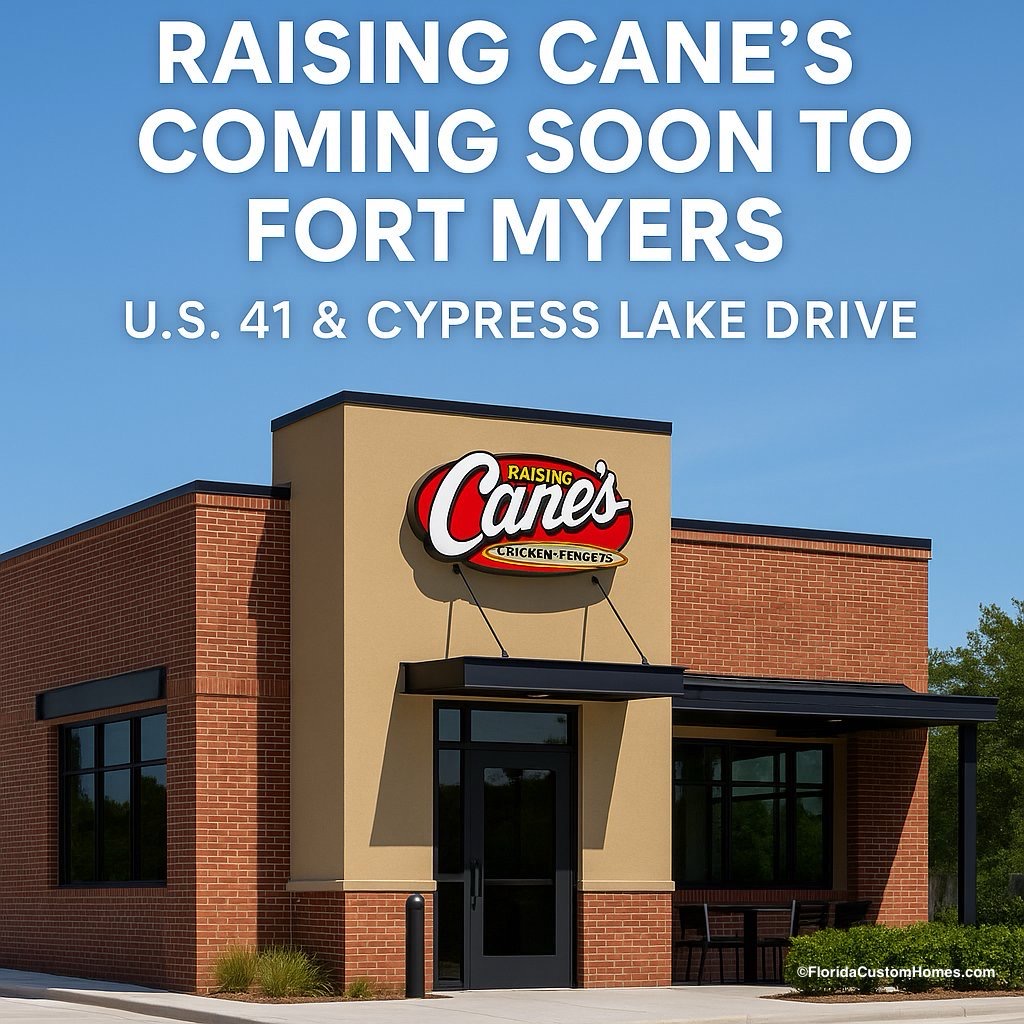
Fried-chicken fans across Southwest Florida have reason to celebrate — Raising Cane’s Chicken Fingers is officially planning to open its first location in Fort Myers. According to recent reports, the Louisiana-based chain has chosen a prime site at the intersection of U.S. 41 and Cypress Lake Drive, one of the busiest commercial corridors in the region. The project marks Raising Cane’s long-awaited arrival in Southwest Florida and adds yet another major national name to the area’s booming retail and dining landscape.

Where It’s Happening – The Cypress Lake and U.S. 41 Site

The proposed location, 13186 South Cleveland Avenue, sits in front of the Coralwood-Cypress Lake commercial corridor — a high-traffic area with more than 120,000 vehicles per day. The lot was previously home to the Lone Star Steakhouse, which has since been demolished to make way for redevelopment. Plans filed with Lee County describe a one-acre parcel designed for a new drive-through restaurant and modern exterior consistent with Raising Cane’s updated store design.

Although permits are still pending, local business outlets such as B103.9 FM News report that Raising Cane’s has taken active steps toward construction approval. Once finalized, the Fort Myers restaurant will become the first Raising Cane’s location in all of Southwest Florida.

Why Raising Cane’s Is Expanding Into Southwest Florida

Founded in Baton Rouge, Louisiana in 1996, Raising Cane’s has built a devoted following around its simple menu — hand-battered chicken fingers, crinkle-cut fries, coleslaw, Texas toast, and its famous Cane’s sauce. The brand’s emphasis on quality, speed, and consistency has helped it grow into a national powerhouse with over 700 locations worldwide.

Florida is a key growth market. As Fortune Magazine reported in June 2025, Raising Cane’s plans to open nearly 100 new locations nationwide this year — many of them across the Sunshine State. With successful restaurants already operating in Orlando, Tampa, and Clearwater, the move into Fort Myers is a natural next step, positioning the company to serve the rapidly growing Gulf Coast market.

Raising Canes Chicken Fort Myers Florida

What This Means for Fort Myers and Lee County

Raising Cane’s arrival reflects a broader pattern of retail and restaurant investment in Fort Myers. Major brands continue to move into the U.S. 41 corridor between College Parkway and Gladiolus Drive, transforming it into one of Southwest Florida’s most active commercial zones.

New restaurants and entertainment venues don’t just add dining choices — they also signal economic confidence in the region. Population growth throughout Lee County has been strong since 2020, driven by domestic migration from northern states. With thousands of new homes being built in Cape Coral, Estero, and Lehigh Acres, the market demand for new dining experiences is stronger than ever.

Developments like Raising Cane’s often become anchors that attract additional retail growth nearby — such as coffee shops, service businesses, and shopping centers. The project could also create dozens of local jobs once construction begins and the restaurant opens.

What Locals Can Expect from the Fort Myers Raising Cane’s

While design plans are still under review, most new Raising Cane’s locations follow a standard layout that includes a dual drive-thru lane, spacious dining room, and modern patio seating. Recent openings in Tampa and Orlando showcase bright red and white exteriors, digital ordering screens, and expanded pickup areas for mobile orders.

Fans can expect the same menu favorites — the Box Combo, Caniac Combo, and three-finger meal — along with freshly brewed sweet tea and Cane’s signature sauce. If approved this winter, the Fort Myers store could begin construction in early 2026, with an opening later that year or in early 2027.

How This Fits Into the Bigger Picture of Southwest Florida Growth

Raising Cane’s move to Fort Myers mirrors the region’s ongoing transformation. New residential communities, infrastructure projects, and retail developments are reshaping the area from Cape Coral to Estero. For local homebuyers and investors, these commercial additions enhance the livability and value of nearby neighborhoods.

Restaurants and national brands tend to follow rooftops — and the rooftops are certainly arriving. According to Lee County permit data, more than 8,000 new residential permits were filed in 2024 alone. That momentum continues into 2025 as builders like DR Horton, Lennar, and Pulte expand their footprints throughout North Fort Myers, Gateway, and Estero.

For homeowners, the arrival of a high-profile brand like Raising Cane’s is another indicator of the region’s strong economic health and growing appeal to national chains — right alongside new additions like Topgolf and Texas Roadhouse.

Community Excitement and Social Buzz

Local reaction has been overwhelmingly positive. Fort Myers residents took to social media to celebrate the announcement, many sharing memories from trips to Tampa or Orlando where they first tried the brand. The phrase “Finally coming to Fort Myers!” has appeared across Facebook and Instagram posts from fans who’ve been awaiting the chain’s arrival for years.

For those unfamiliar, Raising Cane’s focus on community engagement and philanthropy is a big part of its culture. The company often supports local nonprofits, animal shelters, and youth programs through its “Cane’s Crew” volunteer network — initiatives that would likely extend to Fort Myers once operations begin.

Looking Ahead – What’s Next

As of October 2025, construction permits are still in the review process, but the momentum is strong. The Cypress Lake site is already cleared, and surrounding businesses are anticipating the added traffic and foot activity that a Raising Cane’s typically generates. When completed, this will not only satisfy local cravings for crispy chicken fingers but also symbolize the continued growth and vibrancy of Fort Myers as a destination for both residents and business investment.

Final Thoughts – A Small Chicken Chain With Big Regional Impact

While some may see it as just another fast-food opening, the arrival of Raising Cane’s in Fort Myers is a testament to the area’s expanding market potential and continued draw for major brands. As Lee County continues to welcome new residents and businesses, each new addition — from national restaurants to luxury home communities — contributes to a more dynamic Southwest Florida economy.

Stay tuned to the Florida Custom Homes Blog for updates on Fort Myers development news and community growth throughout Southwest Florida.

Contact:
Scott Meadows – Broker Associate
Florida Custom Homes / Premiere Plus Realty
📞 239-220-1157
✉️ scottmeadows3@gmail.com
🌐 www.FloridaCustomHomes.com

Oct. 20, 2025

Legacy Island Fort Myers: A New Waterfront Park Coming to the Caloosahatchee River

Legacy Island

Legacy Island Fort Myers: A New Waterfront Park Coming to the Caloosahatchee River

1. Overview of Legacy Island

Legacy Island is a small island located in the Caloosahatchee River, just off the shoreline of Downtown Fort Myers and near the Edison Bridge. This unique location has long been visible to boaters and paddlers passing through the river, and it’s now being transformed into an exciting new public space: Legacy Island Park.

This project represents a major investment by the City of Fort Myers in expanding waterfront access and recreational opportunities for both residents and visitors. Once complete, Legacy Island will feature trails, beaches, docks, and a restored shoreline designed to enhance the area’s natural beauty and usability.

2. Park Development and Features

The plan for Legacy Island Park is structured in multiple phases, each adding layers of functionality and ecological resilience. Key elements of the project include:

  • Walking Trails – Visitors will be able to explore the island on foot via newly constructed pathways.
  • Observation Pier – An elevated pier will provide sweeping views of the Caloosahatchee River and downtown skyline.
  • Paddle-Craft Beaches – Two sandy landings will make it easy for kayakers and paddleboarders to come ashore.
  • 5-Slip Boat Dock – A dock will allow boaters to tie up and enjoy the park amenities.
  • Shoreline Stabilization – A “living shoreline” with mangrove plantings will protect the island against erosion and support local marine habitats.

This combination of recreational and environmental features is designed to make Legacy Island a one-of-a-kind destination on the river.

3. Timeline and Recent Updates

Work on Legacy Island began in earnest in early 2024 with Phase One — removing invasive vegetation, clearing pathways, and preparing the shoreline for restoration. In April 2025, the City of Fort Myers applied for over $300,000 in grant funding from the Florida Fish and Wildlife Conservation Commission to support construction of the dock, observation pier, and additional park features.

City officials have stated a goal of opening the park by July 2025, pending funding and permitting. This timeline is ambitious but demonstrates Fort Myers’ commitment to activating its waterfront as part of broader downtown redevelopment efforts.

4. Environmental Restoration & Living Shoreline

One of the standout aspects of the Legacy Island project is its emphasis on environmental resilience. Instead of hard seawalls or dredge-and-fill methods, the city is creating a living shoreline — a method of shoreline protection that uses natural elements like mangroves, native grasses, and oyster beds to stabilize land while enhancing water quality and habitat.

By restoring this island using natural systems, the park will help support fish nurseries, bird species, and improve the health of the Caloosahatchee River, which flows directly into the Gulf of Mexico.

5. A New Destination for Boaters & Paddlers

Legacy Island is only accessible by water, making it a unique destination for Southwest Florida’s vibrant boating community. Once the boat slips and paddle beaches are complete, boaters will be able to stop at the island, go ashore, and enjoy a new recreational space just minutes from downtown Fort Myers marinas.

This makes Legacy Island an ideal waypoint for weekend boat trips, eco-tours, and casual gatherings. For paddlers, the protected beaches offer safe, easy access without the need for larger marina infrastructure.

6. Economic & Lifestyle Impact on Fort Myers

The transformation of Legacy Island goes beyond a park project — it’s part of a larger strategy to enhance the Fort Myers waterfront economy. Adding a new riverfront destination can boost nearby businesses, increase tourism traffic, and create a more vibrant boating culture throughout the Caloosahatchee corridor.

For residents, it means new outdoor spaces for recreation, gatherings, and scenic enjoyment. For visitors, it’s another reason to explore Fort Myers by water — which aligns with the city’s vision of becoming a premier waterfront destination in Southwest Florida.

7. Legacy Island’s Connection to Real Estate

Waterfront improvements like Legacy Island often have a ripple effect on real estate demand and property values in the surrounding area. Buyers seeking homes with boating access and proximity to recreational amenities are drawn to communities near such projects.

For example, properties in neighborhoods near the Edison Bridge, downtown Fort Myers, and along the Caloosahatchee River stand to benefit from increased demand and appeal. New parks and boating destinations typically increase desirability, making this development particularly noteworthy for investors, buyers, and sellers.

8. Final Thoughts

The Legacy Island project is an exciting example of how thoughtful planning can enhance both recreation and environmental stewardship. As construction progresses, it will open up new opportunities for boaters, paddlers, residents, and visitors to experience Fort Myers’ waterfront in a whole new way.

With its prime location, living shoreline, and boater-friendly design, Legacy Island is poised to become a signature destination on the Caloosahatchee River — and a powerful amenity for surrounding communities.

9. Contact Scott Meadows

Interested in learning how projects like Legacy Island can impact waterfront property values and real estate investment opportunities in Southwest Florida?

Contact:
Scott Meadows – Broker Associate
Florida Custom Homes / Premiere Plus Realty
📞 239-220-1157
✉️ scottmeadows3@gmail.com
🌐 www.FloridaCustomHomes.com

Oct. 17, 2025

Cape Coral Yacht Club: A $225 Million Vision for the Future

Cape Coral Yacht Club

Cape Coral, Florida, is embarking on one of its most ambitious redevelopment projects to date: the complete transformation of the historic Yacht Club Community Park. Once a vibrant hub for residents and visitors alike, the park was severely damaged by Hurricane Ian in 2022. Now, city officials are proposing a $225 million revitalization plan aimed at restoring and enhancing this cherished waterfront destination.

A Glimpse into the Vision

The proposed redevelopment plan envisions a comprehensive overhaul of the Yacht Club area, blending modern amenities with the site's rich history. Key features of the plan include:

  • New Marina and Boat Slips: Replacing the existing docks with 204 slips, including a fuel dock and wastewater pump-out slip, to accommodate a variety of vessels.
  • Seawall Reconstruction and Dredging: Approximately 3,000 linear feet of seawall will be replaced, and maintenance dredging will be conducted to improve water depth and navigation.
  • Boat Ramp Relocation: The current boat ramp will be relocated from the Caloosahatchee River to the Godman Yacht Basin to enhance accessibility.
  • Community Center: A two-story, 47,000-square-foot facility featuring meeting spaces, event areas, and concessions.
  • Resort-Style Pool and Riverfront Beach: A new pool area and beach access to provide recreational opportunities for families and visitors.
  • Playground and Landscaping: Updated playground facilities and landscaping to create a welcoming environment for all ages.
  • Four-Story Parking Garage: A 500-space parking structure to accommodate increased visitor numbers.

Navigating the Financial Waters

The projected $225 million cost for the redevelopment has raised questions about funding and financial sustainability. City officials have outlined several revenue sources to support the project:

  • Public Service Tax Increase: A proposed 3% increase in the public service tax on electricity and gas bills, potentially raising approximately $9.5 million annually.
  • User Fees: Fees from parking ($3 per hour), boat slip rentals ($5 per hour), and the Boathouse Tiki Bar & Grill.
  • General Fund Loan: An $8 million loan from the city's general fund to cover initial costs.

Despite these measures, there is ongoing concern among city council members about the project's cost and the potential burden on taxpayers. Discussions are underway to explore public-private partnerships to alleviate financial pressures.

Permits and Progress

Significant strides have been made in securing the necessary approvals for the project. In May 2025, the city received the final permit required to begin renovations at the Yacht Club Community Park from the U.S. Army Corps of Engineers (USACE). This permit allows for essential construction activities, including dock replacement, seawall reconstruction, and boat ramp relocation. The Florida Department of Environmental Protection (FDEP) had previously issued the environmental resource permit in February 2025, clearing the way for marine improvements.

Design plans for the Yacht Club Community Park renovation are underway, with completion anticipated by November 2025. Once finalized, construction is expected to proceed in multiple phases, with initial work focusing on marine infrastructure and subsequent phases addressing upland amenities.

Community Perspectives

The redevelopment of the Yacht Club has elicited a range of responses from the Cape Coral community. Many residents express enthusiasm about the potential for a revitalized waterfront area that offers enhanced recreational opportunities and attracts visitors. However, there are concerns about the project's cost and the impact on local taxes.

Councilmember Jennifer Lastra has emphasized the importance of not burdening taxpayers with excessive expenses. "We need to ensure that this project is financially sustainable and that the benefits outweigh the costs," she stated.

As discussions continue, the city remains committed to engaging with the community to address concerns and ensure that the redevelopment aligns with the needs and desires of Cape Coral residents.

Looking Ahead

The proposed $225 million redevelopment of the Cape Coral Yacht Club represents a bold vision for the city's future. By blending modern amenities with the site's historic charm, the project aims to create a vibrant waterfront destination that serves as a hub for community engagement and tourism. While challenges remain, the city's commitment to thoughtful planning and community involvement provides a strong foundation for the project's success.

As the redevelopment progresses, Cape Coral looks forward to a revitalized Yacht Club that reflects the city's growth and aspirations, offering residents and visitors alike a premier destination on the Caloosahatchee River.

For ongoing updates and detailed plans, residents can visit the city's official Yacht Club project page: Cape Coral Yacht Club Project.