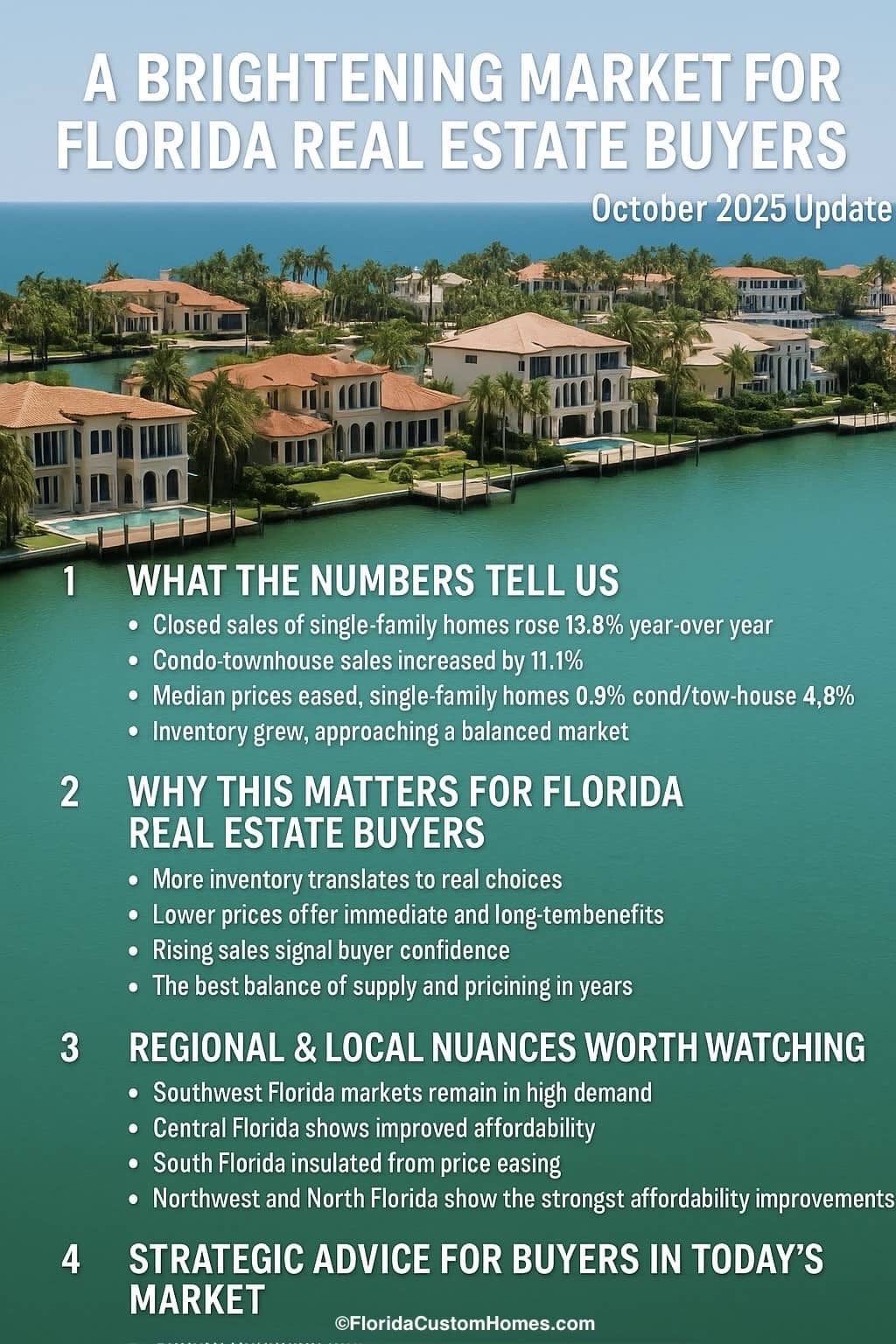
A Brightening Market for Florida Real Estate Buyers: October 2025 Update
Florida’s October 2025 housing report delivered a wave of optimism for Florida real estate buyers . For the first time in several years, buyers are experiencing meaningful relief as inventory expands, sales rise, and median prices show signs of stabilizing. The statewide market appears to be shifting out of the hyper-competitive post-pandemic era and settling into a more balanced environment—one where buyers can make more thoughtful decisions without fear of being outbid instantly.
1. What the Numbers Tell Us
The October 2025 data from Florida Realtors paints a clear picture of a market gaining stability. Closed sales of existing single-family homes reached 21,191, representing a 13.8% year-over-year increase. This is not a one-off spike—it's the continuation of several months of steady buyer re-engagement after elevated mortgage rates had previously cooled activity across the state.
Condo and townhouse transactions also rose sharply, hitting 7,223 closed sales, an 11.1% increase from October 2024. This segment is particularly important because condo and multifamily markets tend to adjust faster than single-family homes, offering a window into broader affordability trends.
More striking is the shift in pricing. The statewide median sales price for single-family homes dipped to $411,105, down 0.9% from a year ago. While the decrease is modest, it represents a turning point considering the dramatic price growth Florida experienced between 2020 and 2023.
Condo and townhouse prices fell more substantially—down 4.8% year-over-year to $300,000. This opens the door for first-time buyers, retirees, and seasonal residents seeking a more attainable entry point into the Florida lifestyle.
Perhaps the most important indicator is inventory growth. Single-family homes now sit at 5.1 months of supply, edging closer to what economists describe as a “balanced market.” Condo-townhouse inventory rose to 9.3 months, which technically positions that sector in buyer-market territory.
These numbers collectively signal a market that is cooling but healthy—a far cry from the bidding war environment of 2021–2022 or the sluggish uncertainty seen in 2023–2024.
2. Why This Matters for Florida Real Estate Buyers
For active and aspiring Florida real estate buyers, this shift brings several meaningful advantages. The combination of improving supply and mild price softening gives buyers new leverage that simply did not exist during the pandemic-era feeding frenzy.
More inventory translates to real choices. Buyers now have broader selection across multiple price points, property types, and geographic zones. Waterfront buyers on the Gulf Coast have more listings to compare; inland buyers seeking affordability gain access to more neighborhoods previously constrained by low supply.
Lower prices offer immediate and long-term benefits. A 1% or 5% drop in median pricing may not sound dramatic, but it can be the difference between qualifying—or not qualifying—for a preferred mortgage product. It also lowers property taxes and insurance in some counties.
Rising sales signal buyer confidence. When sales grow at double-digit rates despite elevated mortgage rates, it’s a sign that buyers are adjusting to the “new normal” and no longer waiting indefinitely for rates to collapse. Confidence is a critical ingredient in a healthy real estate cycle.
And perhaps most importantly, this moment may represent the best balance of supply and pricing Florida has seen in years. Buyers can negotiate again: for repairs, concessions, credits, and—in some cases—seller rate buydowns.
3. Regional & Local Nuances Worth Watching
While statewide numbers provide context, Florida is a mosaic of micro-markets, each behaving differently. Factors such as hurricane exposure, waterfront desirability, insurance costs, and migration patterns all play a role in shaping local trends.
Southwest Florida markets, including Cape Coral, Fort Myers, Bonita Springs, and Naples, continue to diverge from broader statewide trends. These areas remain in high demand due to Gulf-access canals, new construction, and post-Hurricane Ian modernization, even as supply increases.
Central Florida—Orlando, Kissimmee, Davenport, Clermont— remains influenced by tourism employment cycles and second-home buyers. Inventory improvements here give entry-level families an opportunity not seen since 2018–2019.
South Florida—Miami, Fort Lauderdale, Palm Beach— continues its luxury-driven trajectory. Despite inventory increases, foreign investment, digital nomads, and corporate relocations insulate this region from the price easing seen elsewhere.
Northwest and North Florida—Pensacola, Tallahassee, Gainesville, Jacksonville— show some of the strongest affordability improvements due to increasing new construction and migration away from denser urban Southern metros.
Buyers should also consider the influence of weather events. Hurricanes Helene and Milton affected October 2024’s numbers, creating a “base effect” that exaggerates this year’s improvements. Still, the upward trend is organic and widespread.
4. Strategic Advice for Buyers in Today’s Market
The shift toward a more balanced market doesn’t eliminate competition—but it does change how buyers should approach their strategy. Here are several high-level and tactical recommendations for buyers entering the Florida market in late 2025:
- Secure financing early and compare multiple lenders.
Rates remain volatile. A pre-approval demonstrates credibility and prevents surprises during negotiations. Buyers should explore conventional, FHA, VA, and portfolio loans, along with temporary 2-1 buydown programs gaining popularity. For more guidance, visit the Florida mortgage tips and financing guide . - Don’t attempt to time the market perfectly.
Many buyers lost opportunities between 2022–2024 by waiting for large price corrections that never came. The current environment—rising inventory paired with modest price easing—is highly favorable. - Look for motivated sellers.
Homes lingering 45+ days on market, vacant properties, estate sales, and investor-owned units often provide opportunities for price reductions or credited closing costs. - Target value segments such as condos/townhomes.
With median prices down nearly 5%, buyers can secure Florida lifestyle perks—resort pools, proximity to beaches, security, and amenities—for significantly less than single-family prices. Explore current opportunities in Florida condos and townhomes . - Work with a buyer's agent who understands Florida’s insurance and hurricane codes.
Insurance premiums can make or break affordability. A knowledgeable agent can help identify properties with updated roofs, impact windows, modern elevation, and hurricane-resilient features that dramatically reduce long-term costs. Learn more about working with a buyer’s agent in Florida . - Take a long-term perspective.
Florida remains one of the fastest-growing states for population and job growth. Whether buying for residence or investment, today’s balanced market offers an advantageous entry point. You can review additional Florida housing market trends and forecasts to align your strategy with long-term goals.
5. What to Watch in the Coming Months
Several key factors will influence the Florida real estate landscape heading into early 2026. Buyers monitoring these trends will be positioned to move quickly during favorable conditions.
- Interest Rates.
If rates continue to ease, buyer demand could heat up rapidly, reducing negotiating leverage. Rate drops of even half a point can shift affordability dramatically. - Inflation and Economic Policy.
National economic shifts affect construction costs, lending appetite, and inventory pipelines. Florida’s housing is especially sensitive to insurance trends and building material pricing. - New Construction Supply.
Builders in Florida are strategically increasing production, especially inland. A slowdown or surge in starts will influence pricing in 2026. You can track new communities and Florida new construction home opportunities as they come online. - Hurricane Season Aftereffects.
Weather events can cause short-term listing delays or long-term rebuilding, temporarily affecting inventory and buyer psychology. - Population Growth and Migration.
Florida continues drawing new residents from high-cost states. As long as migration remains strong, long-term demand will support pricing.
6. Conclusion
October 2025 marks an encouraging pivot for Florida real estate buyers. The combination of rising sales, expanding inventory, and mild price softening signals a healthier and more accessible market than Florida has seen in years. Buyers who were previously discouraged by fierce competition now have an opportunity to enter the market with confidence, clear options, and negotiation power.
Whether you're seeking a primary residence, vacation home, or long-term investment, the current environment offers a strategic window—one defined by balance, opportunity, and improved affordability. With the right preparation and expert guidance, buyers can secure strong long-term value in one of the nation’s most resilient and desirable housing markets.
If you’re ready to explore opportunities in Cape Coral waterfront homes , Naples luxury real estate , or other Southwest Florida housing markets , connect with a local expert and take advantage of today’s more balanced conditions.
Stay tuned to the Florida Custom Homes Blog for updates on development news and community growth throughout Southwest Florida.
Contact:
Scott Meadows – Broker Associate
Florida Custom Homes / Premiere Plus Realty
📞 239-220-1157
✉️ scottmeadows3@gmail.com
🌐 www.FloridaCustomHomes.com