Aug. 18, 2014

For Sale by Owner

5 Reasons You Shouldn’t For Sale by Owner

5 Reasons You Shouldn’t For Sale by Owner | Keeping Current Matters 

Some homeowners consider trying to sell their home on their own, known in the industry as a For Sale by Owner (FSBO). There are several reasons this might not be a good idea for the vast majority of sellers.

Here are five of those reasons:

1. There Are Too Many People to Negotiate With

Here is a list of some of the people with whom you must be prepared to negotiate if you decide to FSBO.

  • The buyer who wants the best deal possible
  • The buyer’s agent who solely represents the best interest of the buyer
  • The buyer’s attorney (in some parts of the country)
  • The home inspection companies which work for the buyer and will almost always find some problems with the house
  • The appraiser if there is a question of value
  • Your bank in the case of a short sale

2. Exposure to Prospective Purchasers

Recent studies have shown that 92% of buyers search online for a home. That is in comparison to only 28% looking at print newspaper ads. Most real estate agents have an extensive internet strategy to promote the sale of your home. Do you?

3.  Actual Results also come from the Internet

Where do buyers find the home they actually purchased?

  • 43% on the internet
  • 9% from a yard sign
  • 1% from newspapers

The days of selling your house by just putting up a sign and putting it in the paper are long gone. Having a strong internet strategy is crucial.

4. FSBOing has Become More and More Difficult

The paperwork involved in selling and buying a home has increased dramatically as industry disclosures and regulations have become mandatory. This is one of the reasons that the percentage of people FSBOing has dropped from 19% to 9% over the last 20+ years.

5. You Net More Money when Using an Agent

Many homeowners believe that they will save the real estate commission by selling on their own. Realize that the main reason buyers look at FSBOs is because they also believe they can save the real commission. The seller and buyer can’t both save the same commission. Studies have shown that the typical house sold by the homeowner sells for $184,000 while the typical house sold by an agent sells for $230,000.   This doesn’t mean that an agent can get $46,000 more for your home as studies have shown that people are more likely to FSBO in markets with lower price points. However, it does show that selling on your own might not make sense.

Bottom Line

Before you decide to take on the challenges of selling your house on your own, sit with a real estate professional in your marketplace and see what they have to offer.


Bottom Line

Before you decide to take on the challenges of selling your house on your own, sit with a real estate professional in your marketplace and see what they have to offer.
Aug. 12, 2014

You’re Still Paying a Mortgage

Either Way, You’re Still Paying a Mortgage
Either Way, You're Still Paying A Mortgage | Keeping Current Matters 

There are some people that have not purchased a home because they are uncomfortable taking on the obligation of a mortgage. Everyone should realize that, unless you are living with your parents rent free, you are paying a mortgage - either your mortgage or your landlord’s. As a paper from the Joint Center for Housing Studies at Harvard University explains:

“Households must consume housing whether they own or rent. Not even accounting for more favorable tax treatment of owning, homeowners pay debt service to pay down their own principal while households that rent pay down the principal of a landlord plus a rate of return. That’s yet another reason owning often does—as Americans intuit—end up making more financial sense than renting.”

Also, if you purchase with a 30-year fixed rate mortgage, your ‘housing expense’ is locked in over the thirty years for the most part. If you rent, the one guarantee you will have is that your rent will increase over that same thirty year time period. And, as an owner, the mortgage payment is a ‘forced savings’ which will allow you to have equity in your home you can tap into later in your life. As a renter, you guarantee the landlord is the person with that equity. Whether you are looking for a primary residence for the first time or are considering a vacation home on the shore, owning might make more sense than renting since home values and interest rates are still at bargain prices.

Bottom Line

Either Way, You're Still Paying A Mortgage | Keeping Current Matters 

There are some people that have not purchased a home because they are uncomfortable taking on the obligation of a mortgage. Everyone should realize that, unless you are living with your parents rent free, you are paying a mortgage - either your mortgage or your landlord’s. As a paper from the Joint Center for Housing Studies at Harvard University explains:

“Households must consume housing whether they own or rent. Not even accounting for more favorable tax treatment of owning, homeowners pay debt service to pay down their own principal while households that rent pay down the principal of a landlord plus a rate of return. That’s yet another reason owning often does—as Americans intuit—end up making more financial sense than renting.”

Also, if you purchase with a 30-year fixed rate mortgage, your ‘housing expense’ is locked in over the thirty years for the most part. If you rent, the one guarantee you will have is that your rent will increase over that same thirty year time period. And, as an owner, the mortgage payment is a ‘forced savings’ which will allow you to have equity in your home you can tap into later in your life. As a renter, you guarantee the landlord is the person with that equity. Whether you are looking for a primary residence for the first time or are considering a vacation home on the shore, owning might make more sense than renting since home values and interest rates are still at bargain prices.

Aug. 11, 2014

Retirement

You’ve Played the Housing Market Perfectly. Don’t Blow it Now!
You've Played the Real Estate Market Perfectly! Don't Blow It Now! | Keeping Current Matters 

Many people suffered through the housing crisis. We realize that most of the heartache was the result of a housing and mortgage market gone wild. Many consumers were swept away by the waters of a frenzied real estate market that resulted in a crisis even the experts didn’t see coming. However, some of the suffering was caused by home buyers and home owners simply making bad decisions. NOT YOU! You didn’t buy that house that stretched your family finances past the point of sustainability. You didn’t take out a home equity loan and buy new water skis. You didn’t do a cash-out refinance for the maximum amount possible. Instead, you bought a home your family could enjoy – and afford! You waited for interest rates to drop to historic lows and then refinanced your mortgage; not for the sake of taking cash out but instead to lower your monthly payment. You have equity in your house and a nice, low mortgage payment. You played the housing market perfectly.

Don’t Miss the Last Move

Yet, there is one more move many should consider. With interest rates still at historic lows, and prices projected to increase by almost 20% over the next four and a half years, this may be time to buy a new home. Whether, you are a growing family ready to move-up to that waterfront home you always wanted or an empty nester downsizing to a home that makes more sense, now may be the time to buy. If you have considered buying a vacation/retirement home, there may never be a better time to move forward with that plan. You have been fiscally astute enough to navigate the treacherous waters of a housing market that sank many a homeowner. Now, that the seas have settled, don’t think there aren’t even greater opportunities on the horizon.

Bottom Line

You've Played the Real Estate Market Perfectly! Don't Blow It Now! | Keeping Current Matters 

Many people suffered through the housing crisis. We realize that most of the heartache was the result of a housing and mortgage market gone wild. Many consumers were swept away by the waters of a frenzied real estate market that resulted in a crisis even the experts didn’t see coming. However, some of the suffering was caused by home buyers and home owners simply making bad decisions. NOT YOU! You didn’t buy that house that stretched your family finances past the point of sustainability. You didn’t take out a home equity loan and buy new water skis. You didn’t do a cash-out refinance for the maximum amount possible. Instead, you bought a home your family could enjoy – and afford! You waited for interest rates to drop to historic lows and then refinanced your mortgage; not for the sake of taking cash out but instead to lower your monthly payment. You have equity in your house and a nice, low mortgage payment. You played the housing market perfectly.

Don’t Miss the Last Move

Yet, there is one more move many should consider. With interest rates still at historic lows, and prices projected to increase by almost 20% over the next four and a half years, this may be time to buy a new home. Whether, you are a growing family ready to move-up to that waterfront home you always wanted or an empty nester downsizing to a home that makes more sense, now may be the time to buy. If you have considered buying a vacation/retirement home, there may never be a better time to move forward with that plan. You have been fiscally astute enough to navigate the treacherous waters of a housing market that sank many a homeowner. Now, that the seas have settled, don’t think there aren’t even greater opportunities on the horizon.

Aug. 7, 2014

Homeownership's Impact on Net Worth

Homeownership's Impact on Net Worth
Homeownership's Impact on Net Worth | Keeping Current Matters 

Over the last six years, homeownership has lost some of its allure as a financial investment. As homeowners suffered through the housing bust, more and more began to question whether owning a home was truly a good way to build wealth. A study by the Federal Reserve formally answered this question.

Some of the findings revealed in their report:

  • The average American family has a net worth of $77,300
  • Of that net worth, 61.4% ($47,500) of it is in home equity
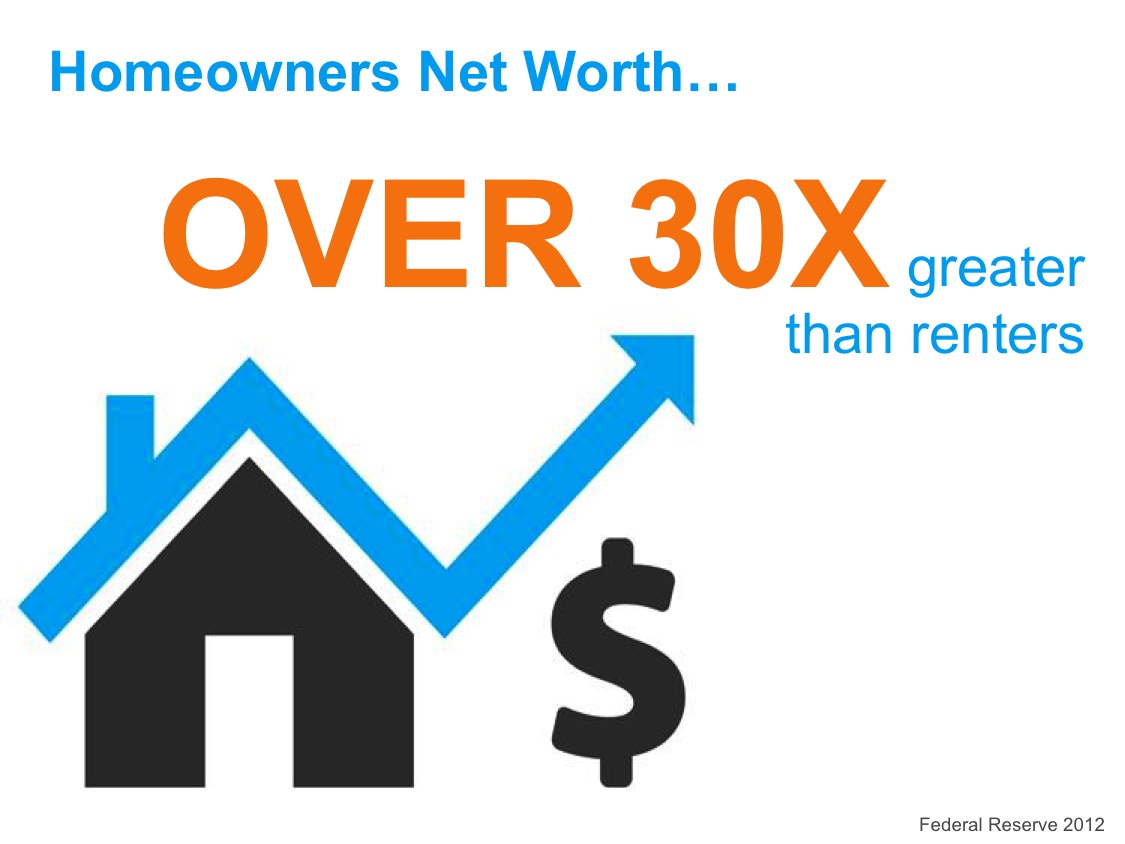
  • A homeowner’s net worth is over thirty times greater than that of a renter
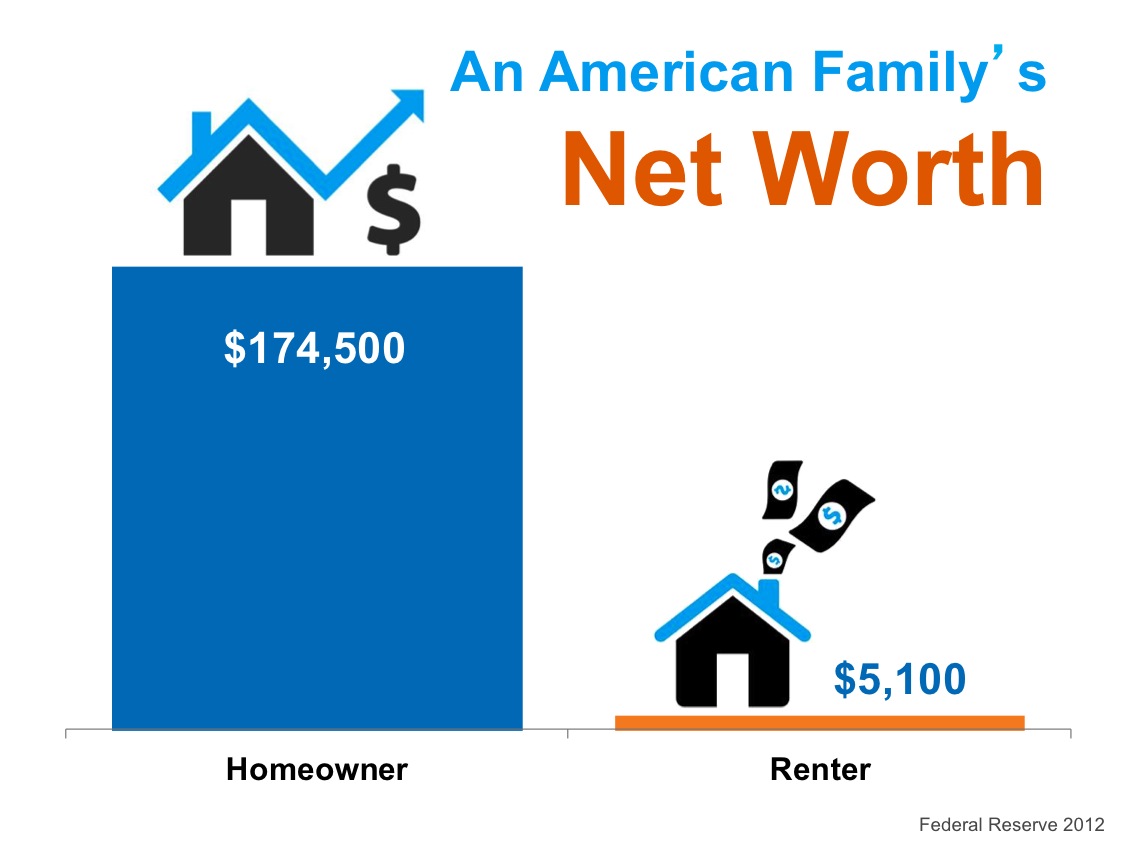
  • The average homeowner has a net worth of $174,500 while the average net worth of a renter is $5,100

Slide13Slide14

Bottom Line

The Fed study found that homeownership is still a great way for a family to build wealth in America.

Bottom Line

Homeownership's Impact on Net Worth | Keeping Current Matters 

Over the last six years, homeownership has lost some of its allure as a financial investment. As homeowners suffered through the housing bust, more and more began to question whether owning a home was truly a good way to build wealth. A study by the Federal Reserve formally answered this question.

Some of the findings revealed in their report:

  • The average American family has a net worth of $77,300
  • Of that net worth, 61.4% ($47,500) of it is in home equity
  • A homeowner’s net worth is over thirty times greater than that of a renter
  • The average homeowner has a net worth of $174,500 while the average net worth of a renter is $5,100

Slide13Slide14

Bottom Line

The Fed study found that homeownership is still a great way for a family to build wealth in America.

Aug. 6, 2014

Home Prices

Home Prices…Where are They Headed?
Home Prices... Where are they Headed? | Keeping Current Matters 

Today, many real estate conversations center on housing prices and where they may be headed. That is why the Home Price Expectation Survey is seen to be a reliable source. Every quarter, Pulsenomics surveys a nationwide panel of over one hundred economists, real estate experts and investment & market strategists about where prices are headed over the next five years. They then average the projections of all 100+ experts into a single number.  The results of their latest survey

  • Home values will appreciate by 4.6% in 2014.
  • The cumulative appreciation will be 19.5% by 2018.
  • That means the average annual appreciation will be 3.6% over the next 5 years.
  • Even the experts making up the most bearish quartile of the survey still are projecting a cumulative appreciation of 11.2% by 2018.

Individual opinions make headlines. We believe the survey is a fairer depiction of future values.

Bottom Line

Home Prices... Where are they Headed? | Keeping Current Matters 

Today, many real estate conversations center on housing prices and where they may be headed. That is why the Home Price Expectation Survey is seen to be a reliable source. Every quarter, Pulsenomics surveys a nationwide panel of over one hundred economists, real estate experts and investment & market strategists about where prices are headed over the next five years. They then average the projections of all 100+ experts into a single number.  The results of their latest survey

  • Home values will appreciate by 4.6% in 2014.
  • The cumulative appreciation will be 19.5% by 2018.
  • That means the average annual appreciation will be 3.6% over the next 5 years.
  • Even the experts making up the most bearish quartile of the survey still are projecting a cumulative appreciation of 11.2% by 2018.

Individual opinions make headlines. We believe the survey is a fairer depiction of future values.

Aug. 5, 2014

Bigger Ads Don't Make Dumber Buyers

Bigger Ads Don't Make Dumber Buyers
Bigger Ads Don't Make Dumber Buyers | Keeping Current Matters 

Being 'in and around' the real estate business for over 30 years, we are still confused about the importance both sellers and real estate agents put on advertising.  Decades ago, advertising a home was important to attract a buyer because there was no other way for an individual real estate office to announce to the world that a house was now on the market. But times have changed.  With the development of the Multiple Listing Systems (MLS), as soon as a listing is taken the entire agent population of that area or region is informed. Instantly! Every agent working every buyer is put on notice that a new opportunity to sell a home is here. In many cases, through new technologies, the buyers are directly informed of the new listing before the agent can even reach out to them. Buyers already in the market will know the home is up for sale immediately. No ad is required to do this. You may ask - what about the buyer who is not yet actively engaging an agent in search of a home? Those future buyers are searching the internet months before they are ready to commit. In most areas, once a home is placed on the MLS system, the listing populates a plethora of real estate internet sites where a buyer can easily find it. Why are no buyers looking at the house? I will argue that it is probably not because they are unaware of the listing. In 99% of the cases, it is about pricing. They know of it and, for some reason, have decided it is not worth seeing. The value was not there for them.

Look at the Price

You may think there are just no buyers in the market for your type of home at the present time. Well, let's take a step back and ask a question. Would someone buy it at $1? How about $100?  $1,000?  $10,000?  $100,000? Of course!! But, that proves our point. There is a price that buyers will pay for each and every home that is for sale today. You must decide if you are willing to take what the current value of your property is. That is entirely your decision. But, let's not believe the house hasn't sold because it wasn't advertised more aggressively. You could put it on the front page of your large, regional paper for the next 365 straight days. If it is not priced right, a buyer will not buy it. Does that mean that you don't need an agent to sell your home? Actually, we are saying the exact opposite. You need a well-informed real estate professional who knows the proper price for your house and has the courage to tell you the truth. It was great to see that a recent survey by the National Association of Realtors revealed that the number one benefit a seller wants from their agent is assistance in setting a competitive price. That truly is the most important thing an agent can deliver to a seller in this market.

Bottom Line

Get a great agent. Price your home appropriately. And don't believe that running more ads will create a group of buyers that don't understand value!!

Bottom Line

Get a great agent. Price your home appropriately. And don't believe that running more ads will create a group of buyers that don't understand value!!

Aug. 4, 2014

Using an Agent

The Importance of Using an Agent when Selling Your Home
The Importance of Using an Agent when Selling Your Home | Keeping Current Matters 

When a homeowner decides to sell their house, they obviously want the best possible price with the least amount of hassles. However, for the vast majority of sellers, the most important result is to actually get the home sold. In order to accomplish all three goals, a seller should realize the importance of using a real estate professional. We realize that technology has changed the purchaser’s behavior during the home buying process. Today, 92% of all buyers use the internet in their home search according to the National Association of Realtors’ 2013 Profile of Home Buyers & Sellers. However, the report also revealed that 96% percent of buyers that used the internet when searching for a home purchased their home through either a real estate agent/broker or from a builder or builder’s agent. Only 2% purchased their home directly from a seller whom the buyer didn’t know. Buyers search for a home online but then depend on the agent to find the actual home they will buy (52%) or to help them handle the paperwork (24%) or understand the process (24%). It is true that the percentage of buyers that are using the internet to search for homes and information on the home buying process has increased dramatically over the last decade. But the plethora of information now available has also resulted in an increase in the percentage of buyers that reach out to real estate professionals to “connect the dots”. This is obvious as the percentage of overall buyers who used an agent to buy their home has steadily increased from 69% in 2001.

BOTTOM LINE

If you are thinking of selling your home, don’t underestimate the role a real estate professional can play in the process.

Bottom Line

The Importance of Using an Agent when Selling Your Home | Keeping Current Matters 

When a homeowner decides to sell their house, they obviously want the best possible price with the least amount of hassles. However, for the vast majority of sellers, the most important result is to actually get the home sold. In order to accomplish all three goals, a seller should realize the importance of using a real estate professional. We realize that technology has changed the purchaser’s behavior during the home buying process. Today, 92% of all buyers use the internet in their home search according to the National Association of Realtors’ 2013 Profile of Home Buyers & Sellers. However, the report also revealed that 96% percent of buyers that used the internet when searching for a home purchased their home through either a real estate agent/broker or from a builder or builder’s agent. Only 2% purchased their home directly from a seller whom the buyer didn’t know. Buyers search for a home online but then depend on the agent to find the actual home they will buy (52%) or to help them handle the paperwork (24%) or understand the process (24%). It is true that the percentage of buyers that are using the internet to search for homes and information on the home buying process has increased dramatically over the last decade. But the plethora of information now available has also resulted in an increase in the percentage of buyers that reach out to real estate professionals to “connect the dots”. This is obvious as the percentage of overall buyers who used an agent to buy their home has steadily increased from 69% in 2001.

BOTTOM LINE

If you are thinking of selling your home, don’t underestimate the role a real estate professional can play in the process.

July 30, 2014

Buying a Home?

Buying a Home? You Don’t Need to Do It Alone
Buying a Home? You Don’t Need to Do It Alone | Keeping Current Matters 

Last week, Discover Home Loans released an interesting survey which revealed how prepared home buyers are for the actual mortgage process. The survey reported that 94 percent of prospective buyers believe they are making a good investment decision if they buy a home. The survey also explained that 66 percent of buyers reach out to real estate agents to help determine whether buying a certain home would be a good investment. However, there is less certainty regarding the mortgage process.

Most buyers overwhelmed

The majority of potential buyers are actually overwhelmed with the plethora of information available about the home financing process.  Here are some interesting highlights from the report:

  • Nearly 66% feel overwhelmed with the amount of information available
  • 76% of those under the age of 30 feel overwhelmed
  • 76% of first time buyers feel the same way
  • 54% of those buyers who have previously owned also were overwhelmed
  • 59% of buyers turn to mortgage bankers to help evaluate mortgage terms and comparing offers
  • 49% of buyers turn to real estate agents to help evaluate mortgage terms and comparing offers

There is help available…use it!

Cameron Findlay, chief economist at Discover Home Loans, gives great advice: “The industry is becoming more transparent in an effort to help homebuyers become informed about changes that may affect their process. The sheer amount of information can lead to confusion and stress. Those looking to purchase should work closely with their lender and realtor to make sure they are comfortable with mortgage terms and understand the impact a loan will have on their finances.”

Bottom Line

The purchasing of a home can put great pressure on a family. Reach out to the best mortgage and real estate professionals in your market for assistance throughout the process.

Bottom Line

The purchasing of a home can put great pressure on a family. Reach out to the best mortgage and real estate professionals in your market for assistance throughout the process.

July 28, 2014

Buying a House? 4 Reasons to DO IT NOW

Buying a House? 4 Reasons to DO IT NOW
Buying a House? 4 Reasons to DO IT NOW | Keeping Current Matters 

Here are four great reasons to consider buying a home today, instead of waiting.

1. Prices Will Continue to Rise

The Home Price Expectation Survey polls a distinguished panel of over 100 economists, investment strategists, and housing market analysts. Their most recent report projects appreciation in home values over the next five years to be between 30.8% (most optimistic) and 9.4% (most pessimistic). The bottom in home prices has come and gone. Home values will continue to appreciate for years. Waiting no longer makes sense.

2. Mortgage Interest Rates Are Projected to Increase

Although the Primary Mortgage Market Survey shows that interest rates for a 30-year mortgage are currently around 4.2%, Freddie Mac is projecting that rates will increase to 5.2% by this time next year. An increase in rates will impact YOUR monthly mortgage payment. Your housing expense will be more a year from now if a mortgage is necessary to purchase your next home.

3. Either Way, You are Paying a Mortgage

As a research paper from the Joint Center for Housing Studies at Harvard University explains: “Households must consume housing whether they own or rent. Not even accounting for more favorable tax treatment of owning, homeowners pay debt service to pay down their own principal while households that rent pay down the principal of a landlord plus a rate of return. That’s yet another reason owning often does—as Americans intuit—end up making more financial sense than renting.”

4. It’s Time to Move On with Your Life

The ‘cost’ of a home is determined by two major components: the price of the home and the current mortgage rate. It appears that both are on the rise. But, what if they weren’t? Would you wait? Look at the actual reason you are buying and decide whether it is worth waiting. Whether you want to have a great place for your children to grow up, you want your family to be safer, or you just want to have control over renovations, maybe it is time to buy. If the right thing for you and your family is to purchase a home this year, buying sooner rather than later could lead to substantial savings.

July 24, 2014

What is holding back the Real Estate Market?

What is holding back the Real Estate Market?
What is holding back the Real Estate Market? | Keeping Current Matters 

Though the housing market is recovering nicely, it is not doing quite as well as some analysts had predicted. There has been no shortage of excuses offered as to why this is: the rise in interest rates, more stringent lending standards, the weather. However, we feel that there is one factor that is most responsible for curtailing the number of houses sold – the number of houses available for sale!

Inventory Levels are BELOW Historic Norms

In a recent economic forecast, Freddie Mac addressed this exact issue: “Including newly built homes in the inventory count, the total number of homes offered for sale relative to the number of households in the U.S. has been running at the lowest level in more than 30 years, as shown in the second exhibit. The relatively low for-sale inventory reflects several features of today’s market.” “A supply-constrained market (holding other factors constant) will result in a decline in the volume of sales and an increase in real transaction prices.”

NAR Report Confirms Inventory Constriction

History shows us that a balanced real estate market requires a six month supply of available housing inventory. The National Association of Realtors released their Existing Homes Sales Report earlier this week. The report revealed that we are still only at a 5.5 month supply of homes for sale. We have not reached the 6 month mark in over two years. The recent increase in buyers now looking will again put a strain on this number.

Bottom Line

While inventory levels remain below historic norms, it will remain a seller’s market. This being the case, if you are considering selling your home, now may be the time to list it for sale.

Bottom Line

While inventory levels remain below historic norms, it will remain a seller’s market. This being the case, if you are considering selling your home, now may be the time to list it for sale.