Sept. 25, 2014

Heading in the Right Direction”

Gallup Poll: Real Estate “Heading in the Right Direction”


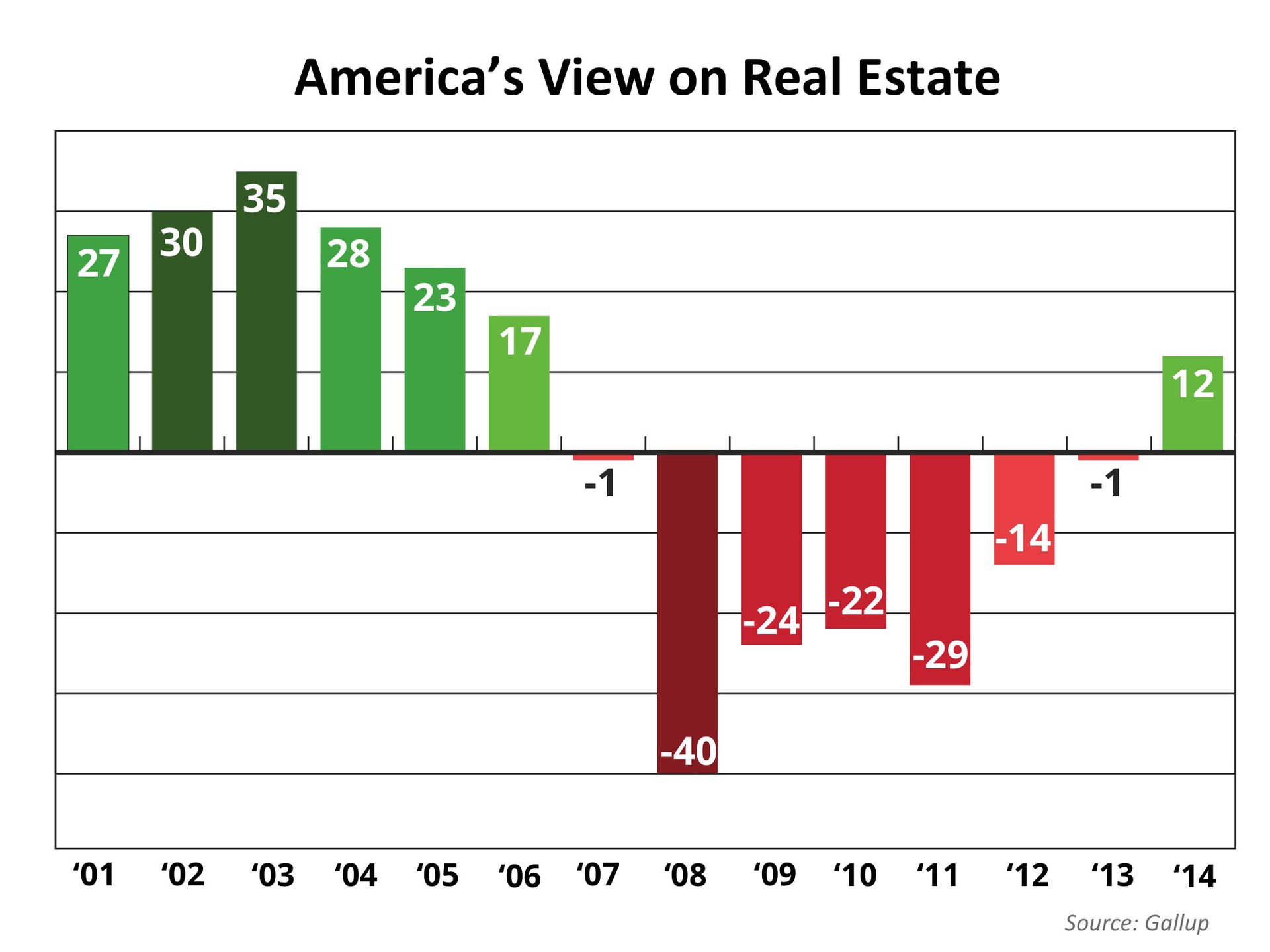
Real Estate "Heading in the Right Direction" | Keeping Current Matters In a recent Gallup poll, Americans were asked to rate 24 different business sectors and industries on a five-point scale ranging from "very positive" to "very negative." The poll was first conducted in 2001, and has been used as an indicator of “Americans’ overall attitudes toward each industry”. For the first time since 2006, Americans had an overall positive view of real estate, giving the industry a 12% positive ranking. Real Estate “Heading in the Right Direction” | Keeping Current Matters Americans’ view of the real estate industry worsened from 2003 to the -40% plummet of 2008.  Gallup offers some insight into the reason for decline:

Prices Dropped

“In late 2006, real estate prices in the U.S. began falling rapidly, and continued to drop. Many homeowners saw their home values plummet, likely contributing to real estate's image taking a hard hit.”

Housing Bubble

“The large drops in the positive images of banking and real estate in 2008 and 2009 reflect both industries' close ties to the recession, which was precipitated in large part because of the mortgage-related housing bubble.”

Bottom Line

“Although the image of real estate remains below the average of 24 industries Gallup has tracked, the sharp recovery from previous extreme low points suggests it is heading in the right direction.”
Sept. 23, 2014

Downpayments

The Truth About Buying a Home: You DON'T Need 20% Down
The Truth About Buying a Home: You DON'T Need 20% Down | Keeping Current Matters 

In a recent survey, How America Views Homeownership, it was revealed that 68% of Americans feel that now is a good time to buy a home and 95% said they want to own a home if they don’t already. Franklin Codel, head of Wells Fargo home mortgage production, explains:

“Although the home buying process has changed in many ways in recent years, our survey found Americans still view homeownership as an achievement to be proud of and many believe that now is a good time to buy a home.”

Confusion Creates Paralysis

However, the survey also reported that many are afraid to purchase a home because of uncertainty about “qualifying for a mortgage or navigating the home buying process”. Though 74% said they “know and understand” the financial process involved in buying a home, they also gave answers that suggest otherwise. For example:

  • 30% of respondents believe that only individuals with high incomes can obtain a mortgage
  • 64% of respondents believe they must have a “very good” credit score to buy a home
  • 44% believe that a 20% down payment is required

In actuality many of these beliefs are unfounded. Let’s look at the question of down payment: Freddie Mac, in a recent blog post addressing the issue, confirmed that there is misinformation regarding the amount necessary when determining the down payment for a home purchase:

“Did you know 40 percent of today's homebuyers using mortgage financing are making down payments that are less than 10 percent? And how about this: since 2010, the number of people putting down less than 10 percent for conventional loans has grown three fold.  So, not only are low down payment options real, they represent a significant portion of today's purchases.”

In a separate Executive Perspectives, Christina Boyle, Freddie Mac’s VP and Head of Single-Family Sales & Relationship Management explained further:

  • A person “can get a conforming, conventional mortgage with a down payment of as little as 5 percent (sometimes with as little as 3 percent coming out of their own pockets)”.
  • Qualified borrowers can further reduce the down payment coming out of their own pockets to 3 percent by lining up gifts from family, grants or loans from non-profits or public agencies.

Education is the Key

Boyle talked about the importance of educating potential buyers:

“Letting more consumers know how down payments are determined could bring more qualified borrowers off the sidelines. Depending on their credit history and other factors, many borrowers can expect to make a down payment of about 5 or 10 percent.”

Codel agreed:

“It is important for prospective homebuyers to feel empowered to ask lenders and real estate agents questions about available options, such as down payment assistance or FHA loan programs or VA loans for veterans.”

Bottom Line

If you are saving for either your first home or that perfect move-up dream house, make sure you know all your options. You may be pleasantly surprised.

Bottom Line

If you are saving for either your first home or that perfect move-up dream house, make sure you know all your options. You may be pleasantly surprised.

Sept. 18, 2014

Home Sales Generate $52,205 Impact on Economy

Home Sales Generate $52,205 Impact on Economy
Home Sales Generate $52,205 Impact on Economy 

The National Association of Realtors (NAR) compiled data from research conducted by the Bureau of Economic Analysis & Macroeconomic Advisors on the economic impact of a home purchase. After reviewing the data, they concluded that the total economic impact of a typical home sale in the United States is an astonishing $52,205. Here is the breakdown of their report: 

Economic Contributions are derived from:

  • Home construction
  • Real estate brokerage
  • Mortgage lending
  • Title insurance
  • Rental and Leasing
  • Home appraisal
  • Moving truck service
  • Other related activities

When a House is Sold in the United States:

$15,912 income is generated from real estate related industries. New homeowners spend an additional $4,429 on consumer items such as furniture, appliances, and remodeling. It generates an economic multiplier impact. There is a greater sense of community associated with owning a home; therefore there is greater spending at restaurants, sports games, and charity events. The size of this “multiplier” effect is estimated to be: $9,764 Additional home sales induce additional home production. Typically one new home is constructed for every 8 existing home sales. Therefore, for each existing home sale, 1/8 of new home value is added to the economy, which is estimated in the U.S. to be: $22,100

When you add the numbers up it comes to $52,205!

Sept. 17, 2014

Things You Don’t Need to Hear from Your Listing Agent

The Two Things You Don’t Need to Hear from Your Listing Agent
Two Things You Don't Need to Hear From Your Listing Agent | Keeping Current Matters 

You’ve decided to sell your house. You begin to interview potential real estate agents to help you through the process. You need someone you trust enough to:

  1. Set the market value on possibly the largest asset your family owns (your home)
  2. Set the time schedule for the successful liquidation of that asset
  3. Set the fee for the services required to liquidate that asset

An agent must be concerned first and foremost about you and your family in order to garner that degree of trust.  Make sure this is the case.

Be careful if the agent you are interviewing begins the interview by:

  • Bragging about their success
  • Bragging about their company’s success

An agent’s success and the success of their company can be important considerations when deciding on the right real estate professional to represent you in the sale of the house. However, you first need to know they care about what you need and what you expect from the sale. If the agent is not interested in first establishing your needs, how successful they may seem is much less important. Look for someone with the ‘heart of a teacher’ who comes in prepared well enough to explain the current real estate market and patient enough to take the time to show how it may impact the sale of your home. Not someone only interested in trying to sell you on how great they are. You have many agents from which to choose. Pick someone who truly cares.

Bottom Line

Two Things You Don't Need to Hear From Your Listing Agent | Keeping Current Matters 

You’ve decided to sell your house. You begin to interview potential real estate agents to help you through the process. You need someone you trust enough to:

  1. Set the market value on possibly the largest asset your family owns (your home)
  2. Set the time schedule for the successful liquidation of that asset
  3. Set the fee for the services required to liquidate that asset

An agent must be concerned first and foremost about you and your family in order to garner that degree of trust.  Make sure this is the case.

Be careful if the agent you are interviewing begins the interview by:

  • Bragging about their success
  • Bragging about their company’s success

An agent’s success and the success of their company can be important considerations when deciding on the right real estate professional to represent you in the sale of the house. However, you first need to know they care about what you need and what you expect from the sale. If the agent is not interested in first establishing your needs, how successful they may seem is much less important. Look for someone with the ‘heart of a teacher’ who comes in prepared well enough to explain the current real estate market and patient enough to take the time to show how it may impact the sale of your home. Not someone only interested in trying to sell you on how great they are. You have many agents from which to choose. Pick someone who truly cares.

Sept. 11, 2014

Getting A Mortgage

Getting A Mortgage: Why So Much Paperwork?
Getting a Mortgage: Why so much Paperwork? | Keeping Current Matters 

We are often asked why there is so much paperwork mandated by the bank for a mortgage loan application when buying a home today. It seems that the bank needs to know everything about us and requires three separate sources to validate each and every entry on the application form. Many buyers are being told by friends and family that the process was a hundred times easier when they bought their home ten to twenty years ago. There are two very good reasons that the loan process is much more onerous on today’s buyer than perhaps any time in history.

  1. The government has set new guidelines that now demand that the bank prove beyond any doubt that you are indeed capable of affording the mortgage. During the run-up in the housing market, many people ‘qualified’ for mortgages that they could never pay back. This led to millions of families losing their home. The government wants to make sure this can’t happen again
  2. The banks don’t want to be in the real estate business. Over the last seven years, banks were forced to take on the responsibility of liquidating millions of foreclosures and also negotiating another million plus short sales. Just like the government, they don’t want more foreclosures. For that reason, they need to double (maybe even triple) check everything on the application.

However, there is some good news in the situation. The housing crash that mandated that banks be extremely strict on paperwork requirements also allowed you to get a mortgage interest rate probably below 5%. The friends and family who bought homes ten or twenty ago experienced a simpler mortgage application process but also paid a higher interest rate (the average 30 year fixed rate mortgage was 8.12% in the 1990’s and 6.29% in the 2000’s). If you went to the bank and offered to pay 7% instead of <5%, they would probably bend over backwards to make the process much easier.

Bottom Line

Instead of concentrating on the additional paperwork required, let’s be thankful that we are able to buy a home at historically low rates.

Bottom Line

Getting a Mortgage: Why so much Paperwork? | Keeping Current Matters 

We are often asked why there is so much paperwork mandated by the bank for a mortgage loan application when buying a home today. It seems that the bank needs to know everything about us and requires three separate sources to validate each and every entry on the application form. Many buyers are being told by friends and family that the process was a hundred times easier when they bought their home ten to twenty years ago. There are two very good reasons that the loan process is much more onerous on today’s buyer than perhaps any time in history.

  1. The government has set new guidelines that now demand that the bank prove beyond any doubt that you are indeed capable of affording the mortgage. During the run-up in the housing market, many people ‘qualified’ for mortgages that they could never pay back. This led to millions of families losing their home. The government wants to make sure this can’t happen again
  2. The banks don’t want to be in the real estate business. Over the last seven years, banks were forced to take on the responsibility of liquidating millions of foreclosures and also negotiating another million plus short sales. Just like the government, they don’t want more foreclosures. For that reason, they need to double (maybe even triple) check everything on the application.

However, there is some good news in the situation. The housing crash that mandated that banks be extremely strict on paperwork requirements also allowed you to get a mortgage interest rate probably below 5%. The friends and family who bought homes ten or twenty ago experienced a simpler mortgage application process but also paid a higher interest rate (the average 30 year fixed rate mortgage was 8.12% in the 1990’s and 6.29% in the 2000’s). If you went to the bank and offered to pay 7% instead of <5%, they would probably bend over backwards to make the process much easier.

Bottom Line

Instead of concentrating on the additional paperwork required, let’s be thankful that we are able to buy a home at historically low rates.

Sept. 9, 2014

You Need A Professional When Buying A Home

You Need A Professional When Buying A Home

You Need a Pro When Buying a Home | Keeping Current Matters

Many people wonder whether they should hire a real estate professional to assist them in buying their dream home or if they should first try to go it on their own. In today’s market: you need an experienced professional!

You Need an Expert Guide if you are Traveling a Dangerous Path

The field of real estate is loaded with land mines. You need a true expert to guide you through the dangerous pitfalls that currently exist. Finding a home that is priced appropriately and ready for you to move in to can be tricky. An agent listens to your wants and needs, and can sift out the homes that do not fit within the parameters of your “dream home”.

A great agent will also have relationships with mortgage professionals and other experts that you will need in securing your dream home.

You Need a Skilled Negotiator

In today’s market, hiring a talented negotiator could save you thousands, perhaps tens of thousands of dollars. Each step of the way – from the original offer, to the possible renegotiation of that offer after a home inspection, to the possible cancellation of the deal based on a troubled appraisal – you need someone who can keep the deal together until it closes.

Realize that when an agent is negotiating their commission with you, they are negotiating their own salary; the salary that keeps a roof over their family’s head; the salary that puts food on their family’s table. If they are quick to take less when negotiating for themselves and their families, what makes you think they will not act the same way when negotiating for you and your family? If they were Clark Kent when negotiating with you, they will not turn into Superman when negotiating with the buyer or seller in your deal.

Bottom Line

Famous sayings become famous because they are true. You get what you pay for. Just like a good accountant or a good attorney, a good agent will save you money…not cost you money.
Bottom Line

You Need a Pro When Buying a Home | Keeping Current Matters

Many people wonder whether they should hire a real estate professional to assist them in buying their dream home or if they should first try to go it on their own. In today’s market: you need an experienced professional!

You Need an Expert Guide if you are Traveling a Dangerous Path

The field of real estate is loaded with land mines. You need a true expert to guide you through the dangerous pitfalls that currently exist. Finding a home that is priced appropriately and ready for you to move in to can be tricky. An agent listens to your wants and needs, and can sift out the homes that do not fit within the parameters of your “dream home”.

A great agent will also have relationships with mortgage professionals and other experts that you will need in securing your dream home.

You Need a Skilled Negotiator

In today’s market, hiring a talented negotiator could save you thousands, perhaps tens of thousands of dollars. Each step of the way – from the original offer, to the possible renegotiation of that offer after a home inspection, to the possible cancellation of the deal based on a troubled appraisal – you need someone who can keep the deal together until it closes.

Realize that when an agent is negotiating their commission with you, they are negotiating their own salary; the salary that keeps a roof over their family’s head; the salary that puts food on their family’s table. If they are quick to take less when negotiating for themselves and their families, what makes you think they will not act the same way when negotiating for you and your family? If they were Clark Kent when negotiating with you, they will not turn into Superman when negotiating with the buyer or seller in your deal.

Bottom Line

Famous sayings become famous because they are true. You get what you pay for. Just like a good accountant or a good attorney, a good agent will save you money…not cost you money.

Aug. 27, 2014

‘Renter’s Trap’

Don’t Get Caught in the ‘Renter’s Trap’

Don’t Get Caught in the ‘Renter’s Trap’ | Keeping Current Matters

In a recent press releaseZillow stated that the affordability of the nation’s rental inventory is currently much worse than affordability of the country’s home sale inventory. The release revealed two things:

  1. Nationally, renters signing a lease at the end of the second quarter paid 29.5% of their income to rent
  2. U.S. home buyers at the end of the second quarter could expect to pay 15.3% of their incomes to a mortgage on the typical home

Furthermore, renters pay more than the average of 24.9% that was paid in the pre-bubble period while buyers actually pay far less than the 22.1% share homeowners devoted to mortgages in the pre-bubble days.

Don’t Become Trapped

If you are currently renting you could get caught up in a cycle where increasing rents continue to make it impossible for you to save for a necessary down payment. Zillow Chief Economist Dr. Stan Humphries explains:

"The affordability of for-sale homes remains strong, which is encouraging for those buyers that can save for a down payment and capitalize on low mortgage interest rates…As rents keep rising, along with interest rates and home values, saving for a down payment and attaining homeownership becomes that much more difficult for millions of current renters.”

Know Your Options

Perhaps you already have saved enough to buy your first home. HousingWire recently reported that analysts at Nomura believe:

“It’s not that Millennials and other potential homebuyers aren’t qualified in terms of their credit scores or in how much they have saved for their down payment. 

It’s that they think they’re not qualified or they think that they don’t have a big enough down payment.” (emphasis added)

Freddie Mac came out with comments on this exact issue:

  1. A person “can get a conforming, conventional mortgage with a down payment of as little as 5 percent (sometimes with as little as 3 percent coming out of their own pockets)”.
  2. Freddie Mac's purchase of mortgages with down payments under 10 percent more than quadrupled between 2009 and 2013.
  3. More than one in five borrowers who took out conforming, conventional mortgages in 2014 put down 10 percent or less.

Bottom Line

Don’t get caught in the trap so many renters are currently in. If you are ready and willing to buy a home, find out if you are able. Have a professional help you determine if you are eligible to get a mortgage.

Bottom Line

Don’t get caught in the trap so many renters are currently in. If you are ready and willing to buy a home, find out if you are able. Have a professional help you determine if you are eligible to get a mortgage.

Aug. 25, 2014

‘Soft’ Housing Market?

A ‘Soft’ Housing Market? We Beg to Differ!
A ‘Soft’ Housing Market? We Beg to Differ! | Keeping Current Matters 

There are some pundits lamenting the softness of the 2014 housing market. We can’t understand why. Though it is true that the early part of the year disappointed because of a myriad of reasons (ex. weather, lack of inventory, less distressed sales), the recent housing news is extremely encouraging. Let’s give some examples:

Spring Home Buying Season is Healthiest in 3 Years

Move, Inc. just last week revealed that this spring’s housing market finished stronger than any time in the last three years. In the report, Jonathan Smoke, chief economist for realtor.com explained:

"This is the first time, since the beginning of the recovery that we expect to see positive momentum throughout the second half of the year. While seasonal patterns are emerging in July month-to-month comparisons, all other metrics point to fundamental market health and a build-up of momentum."

Existing Home Sales are Up

In their latest Existing Home Sales Report, the National Association of Realtors (NAR) announced existing-home sales increased in July to their highest annual pace of the year. That is even though distressed property sales fell to 9%, the first time they were in the single-digits since NAR started tracking the category in October 2008. Lawrence Yun, chief economist for NAR explained:

“The number of houses for sale is higher than a year ago and tamer price increases are giving prospective buyers less hesitation about entering the market. More people are buying homes compared to earlier in the year and this trend should continue.”

New Construction Surging

According to an article on Market Watch, new constructing is surging:

“Construction on new U.S. homes jumped 15.7% in July to the highest level in eight months and starts were revised up sharply for June, indicating a pickup in home building after an early-year lull. Housing starts climbed to an annual rate of 1.09 million last month…Economists surveyed by MarketWatch had expected starts to climb to a seasonally adjusted 975,000 in July.”

Foot Traffic at Year High Numbers

Foot traffic (the number of people out actually physically looking at homes) has a strong correlation with future contracts and home sales, so it can be viewed as a peek ahead at sales trends two to three months into the future. The latest foot traffic numbers show that there are more prospective purchasers currently looking at homes than at any other time in the last twelve months which includes the latest spring buyers’ market.

Bottom Line

The spring market finished stronger than any time in the last three years. Home sales are at year long highs. New construction is beating estimates. There are more buyers out than at any time in the last twelve months. We think the housing market is doing just fine.

Bottom Line

The spring market finished stronger than any time in the last three years. Home sales are at year long highs. New construction is beating estimates. There are more buyers out than at any time in the last twelve months. We think the housing market is doing just fine.

Aug. 21, 2014

Where Are Mortgage Rates Headed?

Where Are Mortgage Rates Headed?
Where are Mortgage Rates Headed? | Keeping Current Matters 

The interest rate you pay on your home mortgage has a direct impact on your monthly payment. The higher the rate the greater the payment will be. That is why it is important to look at where rates are headed when deciding to buy now or wait until next year. According to a recent article in Kiplinger, 30 year mortgage rates are about to increase:

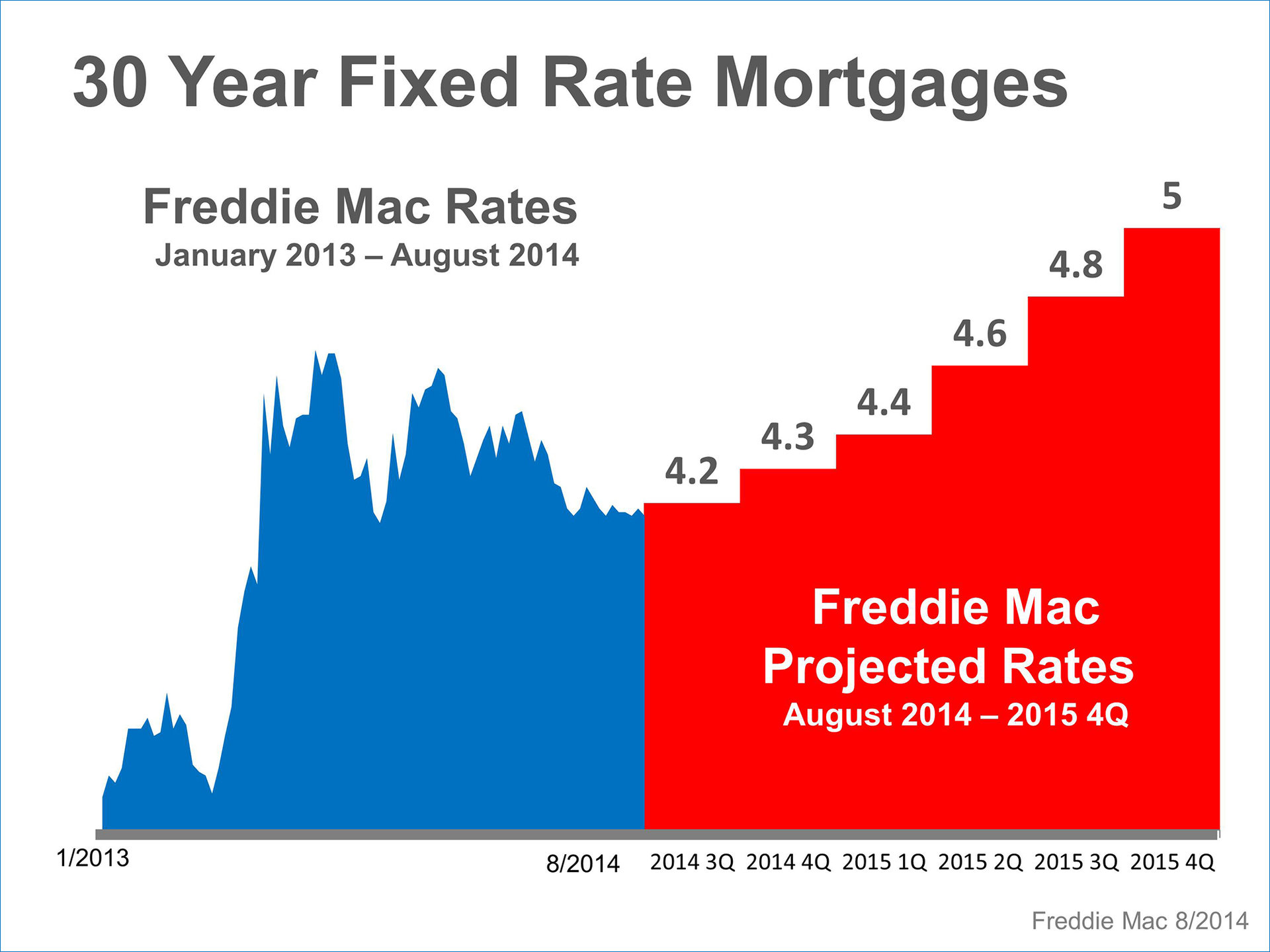
 “Now around 4.1%, rates will edge slowly toward 4.4% by the end of this year. Then they’ll follow the Treasury bond rate’s upward move in early 2015. Thirty-year home loans should end 2015 at around 5.1%, still low by historical standards.”

Here is a graph created by using interest rate projections in Freddie Mac’s August 2014 U.S. Economic & Housing Market OutlookWhere are Mortgage Rates Headed? | Keeping Current Matters

How will this impact a mortgage payment?

Research released this month by Zillow reveals:

“We examined how a 1 percentage point rise in mortgage rates would impact monthly payments for the typical home in 35 metro areas, and found that the difference this year versus next year varies dramatically from market to market. In the San Jose/Silicon Valley area, for example, potential buyers should expect to see a monthly payment increase of more than $700 if they waited a year to buy the same home they were considering today. By contrast, in St. Louis, the difference is only $65 per month.” (emphasis added)

Bottom Line

Again, we turn to the Zillow research:

“As rates rise, new home buyers will confront higher financing costs and monthly mortgage payments. For many, this will mean tightening their budgets and sacrificing some luxuries they may take for granted today.”

Bottom Line

Again, we turn to the Zillow research:

“As rates rise, new home buyers will confront higher financing costs and monthly mortgage payments. For many, this will mean tightening their budgets and sacrificing some luxuries they may take for granted today.”
Aug. 20, 2014

Still a Great Time to Buy a Home

Still a Great Time to Buy a Home…but HURRY!!
Still a Great Time to Buy a Home…but HURRY!! | Keeping Current Matters 

Kevin Kelly, Chairman of the National Association of Home Builders (NAHB), recently explained that:

“With interest rates near historically low levels and strengthening job growth, now continues to be a great opportunity to buy a home.”

We couldn’t agree more. However, one must realize that, with prices and interest rates both projected to increase, waiting could be costly. There are two organizations that look at the affordability of purchasing and actually measure it over time. The National Association of Home Builders has their Housing Opportunity Index (HOI) and the National Association of Realtors’ has the Housing Affordability IndexBoth indexes are reporting the same thing. The cost of buying a home is beginning to increase leading the affordability indexes to dip.

Both indexes say we passed the bottom of the housing market

According to NAHB’s HOI housing affordability dipped slightly in the second quarter of 2014. NAHB’s Chief Economist David Crowe explains:

“The second quarter HOI reflects the slow but steady march toward the historic levels of price appreciation and interest rates that result in affordability levels we experienced before the mid-2000s boom.”

According to NAR in a recent Economists’ Outlook post, home affordability is down from both one month ago and one year ago in all regions. Michael Hyman, Research Assistant at NAR said:

“At the national level, housing affordability is down for the month of June due to higher prices and qualifying income levels despite the lowest mortgage rates of the year.”

In a recent article, the Wall Street Journal also revealed that the cost of home ownership is higher than any time in over five years:

“Housing affordability hit its lowest level in nearly six years in June as home prices continued to climb."

Bottom Line

If you were waiting for the bottom of the market, you missed it. Yet, with prices below values of seven years ago in most parts of the country and interest rates near historic lows, it is still a great time to buy a home…but hurry!

Bottom Line

If you were waiting for the bottom of the market, you missed it. Yet, with prices below values of seven years ago in most parts of the country and interest rates near historic lows, it is still a great time to buy a home…but hurry!