Aug. 23, 2025

Legacy Harbour Marina Fort Myers: Rebuilding a Waterfront Icon After Hurricane Ian

Legacy Harbour Marina Fort Myers

Legacy Harbour Marina Fort Myers: Rebuilding a Waterfront Icon After Hurricane Ian

Legacy Harbour Marina in Fort Myers, Florida, has long been a favorite among boaters and residents for its prime downtown location, scenic views along the Caloosahatchee River, and vibrant waterfront lifestyle. But after suffering devastating damage from Hurricane Ian in 2022, this beloved marina is undergoing a bold transformation.

As of mid-2025, Legacy Harbour Marina is being completely redeveloped—ushering in a new era of coastal resilience, modern design, and state-of-the-art marine infrastructure. For boaters, real estate investors, and Fort Myers locals, this redevelopment is more than just a construction project—it represents the rebirth of a Southwest Florida landmark.

Hurricane Ian’s Destruction: The Turning Point for Legacy Harbour Marina

In September 2022, Hurricane Ian made landfall in Southwest Florida with catastrophic storm surge and wind damage. Legacy Harbour Marina, like much of downtown Fort Myers, was severely impacted. Floating docks were destroyed, mooring infrastructure was compromised, and much of the marina’s shoreline facilities were rendered inoperable.

AIRN Management, the owner of Legacy Harbour Marina, faced a difficult decision: either repair the aging marina or reimagine it entirely. Ultimately, they chose the latter—an ambitious full-scale redevelopment to create a world-class marina equipped for the future.

The New Vision: Legacy Harbour Marina 2.0

The rebuild of Legacy Harbour Marina is more than just restoration—it’s a complete reinvention. AIRN Management has partnered with Bellingham Marine, a global leader in marina construction, to deliver a top-tier boating facility designed with both resilience and luxury in mind.

Key Highlights of the Redevelopment:

  • 131 Concrete Floating Slips: Accommodating vessels from 40 to 150 feet using Bellingham’s Unifloat dock system.
  • Wave Attenuation System: An outer wave-break dock system anchored by 70-foot steel piles.
  • Wear Deck Surfacing and Aluminum Framing: Durable composite decking and aluminum Unideck construction.
  • Enhanced Utility Infrastructure: In-slip water, pump-out, fire suppression, and upgraded electrical service.
  • Resilient Pile System: HDPE-sleeved steel piles for longevity and low maintenance.

Timeline and Construction Progress

Construction began in early 2025, and the project is progressing on schedule. According to marina representatives and news coverage, the full relaunch is expected in Q1 of 2026, just in time for Southwest Florida’s peak boating season.

While full operations remain suspended, the marina’s hotel, Regatta Restaurant, and mini-market have reopened, providing a glimpse into the future vibrancy of the site.

Why the Redevelopment Matters for Fort Myers

1. Economic Boost and Increased Tourism

The revitalization of Legacy Harbour Marina will attract transient boaters, long-term slip renters, and waterfront enthusiasts—injecting much-needed energy and tourism revenue back into the local economy.

2. Real Estate Value Appreciation

Nearby neighborhoods and riverfront condos will likely see increased values, with the redeveloped marina serving as a magnet for investment and activity.

3. Storm Resilience and Climate Adaptation

Legacy Harbour Marina’s rebuild uses hurricane-hardened infrastructure designed for storm surge and sea-level rise, setting a new standard for coastal resilience.

Nearby Amenities and Waterfront Attractions

Legacy Harbour Marina sits at the heart of downtown Fort Myers—steps from:

  • Fort Myers Yacht Basin (also being rebranded)
  • River District restaurants, shops, and nightlife
  • Edison & Ford Winter Estates
  • Centennial Park and public events
  • Monthly art walks, music walks, and festivals

Sustainability and Green Marina Practices

The redevelopment prioritizes eco-friendly construction materials, modern pump-out systems, and energy-efficient electrical utilities. The project is expected to join Florida’s Clean Marina Program to uphold environmental standards.

Long-Term Vision for Legacy Harbour Marina

Following its 2026 reopening, the marina may see future additions such as:

  • Expanded transient boating facilities
  • Yacht concierge services and club access
  • Retail partnerships and waterfront cafes
  • Seasonal waterfront events and festivals

What This Means for Florida Real Estate Buyers

If you’re a Florida real estate buyer or investor, here’s why the Legacy Harbour redevelopment matters:

  • Waterfront properties nearby may experience rising demand and appreciation.
  • Downtown Fort Myers is evolving into a premier urban waterfront destination.
  • New marina infrastructure increases rental income potential for nearby condos and Airbnbs.

Conclusion: A Rebirth on the River

Legacy Harbour Marina is not just being rebuilt—it’s being reborn. From a storm-battered facility to a state-of-the-art yachting destination, the transformation signals Fort Myers’ resilience and future-forward growth.

As the marina prepares for its 2026 debut, Fort Myers locals, boaters, and real estate professionals alike can look forward to a revitalized downtown waterfront filled with new energy, opportunity, and beauty.

Work With Scott Meadows: Your Fort Myers Real Estate Expert

Scott Meadows has years of experience helping buyers, investors, and waterfront enthusiasts navigate the evolving Fort Myers real estate market. Whether you're looking for a condo near Legacy Harbour Marina, a Gulf-access home, or a new-construction property built for hurricane resilience, Scott can guide you through every step of the journey.

📞 Call or Text: (239) 220‑1157
📧 Email: ScottMeadows3@gmail.com
🌐 Website: FloridaCustomHomes.com

Aug. 22, 2025

The Grove vs. Coral Grove in Cape Coral: Understanding the Differences

The Grove vs Coral Grove

The Grove vs. Coral Grove in Cape Coral: Understanding the Differences

Cape Coral, Florida, has been rapidly growing as one of Southwest Florida’s most vibrant and dynamic cities. With its iconic canals, abundant green spaces, and an expanding economy, Cape Coral is attracting buyers, investors, and entrepreneurs alike. Amidst this growth, two communities often get confused due to their similar names: The Grove and Coral Grove. While they sound alike, they serve very different purposes and cater to distinct audiences. This article breaks down the differences to help residents, buyers, and investors understand what each community offers.

What is The Grove Cape Coral?

The Grove is a private, mixed-use town center in Cape Coral. It’s designed to provide a modern, urban-style environment while still embracing the city’s signature Florida lifestyle. The development combines residential, retail, dining, and community spaces in a single, walkable area.

Key Features of The Grove:

  • Mixed-Use Development: Combines townhomes, condos, apartments, shops, restaurants, and office spaces.
  • Walkable Urban Design: Pedestrian-friendly streets, plazas, and green spaces encourage residents and visitors to explore.
  • Lifestyle Amenities: Community events, farmers markets, and seasonal festivals make it a vibrant social hub.
  • Residential Appeal: Modern homes with open floor plans, high-quality finishes, and convenient access to shops and dining.
  • Investment Potential: Both residential and commercial properties attract investors looking for long-term growth.

Essentially, The Grove is a lifestyle-oriented community that blends urban conveniences with the relaxed Florida way of life. Residents and visitors can enjoy modern living, shopping, dining, and entertainment all within a single development.

What is Coral Grove?

Coral Grove, sometimes called the Cape Coral Grove, is a city-sponsored development initiative rather than a private residential project. Managed by the City of Cape Coral’s Economic Development Office, Coral Grove is designed to stimulate economic growth, attract businesses, and provide public infrastructure.

Key Features of Coral Grove:

  • City-Led Development: Planned and executed by the City of Cape Coral to support economic expansion.
  • Mixed-Use, But Commercial Focused: Includes commercial office space, retail, and public infrastructure, with some residential components.
  • Economic Development Goals: Encourages job creation, attracts new businesses, and fosters entrepreneurship.
  • Public Spaces: Green areas, plazas, and connectivity to surrounding neighborhoods are central to the design.
  • Long-Term Growth: Positioned as a strategic hub for Cape Coral’s ongoing urban expansion.

Unlike The Grove, Coral Grove is primarily an economic development project. Its main purpose is not residential living but rather creating a business-friendly environment with integrated community benefits.

Side-by-Side Comparison

Feature The Grove (Town Center) Coral Grove (City Development)
Type Private mixed-use town center City-led economic development initiative
Primary Focus Residential living, retail, dining, lifestyle Economic growth, commercial space, public infrastructure
Residential Component Townhomes, condos, apartments Limited; primarily commercial and public spaces
Commercial Component Shops, restaurants, offices Office spaces, commercial hubs, city facilities
Community Engagement Farmers markets, events, social activities Public plazas, infrastructure for neighborhood connectivity
Target Audience Residents, lifestyle buyers, investors Businesses, entrepreneurs, investors in commercial real estate
Investment Potential High for both residential and commercial High primarily for commercial properties and long-term city growth
Design & Atmosphere Urban, walkable, vibrant, resort-style Functional, business-focused, strategically planned

Why the Confusion?

The similar names — The Grove and Coral Grove — often cause confusion among buyers and investors. Additionally, both are mixed-use projects to some degree, and both aim to enhance Cape Coral’s urban environment. However, understanding the target audience and development purpose is key:

  • The Grove: A lifestyle destination for people who want to live, shop, dine, and socialize in a modern, walkable town center.
  • Coral Grove: A city initiative aimed at economic growth and business opportunities, with public infrastructure and commercial development at its core.

Opportunities in Both Communities

For Buyers:

  • The Grove: Ideal for residents seeking modern townhomes, condos, or apartments in a vibrant, amenity-rich area.
  • Coral Grove: Residential options are limited, but surrounding neighborhoods may benefit from rising property values as the area develops.

For Investors:

  • The Grove: Attractive for short-term rental properties or commercial leasing in shops and offices.
  • Coral Grove: Long-term commercial investments and opportunities tied to city-led development and business growth.

For Businesses:

  • The Grove: Retail and restaurant opportunities targeting local residents and visitors.
  • Coral Grove: Office and commercial spaces designed to attract businesses, startups, and regional enterprises.

How Scott Meadows Can Help

Navigating Cape Coral’s evolving real estate landscape requires expert guidance. Scott Meadows has extensive experience in residential and commercial properties throughout Southwest Florida, helping buyers, investors, and businesses identify the best opportunities. Whether you’re interested in The Grove’s town center lifestyle properties or exploring investment opportunities near Coral Grove, Scott can provide insights and support to maximize your investment.

Contact Scott Meadows Today

Phone: 239‑220‑1157
Email: ScottMeadows3@gmail.com
Website: FloridaCustomHomes.com

Aug. 22, 2025

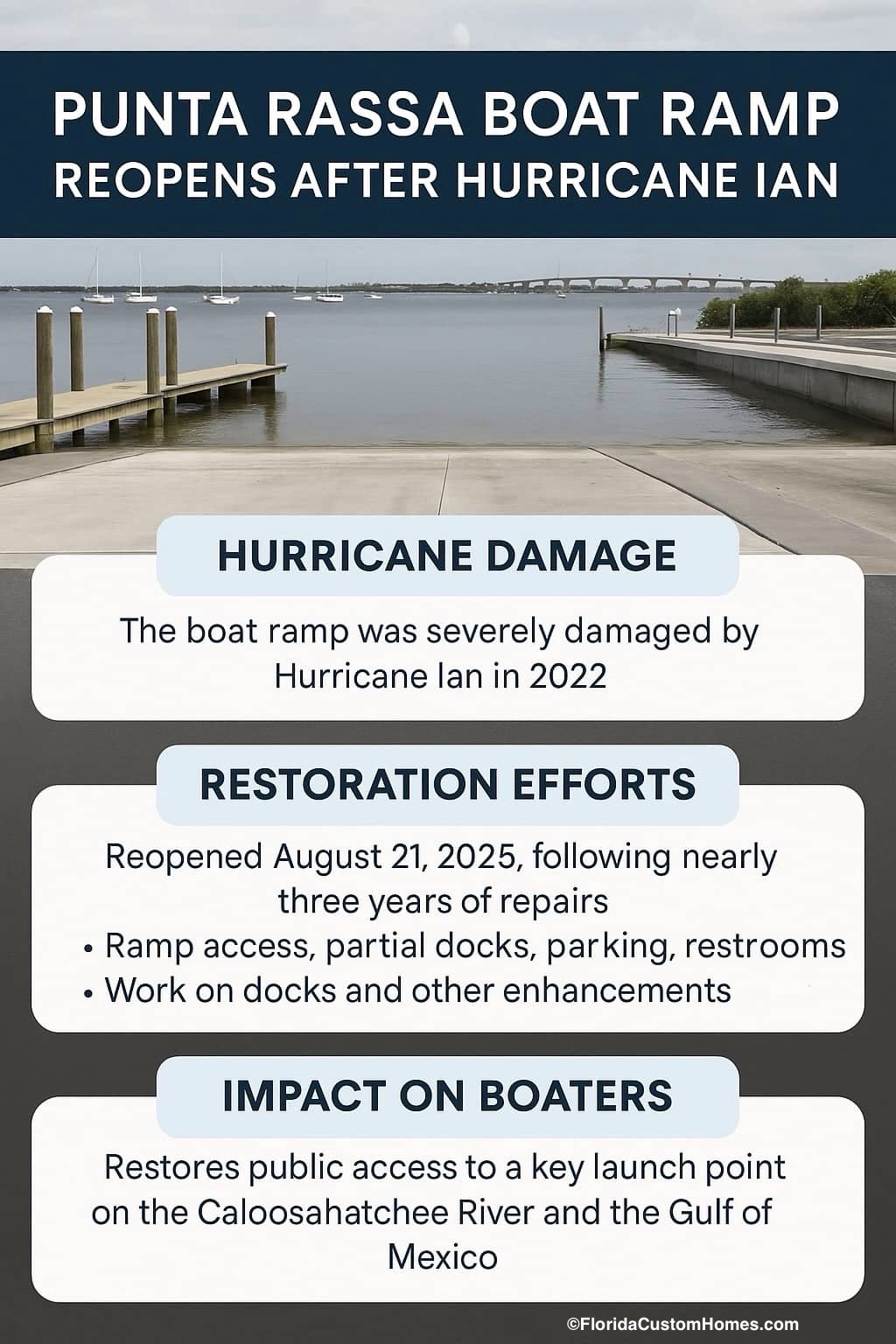
Punta Rassa Boat Ramp Reopens After Hurricane Ian

Punta Rassa Boat Ramp

Punta Rassa Boat Ramp Reopens After Hurricane Ian: What It Means for Local Boaters and the Fort Myers Waterfront Community

Introduction: A Major Milestone for Lee County’s Boating Community

In a triumphant moment for Southwest Florida’s boating community, the Punta Rassa Boat Ramp—one of Lee County’s largest and most vital waterfront launch sites—has officially reopened as of August 21, 2025. After nearly three years of closure and uncertainty following the catastrophic damage caused by Hurricane Ian in 2022, local boaters, anglers, and waterfront residents are finally celebrating the return of this key access point to the Caloosahatchee River, Pine Island Sound, and the Gulf of Mexico.

This reopening marks not just a restoration of physical infrastructure, but a powerful symbol of resilience, recovery, and revitalization for Fort Myers, Sanibel, and the entire Greater Lee County region.

Hurricane Ian’s Devastating Impact on Punta Rassa

When Hurricane Ian made landfall on September 28, 2022, it delivered one of the most destructive storm surges ever recorded in Southwest Florida. The storm surge, which reached over 12 feet in some areas, decimated marine infrastructure across Fort Myers Beach, Sanibel, and Punta Rassa.

The Punta Rassa Boat Ramp, located at the base of the Sanibel Causeway, suffered severe damage. Flooding and saltwater intrusion further eroded the area’s stability, making it unsafe and unsuitable for any public use.

A Crucial Staging Ground

In the aftermath of Hurricane Ian, the boat ramp was repurposed as a staging ground for emergency response and Sanibel Causeway reconstruction. It became the launching site for barges and heavy equipment essential to restoring island access.

Rebuilding Punta Rassa: From Staging Site to Community Asset

Phase 1: Utility Infrastructure and Site Stabilization

In March 2025, the Lee County Commission approved a $1.6 million contract to initiate the first phase of reconstruction, including:

  • New water lines and fire hydrants
  • Improved irrigation systems
  • Rebuilt fish-cleaning discharge lines
  • ADA-compliant ramps
  • Stabilized parking areas

Phase 2: Dock Repairs and Amenities

The second phase focused on:

  • Repairing northern, middle, and southern docks
  • Installing a shaded fish-cleaning station
  • Upgraded landscaping and lighting
  • New signage and paved access points

Reopening Day: A Celebration of Resilience

On August 21, 2025, Lee County and state officials held a ribbon-cutting ceremony to mark the reopening of Punta Rassa. With ramp access restored, boaters can now enjoy:

  • Six+ lanes of ramp access
  • Partial dock functionality (with full access by late 2025)
  • Refurbished ADA parking and restrooms
  • Lighting, signage, and landscaped areas

What the Reopening Means for Boaters, Anglers, and Tour Operators

1. Restored Convenience and Accessibility

Boaters previously had to rely on distant ramps in Matlacha and Lovers Key. Now, Punta Rassa offers fast, direct access to:

  • Sanibel and Captiva
  • Pine Island Sound
  • Gulf of Mexico inshore and offshore zones

2. A Boost for Charter Captains and Eco-Tours

Tourism operators benefit greatly from the reopening, enabling faster scheduling and better convenience for fishing charters, eco tours, and family outings departing from Fort Myers and Sanibel.

3. Economic and Real Estate Implications

Nearby neighborhoods like Sanibel View, McGregor Isles, and Punta Rassa waterfront condos are seeing renewed interest from buyers now that boating access has returned.

Environmental Considerations and Long-Term Resilience

Engineers implemented improvements with storm resilience in mind, including elevated structures, durable materials, and ADA-friendly construction. Plans are underway for better drainage, boater education signage, and ongoing environmental monitoring through 2026.

What’s Still to Come in Late 2025

The ramp is open, but more enhancements are expected by year-end, including:

  • Full dock repairs and walkways
  • New fish-cleaning station installation
  • Landscaping and shaded observation areas

For project updates, visit Lee County Parks & Recreation.

Final Thoughts: A Symbol of Hope and Reconnection

The reopening of Punta Rassa Boat Ramp represents more than infrastructure—it’s about reconnecting with the water, reestablishing quality of life, and showing how Lee County continues to rebound from Hurricane Ian with determination and foresight.

Call to Action: Discover Waterfront Living in Southwest Florida

If you're a boater, angler, or nature enthusiast dreaming of living near Gulf-access waterways, now is the perfect time to explore waterfront real estate in Fort Myers and surrounding communities.

Scott Meadows is a trusted buyer’s agent with years of experience helping clients find new construction, hurricane-resilient homes, and prime Gulf-access properties.

📞 239‑220‑1157
📧 ScottMeadows3@gmail.com
🌐 www.FloridaCustomHomes.com

Aug. 22, 2025

Why It’s Important to Work with a Marco Island Florida Buyer’s Agent in a Buyer’s Market

Why it's important to work with a Marco Island Florida Buyer's Agent

Why It’s Important to Work with a Marco Island Florida Buyer’s Agent in a Buyer’s Market

Marco Island is one of Florida’s most desirable destinations for luxury living, waterfront views, and seasonal getaways. With its white-sand beaches, pristine canals, and access to the Gulf of Mexico, it's no surprise that demand for real estate here has been strong. But as of late 2025, the local housing market is shifting—inventory is rising, sellers are adjusting prices, and buyers are regaining leverage. This shift marks the entrance into a buyer’s market, making it the perfect time to explore Marco Island homes.

However, navigating this market successfully hinges on one critical decision: choosing the right real estate representation. Many buyers mistakenly think contacting the listing agent will help them secure a better deal. In truth, this could work against you. The smartest move? Partnering with a dedicated Marco Island buyer’s agent who advocates solely for your interests.

In this article, we’ll explore:

  • The different types of real estate agent relationships

  • The pros and cons of each

  • The risks of dual representation

  • The advantages of working with a buyer’s agent in a buyer’s market

  • Why Scott Meadows is the trusted name for Marco Island buyers


Understanding Realtor Relationships in Florida

In Florida, real estate agents can operate under different roles depending on the client relationship. Each relationship determines the agent’s obligations and loyalties.

1. Listing Agent (Seller’s Agent)

A listing agent signs a listing agreement with the seller and represents the seller exclusively. Their goal is to:

  • Market the property to generate the highest offer

  • Negotiate on behalf of the seller

  • Disclose anything beneficial to the seller

  • Secure terms that favor the seller

Even if a buyer contacts the listing agent directly, the agent is still legally obligated to protect the seller’s best interest—not the buyer’s.

2. Buyer’s Agent

A buyer’s agent exclusively represents the buyer throughout the transaction. Their responsibilities include:

  • Finding and showing appropriate properties

  • Conducting comparative market analysis

  • Advising on offer strategy and contingencies

  • Negotiating price and terms

  • Managing inspections and timelines

  • Ensuring your legal protections are enforced

A Marco Island buyer’s agent like Scott Meadows works only for you, providing undivided loyalty.

3. Transaction Broker (Default in Florida)

A transaction broker offers limited representation to both the buyer and seller, without fiduciary loyalty to either. They assist with paperwork and process but cannot advise, negotiate, or advocate for either party.


Pros and Cons of Each Relationship

Relationship Type Pros Cons
Listing Agent Direct access to seller’s rep Represents seller only, no loyalty to buyer
Buyer’s Agent Full buyer advocacy, legal representation None—typically compensated by seller at closing
Transaction Broker Basic facilitation for both parties Cannot give advice or advocate solely for buyer

The Pitfalls of Going Directly to the Listing Agent

Many Marco Island buyers believe that reaching out to the listing agent will:

  • Lead to a quicker deal

  • Save them money

  • Give them insider knowledge

However, this approach often results in:

  • Overpaying for the home

  • Waiving critical contingencies

  • No guidance on contracts or negotiations

  • Unintentional disclosure of motivation or budget

Remember: the listing agent works for the seller. You wouldn’t go to court without your own attorney—why approach a six- or seven-figure purchase without your own representation?


Why It’s Critical to Work with a Marco Island Buyer’s Agent in a Buyer’s Market

The dynamics of a buyer’s market create leverage—but only if you know how to use it. Here’s why working with a dedicated Marco Island buyer’s agent gives you the upper hand:

✅ 1. Local Market Intelligence

From Hideaway Beach and Tigertail to Old Marco and South End condos, every neighborhood has unique trends. A local expert like Scott Meadows knows:

  • Where prices are negotiable

  • Where flood zones impact insurance

  • What upcoming developments will affect property values

  • Which HOA rules impact rentals or seasonal use

✅ 2. Skilled Negotiation Tactics

In a buyer’s market, sellers are more flexible—but you still need a professional who can:

  • Craft competitive but advantageous offers

  • Push for seller concessions (credits, warranties, repairs)

  • Negotiate flexible closing dates or financing terms

Scott Meadows has decades of experience negotiating favorable terms for his clients, saving them thousands.

✅ 3. Legal and Contract Protection

Real estate contracts are binding. A mistake or omission could lead to:

  • Loss of your deposit

  • Delays or termination of closing

  • Uncovered repair costs or hidden fees

A buyer’s agent ensures:

  • All contingencies (inspection, appraisal, financing) are in place

  • Timelines are tracked

  • You’re fully protected throughout the process

✅ 4. Access to Off-Market and Pre-Listing Opportunities

Experienced buyer’s agents often have:

  • Access to “pocket listings” not on MLS

  • Builder inventory not yet publicly released

  • Relationships with sellers preparing to list

This gives you a major advantage in finding exclusive or undervalued properties.

✅ 5. Trusted Local Network

From inspectors to title companies, agents like Scott Meadows work with vetted professionals to ensure a smooth closing. This saves you time, money, and headaches.


What Does It Cost to Hire a Buyer’s Agent in Marco Island?

The best part? In nearly all cases, the seller pays the buyer’s agent commission. That means you receive:

  • Full representation

  • Expert advice and negotiation

  • Protection at every step

At no cost to you.


Who Should Always Work with a Marco Island Buyer’s Agent?

  • First-time buyers navigating complex contracts

  • Out-of-state buyers unfamiliar with Florida law or insurance

  • Luxury buyers seeking privacy and waterfront access

  • Investors purchasing short-term rental properties

  • Buyers of new construction homes or condos

Whether you’re buying a $400K condo or a $4M estate, a buyer’s agent levels the playing field.


How to Choose the Right Buyer’s Agent in Marco Island

Look for a professional with:

✅ Deep knowledge of the Marco Island market
✅ Experience in waterfront, condo, and luxury segments
✅ Strong track record of buyer success
✅ Stellar communication and negotiation skills
✅ A network of professionals and builders


Why Buyers Trust Scott Meadows on Marco Island

With over 35 years of Florida real estate experience, Scott Meadows has become a leading advocate for buyers across Southwest Florida—including Marco Island, Naples, Bonita Springs, and Estero.

What Sets Scott Apart:

  • Broker Associate at Premiere Plus Realty

  • Deep understanding of hurricane-resilient and flood-zone properties

  • Trusted partner for new construction and luxury sales

  • Proven expertise in negotiating complex deals


📞 Work with Scott Meadows – Marco Island’s Trusted Buyer’s Agent

Whether you're searching for a Gulf-front estate, a waterfront condo with boat dock, or an investment property with income potential, Scott Meadows will protect your interests every step of the way.

Contact Scott Today

📍 Serving Marco Island, Naples, Bonita Springs, Estero, Fort Myers
📞 Phone: 239‑220‑1157
📧 Email: ScottMeadows3@gmail.com
🌐 Website: FloridaCustomHomes.com


Don’t Navigate This Market Alone


This is a buyer’s market—but the advantage is only yours if you have the right representation. Let Scott Meadows help you buy smarter, negotiate stronger, and secure the perfect Marco Island home for your lifestyle and budget.

Aug. 21, 2025

Why It’s Important to Work with a Naples Florida Buyer’s Agent in a Buyer’s Market

Why it's important to work with a Naples Florida Buyer's Agent

Why It’s Important to Work with a Naples Florida Buyer’s Agent in a Buyer’s Market

Naples, Florida—known for its pristine beaches, luxury homes, and upscale lifestyle—has long been one of the most desirable places to buy real estate in Southwest Florida. In late 2025, the Naples real estate market is experiencing a shift: increased inventory, longer days on market, and more negotiable sellers have officially ushered in a buyer’s market.

Yet even in this favorable environment, making a smart real estate purchase in Naples requires expert guidance. Too many buyers assume they can contact the listing agent directly and get a better deal—but that assumption often backfires.

In this article, we’ll explore the types of Realtor relationships, the risks of dual representation, and why it’s crucial to work with a dedicated Naples Florida Buyer’s Agent like Scott Meadows to make the most of your investment in this market.


Understanding Realtor Relationships in Florida

There are three primary types of agency relationships in Florida real estate:

1. Listing Agent (Seller’s Agent)

  • Represents the seller exclusively.

  • Works to get the highest price and best terms for the seller.

  • Legally obligated to disclose any buyer information that benefits the seller.

Even if you reach out directly to the listing agent, they are not working for you—they’re working against your negotiating position.

2. Buyer’s Agent

  • Represents the buyer exclusively.

  • Negotiates on your behalf.

  • Provides property analysis, guidance, and contract protection.

  • Ensures your interests are protected from search to closing.

This is what Scott Meadows, Naples Buyers Agent, provides his clients: 100% loyalty to the buyer, with zero conflicts of interest.

3. Transaction Broker

  • The default role in Florida when no formal relationship is established.

  • Offers limited representation to both sides.

  • Cannot legally promote one party’s interest over the other.

  • Provides general assistance with paperwork but no negotiation strategy.


Pros and Cons of Each Type

Role Pros Cons
Listing Agent Direct communication with seller Works solely for seller; may use your info against you
Buyer’s Agent Full advocacy and loyalty No added cost—seller typically pays commission
Transaction Broker Neutral party Cannot negotiate or advise on your behalf

The Risk of Going Directly to the Listing Agent

Some buyers believe bypassing a buyer’s agent will give them:

  • A better price

  • Faster communication

  • Preferential treatment

However, this often results in:

  • Overpaying for the property

  • Waiving critical contingencies

  • Losing negotiation power

  • Being unrepresented in legal matters

Scott Meadows, a trusted Naples Buyers Agent, advises all buyers to never enter negotiations without someone on their side—especially in complex or luxury transactions.


Why a Buyer’s Agent Is Essential in a Buyer’s Market

In a buyer’s market like Naples in 2025, working with a buyer’s agent doesn’t just make sense—it gives you a serious edge.

✅ 1. Local Expertise that Saves You Time and Money

Naples neighborhoods vary widely in price, elevation, rental potential, and future growth. Scott Meadows, an experienced Naples Buyers Agent, knows:

  • Which communities are overbuilt or undervalued

  • What homes will have better long-term resale value

  • How flood zones, HOA fees, and insurance costs impact value

✅ 2. Strategic Negotiation

Even in a buyer’s market, negotiation is an art. A skilled buyer’s agent helps you:

  • Identify motivated sellers

  • Negotiate price reductions, credits, and seller concessions

  • Push for favorable closing dates and contingency terms

Scott Meadows brings decades of experience negotiating high-end deals for buyers across Naples—maximizing their value while minimizing their risk.

✅ 3. Contract Protection and Contingencies

A Florida real estate contract is binding. Without a buyer’s agent:

  • You may miss deadlines

  • You risk losing your escrow deposit

  • You might not include necessary inspections or financing protections

Scott Meadows, Naples Buyers Agent, ensures every offer is structured to protect your deposit, your rights, and your timeline.

✅ 4. Access to Off-Market Inventory

Scott’s local network includes:

  • Pocket listings not available online

  • Builder properties about to hit the market

  • Sellers who aren’t actively marketing but are willing to negotiate

This gives his buyers first-look access before properties hit the public MLS.

✅ 5. A Trusted Network of Professionals

When you work with Scott Meadows, you gain access to:

  • Home inspectors and appraisers

  • Real estate attorneys and title companies

  • Insurance agents familiar with Naples flood zones

  • Lenders that specialize in jumbo and luxury loans

This ecosystem ensures every step of your transaction is smooth, compliant, and optimized for success.


What Does a Buyer’s Agent Cost?

Nothing out of your pocket.

In nearly every transaction, the seller pays the buyer’s agent commission as part of the listing agreement. That means:

  • You get professional representation

  • You pay nothing additional

  • You benefit from strategic support with no downside


Who Needs a Naples Buyer’s Agent?

Virtually everyone can benefit, but especially:

  • First-time homebuyers who need guidance and protection

  • Luxury buyers navigating complex contracts

  • Out-of-state buyers unfamiliar with Naples zoning and insurance issues

  • Investors seeking ROI, rental potential, or new construction

  • Retirees looking for low-maintenance homes or active-adult communities

Scott Meadows, Naples Buyers Agent, has helped clients in all these categories—and more.


How to Choose the Right Naples Buyer’s Agent

When selecting an agent, look for:

  • Years of experience in Naples and Southwest Florida

  • Proven negotiation skills in your price range

  • Consistent communication and availability

  • Deep understanding of local insurance, zoning, and floodplain issues

  • A full-service, start-to-close client process

Scott Meadows checks every box. With over 35 years of success in Florida real estate, he’s built a reputation as one of the most trusted Naples Buyers Agents in the region.


Why Buyers Trust Scott Meadows in the Naples Real Estate Market

Scott isn’t just a Realtor—he’s a strategic advocate, a market expert, and a transaction specialist.

His qualifications include:

  • Over 35 years in the Florida real estate market

  • Broker Associate with Premiere Plus Realty

  • Hundreds of successful buyer transactions

  • Deep knowledge of Naples communities, builders, and trends

  • Commitment to putting buyers’ goals first—always

Whether you're purchasing a $400K condo or a $4M waterfront estate, Scott Meadows works tirelessly to protect your interests, negotiate the best deal, and secure the property that aligns with your long-term goals.


🏡 Let Scott Meadows Guide Your Naples Home Purchase

Ready to make a smart move in Naples’ buyer’s market? Partner with a real estate professional who represents your best interests—not the seller’s.

📞 Contact Scott Meadows Today

Scott Meadows
Broker Associate – Premiere Plus Realty
📍 Serving Naples, Bonita Springs, Estero, Fort Myers, Marco Island, and nearby communities
📞 Phone: 239‑220‑1157
📧 Email: ScottMeadows3@gmail.com
🌐 Website: FloridaCustomHomes.com


Let Scott Meadows, Naples Buyers Agent, help you find the right home at the right price—and make the most of this buyer’s market opportunity.

Posted in Home Buyers
Aug. 21, 2025

Fort Myers Beach Storm Surge Wall Proposal: How It Would Work and Why It Matters

Fort Myers Beach Wave Mitigation Wall

Fort Myers Beach Storm Surge Wall Proposal: How It Would Work and Why It Matters

In the wake of devastating hurricanes like Ian and Irma, coastal communities in Florida are reevaluating how they defend their homes, businesses, and infrastructure from storm surge. Fort Myers Beach, a picturesque barrier island along Southwest Florida’s Gulf Coast, is now seriously exploring a long-term solution: a wave-mitigation wall and other coastal defenses designed to reduce storm surge damage and improve resiliency. This article takes a deep dive into how the wall could work, its expected benefits for property owners and business operators, and how it fits into a broader strategy for storm protection and recovery.

Understanding the Threat: Why Fort Myers Beach Needs Coastal Defense

Fort Myers Beach sits on Estero Island—a narrow strip of land surrounded by the Gulf of Mexico and Estero Bay. It’s a beloved destination for tourists and home to thousands of permanent residents. But with its low elevation and proximity to open waters, it's also extremely vulnerable to hurricanes and associated storm surges.

  • Hurricane Ian (2022) produced over 15 feet of storm surge, leveling structures and submerging roads.
  • Hurricane Irma (2017) caused flooding and wind damage throughout the region, testing even newly built structures.
  • Climate change and rising sea levels are compounding the risk for future storms.

Given these threats, traditional methods such as beach renourishment and elevation codes are no longer sufficient on their own. Communities must now consider hybrid approaches that combine engineered defenses with environmental strategies.

What Is a Wave Mitigation Wall?

A wave mitigation wall is a specially designed low-profile barrier—typically around 3 to 3.5 feet in height—built parallel to the shoreline. Unlike tall seawalls, which may block views or interfere with beach access, these structures are engineered to reduce wave energy while maintaining a natural aesthetic. They may be:

  • Constructed of reinforced concrete, boulders, or eco-friendly materials
  • Combined with sand dunes and vegetation for a natural look and environmental benefit
  • Multifunctional, acting as benches or seating areas in public areas

The primary purpose of the wall is to reduce the force of waves before they reach buildings and infrastructure. When combined with restored dunes or mangrove buffers, they can dramatically lower storm surge penetration.

How the Fort Myers Beach Project Would Work

The Fort Myers Beach Town Council recently approved a feasibility study, led by JR Evans Engineering, to assess the costs, design options, and practicality of implementing a protective barrier system. This $60,000+ study will explore:

  • Where wave mitigation walls would be most effective
  • How to integrate natural buffers like dunes and mangroves
  • The potential for FEMA flood map reclassification
  • Property owner collaboration and easement challenges
  • Public-private partnerships and grant funding

The proposed barrier would not be a massive seawall spanning the entire beachfront. Instead, it would likely involve coordinated segments across vulnerable areas, supplemented with “living shorelines”—natural elements that reinforce the protective benefit while preserving ecological balance.

Key Components of the Plan

  1. Wave Mitigation Wall: Strategically placed low-profile barriers to reduce wave force.
  2. Dune Enhancement: Rebuilding sand dunes with native vegetation to absorb water and stabilize the beach.
  3. Living Shorelines: Mangroves, sea grasses, and oyster beds to slow wave energy and filter runoff.
  4. Community Coordination: Working with individual beachfront property owners for consistent barrier alignment.
  5. Funding Strategy: Federal and state grants for coastal mitigation and resilience, such as FEMA’s BRIC program.

Benefits for Homeowners

For residents, the benefits of a mitigation wall and hybrid shoreline protection plan are far-reaching:

1. Reduced Property Damage

Hurricane Ian demonstrated how vulnerable properties are to surge. A mitigation wall could serve as the first line of defense, reducing the amount of water and debris reaching homes and lowering repair costs.

2. Lower Flood Insurance Premiums

With FEMA’s new Risk Rating 2.0 methodology, communities with flood mitigation infrastructure in place may qualify for lower flood insurance rates. If Fort Myers Beach properties are reclassified into a lower flood zone, owners could see substantial long-term savings.

3. Increased Property Value

Homes in areas perceived as “storm-resilient” tend to retain value better and recover faster post-storm. Added coastal protection may attract more buyers and investors over time.

4. Protection of Family and Lifestyle

More than just buildings are at stake—these protections help secure people’s way of life, allowing families to stay in their homes without fear of annual hurricane devastation.

Benefits for Businesses

1. Continuity of Operations

Reduced flood and storm damage means faster reopenings for hotels, restaurants, marinas, and retail shops. Business owners can minimize downtime, rebuild costs, and revenue loss.

2. Tourism Confidence

Tourism is the economic engine of Fort Myers Beach. A well-publicized coastal protection system can reassure visitors that the town is resilient and prepared—boosting future bookings and business volume.

3. Investment Appeal

Commercial real estate developers and resort operators often look for communities with forward-thinking infrastructure. This project could spark interest in redevelopment and modernization.

4. Eligible for Resilience Funding

Businesses may qualify for resilience grants and tax incentives when participating in coordinated infrastructure efforts. This can reduce out-of-pocket expenses for flood protection improvements.

Challenges to Address

While the idea is gaining momentum, there are hurdles to overcome:

  • Private Property Coordination: Many beachfront parcels are privately owned. Creating a seamless wall would require voluntary cooperation or easements, which could face pushback.
  • Construction Costs: Estimated between $500 to $750 per linear foot, the price tag could be in the millions depending on the scope.
  • Environmental Impacts: The project must comply with environmental regulations and protect turtle nesting grounds and seagrass beds.
  • Design Considerations: Structures must balance function, aesthetics, and accessibility without impeding beach use.

Learning from Other Coastal Communities

Examples from around the country and world show that this type of hybrid defense system can work:

  • Clearwater Beach, FL: The Hyatt Resort installed a multi-purpose wave wall that also functions as guest seating, blending utility with beauty.
  • New York City: Post-Hurricane Sandy, the city invested billions into protective walls, berms, and green infrastructure.
  • Louisiana & Texas: The use of oyster reefs and mangroves to protect marshes and neighborhoods from storm surge has become part of coastal planning strategy.

Funding the Fort Myers Beach Project

The project would likely rely on a combination of funding sources, including:

  • FEMA Building Resilient Infrastructure and Communities (BRIC) grants
  • State of Florida Department of Environmental Protection (FDEP) resilience programs
  • Lee County coastal protection budgets
  • Tourist development tax reinvestment
  • Private property owner contributions or improvement district bonds

Looking Ahead: What Comes Next?

The engineering study is expected to conclude in late 2025, at which point the Town Council will review detailed design options, projected costs, and community feedback. Public hearings and stakeholder outreach will shape the final decision. If approved, phased construction could begin in 2026 or 2027.

In the meantime, Fort Myers Beach continues to invest in beach renourishment, debris removal, zoning reform, and public education about flood risk. The proposed storm surge mitigation wall would be the centerpiece of a broader coastal resilience strategy, potentially serving as a model for other barrier islands facing similar threats.

Conclusion: A Vision of Resilience and Opportunity

Fort Myers Beach is not just rebuilding from disaster—it’s reimagining how to coexist with nature while protecting its residents, economy, and environment. The proposed wave mitigation wall and shoreline enhancements offer a bold step forward, one that could redefine storm preparation across coastal Florida.

For homeowners, it means peace of mind and stronger property values. For businesses, it signals a community poised to protect its economic engine. And for the region, it reflects a growing commitment to sustainability, safety, and shared prosperity in an era of changing climate and rising seas.

Stay tuned for updates as this transformative project develops, and consider how you can support resilience efforts in your community—because the next storm is not a matter of if, but when.

Aug. 21, 2025

What Rising or Falling Fed Rates Could Mean for Homebuilders and the Housing Market in 2025

Home Builder Performance 2025

What Rising or Falling Fed Rates Could Mean for Homebuilders and the Housing Market in 2025

As the U.S. housing market continues to face a supply crunch, affordability concerns, and macroeconomic uncertainty, major homebuilders like D.R. Horton, Lennar, and PulteGroup are navigating a volatile landscape. Their performance in 2025 not only reflects the resilience of the real estate sector but also hinges heavily on the Federal Reserve’s stance on interest rates.

In this blog post, we dive into the financial strength of top homebuilders, examine sentiment in the building industry, and explore how different Federal Reserve scenarios could shape the housing market for the rest of 2025 and beyond.

The State of Major Homebuilders in 2025

D.R. Horton: Growth with Caution

D.R. Horton, America’s largest homebuilder, reported $9.23 billion in revenue and $3.36 EPS in Q2 2025, beating Wall Street expectations. The company saw a 24% year-over-year gain in stock value during the quarter.

However, Horton trimmed its full-year outlook, projecting 90,000–92,000 home deliveries and revenue between $36–37.5 billion—below the anticipated $39.4 billion. Management cited affordability constraints and rate volatility as key headwinds.

Lennar: Riding the Upswing

Lennar, another industry heavyweight, also exceeded Q2 projections, with a 19% rise in stock value and strong earnings. Lennar’s balance sheet remains robust, with consistent profitability and a scalable business model positioned to take advantage of housing rebounds if mortgage rates fall.

PulteGroup and Others

PulteGroup reported Q2 earnings of $3.03 per share on $4.4 billion in revenue, further illustrating broad sector resilience. Despite solid financials, nearly all builders continue to rely on buyer incentives, such as mortgage rate buydowns and closing cost assistance, to move inventory.

Builder Sentiment in Mid-2025

The NAHB/Wells Fargo Housing Market Index (HMI) dropped to 32 in August 2025, falling short of forecasts and indicating builder pessimism. The subindex for buyer traffic remains near 25, with 66% of builders using incentives and 25% cutting prices to attract buyers.

This sentiment data, coupled with sluggish housing starts and permit numbers, highlights builder anxiety over interest rate uncertainty and declining affordability.

Scenario Analysis: What Fed Policy Means for Builders

Scenario A: Fed Begins Cutting Rates in Late 2025

  • Mortgage rates decline, likely moving closer to 6% or lower, depending on the magnitude of the cut.
  • Homebuyer affordability improves, spurring demand for new builds and resales.
  • Builder incentives decline, improving margins and pricing power.
  • Housing ETFs surge—XHB and ITB see major gains with potential for "golden cross" bullish patterns.

J.P. Morgan and Goldman Sachs are forecasting three rate cuts in 2025, with markets already pricing in the possibility. This scenario favors a stronger rebound in home construction and homebuilder stock values.

Scenario B: Fed Holds Rates Higher for Longer

  • Mortgage rates remain elevated, hovering between 6.5% and 7.25%.
  • Buyer affordability stays weak, prolonging inventory build-up and suppressing builder profitability.
  • Sentiment deteriorates further as HMI readings continue to drop.
  • Builder stocks stagnate or decline amid a pullback in investor optimism.

Fed Chair Jerome Powell remains cautious in his public remarks, suggesting he wants to see clear signs of inflation control and labor stability before enacting cuts. This scenario reflects that hesitancy.

Housing Market Forecasts Through 2026

Source 2025-2026 Outlook
Goldman Sachs 3 Fed rate cuts expected by end of 2025, two more in 2026; mortgage rates drop to ~5.75% by late 2026.
J.P. Morgan Home prices rise 3–4% annually through 2026; recovery in new starts mid-2025 if cuts occur.
RealWealth Home prices to increase steadily through 2029; affordability improves marginally if rates decline below 6%.
NAR 30-year fixed mortgage averages ~6% in 2025; existing home sales projected to hit 4.5 million.

How Builders Are Positioning Themselves

1. Expanding Build-to-Rent Inventory

Many builders are diversifying into the build-to-rent sector to hedge against uncertain homebuyer activity. With institutional partners, this model allows revenue continuity even if buyer demand dips.

2. Regional Price Adjustments

Builders are shifting focus to high-demand metros in Florida, Texas, and the Carolinas—where demographic trends and tax migration from high-cost states continue to support new construction.

3. Supply Chain Efficiency

Following post-pandemic disruptions, builders like Lennar and D.R. Horton are vertically integrating materials and labor sourcing to improve margins and delivery timelines regardless of rate pressures.

Investor Perspective: Builder Stocks in Focus

With rates in flux, homebuilder stocks are a barometer of investor confidence in the real estate sector. Analysts are closely watching:

  • XHB (SPDR S&P Homebuilders ETF) and ITB (iShares U.S. Home Construction ETF) for momentum and confirmation of recovery.
  • Top-performing tickers include DHI (D.R. Horton), LEN (Lennar), and PHM (PulteGroup).
  • Markets await cues from the Fed's September and December meetings, which could swing builder sentiment quickly.

Final Thoughts: Strategic Outlook for 2025

Major U.S. homebuilders are demonstrating strong fundamentals but are operating within a fragile demand environment shaped largely by Fed policy. Whether rates fall or remain elevated will determine:

  • The pace of home sales and starts
  • Consumer affordability and sentiment
  • Stock performance and investor returns
  • The supply of new, entry-level housing across the country

Builders who adapt with smart incentives, product diversity, and operational agility are best positioned to thrive—regardless of how the rate cycle unfolds. If you’re an investor, real estate agent, or prospective homebuyer, 2025 is the year to stay alert to Fed signals and builder earnings alike.

Bottom line: Whether you’re watching from Wall Street or Main Street, the housing market’s next moves are tightly tethered to interest rate policy. In a world of uncertainty, builder strategy, Fed behavior, and consumer affordability form the triangle that will shape housing in 2025 and beyond.

Aug. 20, 2025

Why Warren Buffett Is Betting Big on Homebuilders—And What It Says About Interest Rate Expectations

Warren Buffet Betting Big on Home Builders

Why Warren Buffett Is Betting Big on Homebuilders—And What It Says About Interest Rate Expectations

Overview: Buffett’s Return to Housing

In Q2 2025, Berkshire Hathaway made a notable reentry into the housing sector, acquiring substantial stakes in leading homebuilders D.R. Horton and Lennar. Total investments between the two exceeded $740 million, signaling renewed confidence in the sector.

This marks a sharp shift from late 2023 when Buffett had sold off his D.R. Horton holdings. Today, his re-engagement reflects a deep belief in housing’s long-term fundamentals amid structural supply shortages, demographic shifts to Sunbelt regions, and durable demand.

Why Housing—and Why Now?

Structural Supply Deficit Meets Robust Demand

The U.S. continues to face a housing shortfall estimated at 5.5 to 6.8 million homes. The trend of buyers turning to newly built homes persists even as interest rates remain high. Buffett’s move underscores his long-held strategy: invest in businesses with enduring demand and pricing power—what he often calls “economic moats.”

Resilient Builders with Market Strength

His stakes in D.R. Horton and Lennar coincided with a sharp rebound in their stock performance—DR Horton soared 24% in Q2; Lennar gained 19%, both outperforming broader markets. These figures illustrate that investors perceive homebuilders as undervalued, given demand outpacing supply despite current macroeconomic headwinds.

A Broader Industrial and Housing Play

This isn’t Buffett’s first play in housing. Berkshire also owns Clayton Homes, a manufactured housing business, and Marmon, an industrial holdings firm. Both show notable operational resilience and earnings growth. It’s a diversified strategy: housing offers inelastic demand, industrial holdings offer cyclical support—both afford stability and inflation resilience.

Is Buffett Anticipating Rate Cuts?

Evidence Suggesting He Does

Analysts believe Buffett's renewed investment in homebuilders—an interest-rate-sensitive sector—reflects a bet that interest rates will eventually come down. Commentary from Futu, Goldman Sachs, and others supports the idea that investors are positioning ahead of easing.

What the Fed Thinks and Investors Expect

  • Goldman Sachs forecasts three rate cuts in 2025, bringing the fed funds rate down to 3.00%–3.25%.
  • Markets assign an 87% probability of a rate cut at the Fed’s September 2025 meeting.
  • Fed Governors Michelle Bowman and Christopher Waller have signaled support for easing, citing labor market fragility and softening inflation.
  • Chair Jerome Powell remains cautious but faces increasing pressure to stimulate growth.

Market Sentiment

Speculative signals are strong: small-cap performance has surged, and traders are pricing in up to five quarter-point cuts by 2026, especially if the Fed Chair changes to a more dovish leader.

Buffett’s Strategy: Macro Meets Micro

  • Structural tailwinds: Underbuilding and demographic growth support long-term demand.
  • Timing the dip: If interest rates fall, homebuilders stand to rebound sharply.
  • Value + Safety: Homebuilders are asset-rich with strong pricing power—qualities Buffett seeks.

Broader Implications for Investors

  • Cue from the Oracle: Buffett’s move signals confidence in housing resilience—and a potential policy pivot.
  • Interest-sensitive opportunities: Homebuilders, REITs, and housing-supply stocks may benefit from rate cuts.
  • Diversification with conviction: Housing plays are backed by strong long-term fundamentals and short-term upside potential.

Key Takeaways

Insight Summary
Buffett is investing in housing Large stakes in D.R. Horton and Lennar reaffirm belief in sector fundamentals.
He’s positioning for rate cuts Sector selection implies expectations of Fed easing.
Macro tailwinds are strong Housing shortage and population growth create sustained demand.
Policy shift may be near Goldman Sachs, Fed officials, and markets forecast multiple cuts by mid-2026.
Long-term value play Homebuilders align with Buffett’s value-driven investment philosophy.

Final Thoughts

The U.S. housing market’s biggest challenges—low supply and high prices—are unlikely to disappear overnight. But Warren Buffett, through Berkshire Hathaway, is placing a clear bet that builders like D.R. Horton and Lennar will continue to thrive.

By reentering the housing space in a meaningful way, Buffett signals confidence not just in the sector but in the potential for monetary policy to shift. Whether through declining mortgage rates or improved affordability, the legendary investor seems to be positioning for the next chapter in real estate—and savvy investors may want to pay attention.

Aug. 20, 2025

How Small Investors Are Easing the U.S. Housing Crunch—And What It Means for Affordable Homes

Real Estate Investors

How Small Investors Are Easing the U.S. Housing Crunch—And What It Means for Affordable Homes

Introduction

The U.S. housing market continues to struggle with two major issues: limited housing supply and declining affordability. With fewer than 4 million homes expected to sell this year, buyers—especially first-timers—are finding it difficult to enter the market. Surprisingly, it’s not just homebuilders stepping in to fill the gap. A growing number of small, local investors are playing a key role by renovating vacant homes and reintroducing them to the market.

These investor-driven transactions are helping improve housing availability and are offering more attainable options compared to new construction. In this article, we’ll explore how these small investors are contributing to housing supply, which markets they’re most active in, and how their efforts impact affordability and neighborhood dynamics.

The Rise of Local Home Flippers

A recent report by New Western reveals that local investors have sold nearly 31,000 flipped homes so far in 2025. That’s significantly more than the 19,000 new homes built in the same regions—including cities like Atlanta, Chicago, Denver, and Los Angeles. These individual or small-group investors are targeting homes that need rehabilitation—often ones overlooked by traditional buyers—and breathing new life into them.

Because they work quickly and efficiently, these investors are able to supply homes at price points far below what new construction typically offers, making them an important part of the affordable housing puzzle.

Millions of Vacant Homes Present Opportunity

One major reason this model is working is the sheer volume of vacant homes across U.S. metros. In the markets analyzed, there are more than 2.8 million vacant single-family homes. Many are unlisted or off-market properties—often inherited homes, rentals that fell into disrepair, or former foreclosures.

Local investors are uniquely positioned to identify and acquire these properties, renovate them, and bring them back to the market—often within months. This nimble, grassroots approach contrasts sharply with the years-long timeline often associated with new developments.

Real Estate Agents Are Benefiting Too

Real estate professionals also stand to gain from the rise of small investors. In the first quarter of 2025 alone, transactions involving these types of investors generated more than $900 million in agent commissions. That number is expected to climb as flipping activity accelerates throughout the year.

Agents who specialize in helping investors identify properties, analyze renovation costs, and quickly relist homes after completion are seeing new revenue opportunities. The key is understanding local trends and knowing how to work within the fast-paced timelines typical of investor flips.

It’s Not Institutional Giants Leading This Trend

Despite widespread media coverage about hedge funds and big investment firms buying up homes, the data tells a different story. In Q1 2025, institutional investors accounted for less than 2% of all home purchases—and just 6.6% of investor transactions.

That means over 93% of investor activity came from small-scale players—often individual buyers or partners operating within their own communities. Many are first-time investors, women, or younger buyers seeking alternative ways to build wealth. And roughly 70% of them plan to buy within a 30-mile radius of their home, further emphasizing the local nature of this trend.

Local Flippers Are Outperforming Builders in Tough Markets

In cities where land is expensive, regulations are strict, or infill opportunities are more viable than new development, small investors are dominating. For example:

  • Boston: 307% more flipped homes than new builds
  • Philadelphia: 355% more
  • Pittsburgh: 494% more
  • Los Angeles: 658% more
  • St. Louis: 691% more

In these markets, it’s often far easier and faster to renovate an existing home than to build one from scratch. While builders are slowed by zoning approvals, permitting, and rising costs, investors can move quickly and work under the radar.

Investor Activity Reflects National Trends

The flipper phenomenon isn't just isolated to a few cities. National data shows that small investors are becoming a critical component of the housing market:

  • Investors owning fewer than 100 homes make up around 25% of all single-family purchases.
  • Institutional investors account for just 5% of activity.
  • Nearly 30% of all U.S. home purchases in 2025 have been by investors—a 14-year high.
  • California has 19% investor-owned housing stock; some rural counties report rates exceeding 80%.

These statistics underscore the outsized impact local investors are having on both supply and pricing in today’s market.

Why Small Investors Are Thriving in Today’s Market

Several conditions have created a favorable environment for small investors:

  1. Affordability Pressures: Many traditional buyers have been sidelined by high mortgage rates and steep prices. Investors who pay cash or use private financing aren’t constrained by interest rates.
  2. Flexibility and Speed: Investors can make offers quickly, waive contingencies, and close faster than retail buyers—making them attractive to sellers.
  3. Local Knowledge: Many investors live in the markets they operate in. They know which neighborhoods are up-and-coming, what buyers are looking for, and how to add value strategically.

What This Means for Buyers, Agents, and Communities

For Buyers

Flipped homes can offer move-in-ready alternatives to new construction at lower prices. However, buyers must be diligent about inspections, as the quality of renovations can vary. In tight markets, flippers also represent competition—often outbidding retail buyers for distressed properties.

For Agents

Agents who understand the flipping cycle can benefit twice: first by helping investors acquire distressed properties, and again by representing the renovated home on the resale market. This cycle can also foster long-term business relationships with repeat clients.

For Communities

Flippers often revitalize blighted properties, reducing neighborhood vacancy and improving aesthetics. But if too many homes are flipped and converted into rentals, some neighborhoods may lose owner-occupant stability. Policymakers must strike a balance between encouraging investment and maintaining community character.

Policy Implications and Opportunities

Local and state governments could enhance housing availability by:

  • Streamlining permits for renovations
  • Offering grants or tax incentives for rehab projects
  • Encouraging affordable resale conditions or owner-occupancy covenants on flipped homes

By supporting smaller renovation-focused efforts, municipalities may be able to grow housing stock more sustainably than through large-scale developments alone.

A New Era of Real Estate Investment

This wave of small-scale investors may well represent a new, long-term chapter in American housing. Unlike institutional buyers seeking long-term rentals, these investors often aim to quickly resell or improve the livability of properties within their communities. In doing so, they not only generate income but help create accessible housing options for everyday buyers.

Final Thoughts

The U.S. housing market’s biggest challenges—low supply and high prices—are unlikely to disappear overnight. But local investors are stepping into that gap and delivering solutions that builders, corporations, and even governments struggle to offer quickly. Their efforts are returning vacant properties to the market, creating more homeownership opportunities, and reshaping neighborhoods from the inside out.

For buyers, real estate professionals, and policymakers, understanding and supporting this shift could be key to solving the nation’s housing crunch. Small investors aren’t just flipping homes—they’re flipping the script on housing affordability.

Aug. 19, 2025

Why It’s Important to Work with a Punta Gorda Florida Buyer’s Agent in a Buyer’s Market – Scott Meadows Explains

Why it's important to work with a Punta Gorda Florida Buyers Agent

Why It’s Important to Work with a Punta Gorda Florida Buyer’s Agent in a Buyer’s Market – Scott Meadows Explains

Punta Gorda, a picturesque waterfront town along Florida’s Gulf Coast, is once again gaining national attention—not just for its boating lifestyle and charming downtown, but also for its shifting real estate dynamics. With more homes on the market and prices stabilizing, buyers are entering a stronger negotiating position—but that leverage can be quickly lost without expert guidance.

Enter Scott Meadows, a veteran Punta Gorda buyer’s agent with over 35 years of experience helping Florida real estate buyers seize opportunities and avoid costly pitfalls. In a buyer’s market, it’s more important than ever to have someone like Scott Meadows Southwest Florida Real Estate Broker working solely for you.

In this article, we’ll break down:

  • How Realtor relationships work in Florida

  • The key differences between listing agents, buyer’s agents, and transaction brokers

  • The pros and cons of each

  • Why buyers should never go directly to the listing agent

  • The many benefits of hiring a Punta Gorda buyer’s agent—especially now

  • Why Scott Meadows Punta Gorda Buyer’s Agent is the trusted choice for smart homebuyers


🧭 Understanding Real Estate Relationships: Who Works for Whom?

Navigating a Florida real estate deal without understanding Realtor roles is like setting sail without a compass. Let’s break down the three primary relationship types:

1. Listing Agent (Represents the Seller)

The listing agent is hired by the seller to:

  • Maximize the sales price

  • Represent the seller’s best interests

  • Disclose any buyer information that benefits the seller

  • Legally not advise or negotiate for the buyer

Even if you, the buyer, contact the listing agent directly, they are legally and ethically aligned with the seller.

2. Buyer’s Agent (Your Personal Advocate)

A buyer’s agent—like Scott Meadows Punta Gorda Buyer’s Agent—works exclusively for the buyer. Their duties include:

  • Helping you find the best property based on your goals

  • Researching market comps

  • Strategically drafting and negotiating offers

  • Coordinating inspections, appraisals, and timelines

  • Advising on contract protections and contingencies

3. Transaction Broker (Limited Representation)

If neither side signs a representation agreement, Florida defaults to a transaction broker relationship. These agents:

  • Help both sides equally

  • Cannot favor one party

  • Cannot provide full negotiation support

  • Offer limited confidentiality or strategy


✅ Pros and Cons: Buyer’s Agent vs. Listing Agent vs. Transaction Broker

Agent Type Pros Cons
Listing Agent Direct communication with the seller No loyalty to buyer; can’t negotiate or advocate on your behalf
Buyer’s Agent Full fiduciary duty, advice, and representation Typically none—seller pays commission in most transactions
Transaction Broker Equal treatment of both parties No strategic guidance or negotiation advocacy

🚫 Why You Should Avoid Contacting the Listing Agent Directly

Many buyers—especially those relocating or buying second homes—make the critical mistake of calling the listing agent directly. But doing so can:

  • Reveal your budget, motivation, or timeline to the seller’s representative

  • Leave you vulnerable to overpaying or accepting poor terms

  • Provide zero legal protection or negotiation support

  • Result in missed red flags about the property

Scott Meadows Southwest Florida Real Estate emphasizes:

“Listing agents work for the seller. A buyer needs their own voice and their own negotiator—especially when the stakes are this high.”


📉 The 2025 Punta Gorda Buyer’s Market: What It Means for You

With home inventory rising and sellers growing more flexible, buyers are regaining power in 2025. However, without a skilled Punta Gorda buyer’s agent, many buyers leave money on the table or overpay for homes with hidden issues.


🏡 5 Reasons to Work with a Punta Gorda Buyer’s Agent Like Scott Meadows

✅ 1. Local Market Intelligence You Can’t Google

Punta Gorda’s real estate market includes:

  • Waterfront homes in Punta Gorda Isles

  • Golf course communities like Seminole Lakes

  • Gated developments in Burnt Store Lakes & Meadows

  • Rural acreage in Charlotte Ranchettes

Only a local expert like Scott Meadows Punta Gorda Buyer’s Agent knows:

  • Which areas are overvalued

  • Where flood zones may impact insurance

  • What upcoming developments may affect resale value


✅ 2. Expert Negotiation That Saves You Thousands

A buyer’s agent like Scott will:

  • Use current comps to craft strong but strategic offers

  • Negotiate seller-paid closing costs or rate buydowns

  • Secure favorable terms like extended inspection periods or warranty credits

  • Help you avoid emotional or rushed decisions

In a buyer’s market, negotiation is key—and Scott Meadows is known for getting deals done right.


✅ 3. Full Legal Protection During the Transaction

With decades of experience in contract law, Scott ensures you’re covered with:

  • Inspection and financing contingencies

  • Appraisal protection clauses

  • Timely adherence to critical deadlines

  • Guidance on deposits, escrow, and title issues

Without proper representation, you could lose your deposit or close on a home with costly surprises.


✅ 4. Access to Off-Market Deals and Builder Incentives

Scott’s network includes:

  • Pocket listings from other agents

  • Pre-MLS listings from investors and owners

  • Early access to builder promotions or spec inventory

  • Rehab opportunities or land deals

As a trusted Southwest Florida buyer’s agent, Scott helps buyers get a first look at properties before they hit the public market.


✅ 5. Your Transaction Team Assembled for Success

With Scott Meadows, you gain access to:

  • Trusted inspectors and contractors

  • Local mortgage brokers with creative financing options

  • Top-rated title companies and attorneys

  • Insurance agents who understand coastal risks

This network ensures a smooth and stress-free transaction from start to finish.


💲 What Does a Punta Gorda Buyer’s Agent Cost?

Here’s the best part:
In nearly all Southwest Florida transactions, the buyer’s agent is paid by the seller at closing.

So you get:

  • Professional representation

  • Strategic negotiation

  • Legal and transactional protection

at no cost to you.


🎯 Who Benefits Most from a Buyer’s Agent?

Whether you’re a first-time homebuyer or a seasoned investor, you need Scott Meadows on your side if you’re:

  • Buying waterfront property

  • Purchasing new construction

  • Relocating to Southwest Florida

  • Retiring and downsizing

  • Investing in rental or seasonal homes

  • Navigating complex inspection or insurance issues


🏆 Why Scott Meadows is the Buyer’s Agent Punta Gorda Trusts

With over three decades of success in Florida real estate, Scott Meadows brings unmatched knowledge, trust, and a deep commitment to his clients.

Why buyers choose Scott:

  • Licensed Broker Associate with Premiere Plus Realty

  • Expert in coastal, waterfront, and hurricane-resilient homes

  • Specializes in Charlotte County, Punta Gorda, Cape Coral, Estero, Naples, and Fort Myers

  • Passionate about helping buyers build long-term equity and lifestyle value

  • A track record of protecting clients through market cycles and Florida’s evolving insurance and flood regulations

Scott isn’t just a real estate agent—he’s a strategic advisor, negotiator, and problem solver.


📞 Ready to Make the Most of This Buyer’s Market?

Buying a home is one of the most important decisions you’ll ever make. In today’s market, don’t go it alone.

Let Scott Meadows—Punta Gorda’s trusted buyer’s agent—guide you to a smart, secure, and successful purchase.


Contact Scott Meadows Today:

Scott Meadows
🏡 Broker Associate – Premiere Plus Realty
📍 Serving Punta Gorda, Cape Coral, Port Charlotte, Fort Myers, Naples, Estero, and all of Southwest Florida

📞 Phone: 239‑220‑1157
📧 Email: ScottMeadows3@gmail.com
🌐 Website: FloridaCustomHomes.com


Don’t let opportunity pass you by. Work with a Punta Gorda buyer’s agent who gets results.
Scott Meadows is here to protect your interests—every step of the way.