Sept. 5, 2025

How to Choose the Best Locations in Southwest Florida to Purchase an Airbnb

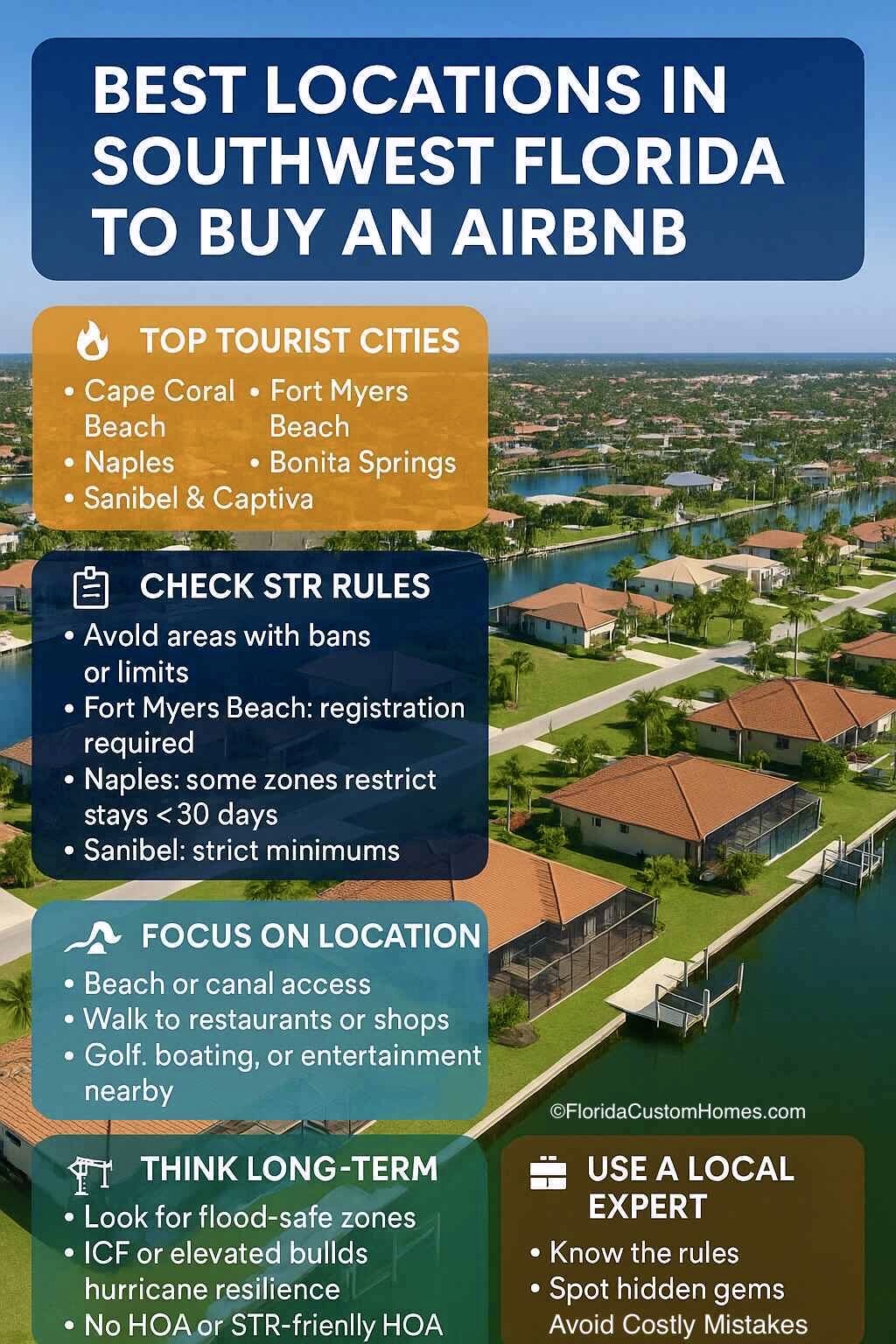
Best Locations in Southwest Florida to Buy an Airbnb

How to Choose the Best Locations in Southwest Florida to Purchase an Airbnb

Author: Scott Meadows, Florida Real Estate Expert | FloridaCustomHomes.com

🧭 Step-by-Step Guide to Choosing the Best Airbnb Location in Southwest Florida

1. Target High-Traffic Tourist Areas

Focus on areas that attract year-round tourists—especially during winter and spring. These spots tend to command higher occupancy and rates.

  • Cape Coral – Waterfront canal homes for boating enthusiasts.
  • Fort Myers Beach – Always in demand for beach vacations.
  • Naples – Luxury market with strong snowbird activity.
  • Sanibel & Captiva Islands – High nightly rates, limited availability.
  • Bonita Springs – Golfers and beachgoers alike love it.
  • Punta Gorda – Historic charm and growing airport activity.
  • Marco Island – Luxury market with strong, steady demand.

2. Check Local STR Regulations

Some municipalities restrict short-term rentals (STRs). Always verify the latest zoning and permitting laws before you buy.

  • Fort Myers Beach: registration and zoning required.
  • Naples: limits STRs under 30 days in some zones.
  • Cape Coral: typically STR-friendly, but verify.
  • Sanibel: strict STR rules with longer minimum stays.

3. Prioritize Waterfront or Walkability

Guests love water views and walkable access to restaurants, shopping, or beaches. These homes command a premium.

4. Consider Seasonality and Occupancy Rates

Southwest Florida’s high season is December–April. Look for properties with amenities that attract guests in slower months, such as heated pools, pet-friendliness, or boat access.

Use tools like: AirDNA, Mashvisor, or PriceLabs for performance data.

5. Factor in Flood Zones and Insurance Costs

Many desirable homes are in FEMA-designated flood zones (AE or VE), which can increase your insurance costs. When possible, target Zone X or elevated/new construction homes.

6. Look for Local Infrastructure Investments

  • Fort Myers Beach seawall and utility upgrades
  • Naples waterfront and pier restorations
  • Punta Gorda airport expansion and downtown growth
  • Legacy Harbour Marina redevelopment

7. Choose the Right Property Type

  • 3–5 Bedroom pool homes
  • Condos with STR approval
  • Waterfront homes with docks
  • ICF or elevated builds with hurricane resilience

8. Work With a Local Realtor Experienced in Airbnb Properties

Choose an agent who understands Airbnb regulations, ROI expectations, and property management referrals—and can help you identify homes that meet your goals and local codes.

📈 Southwest Florida Airbnb Investment ROI Examples

City Avg Nightly Rate Occupancy Rate Est. Monthly Revenue Notes
Cape Coral $190–$280 65–80% $3,500–$6,500 Popular with boaters, year-round income
Fort Myers Beach $300–$450 70–85% $6,000–$9,000 Check STR compliance before purchase
Naples $350–$550 60–75% $6,500–$10,000+ Luxury traveler demand, especially in season
Bonita Springs $250–$400 60–80% $4,500–$8,000 Beach + golf appeal
Sanibel/Captiva $400–$600 60–70% $7,000–$10,000+ Low inventory, high nightly rates
Punta Gorda $175–$275 60–75% $3,000–$5,500 Increasing tourism, historic charm
Marco Island $350–$550 65–80% $6,500–$10,000+ Luxury beachfront market

🧠 Final Tips for Airbnb Success in Southwest Florida

  • Hire a trusted vacation rental manager
  • Use dynamic pricing tools like PriceLabs or Wheelhouse
  • Invest in guest experience: pool, high-speed Wi-Fi, beach gear
  • Use professional photos, drone footage, and SEO listings
  • Consider a 1031 exchange to defer taxes on sale

📞 Need Help Finding an Airbnb Property in SWFL?

I specialize in helping investors find hurricane-resistant, short-term rental–friendly homes across Southwest Florida — including Cape Coral, Naples, Fort Myers Beach, Bonita Springs, and Marco Island.

Let’s find your next income-generating paradise.

Scott Meadows
Florida Real Estate Expert
www.FloridaCustomHomes.com
📞 (239) 220-1157
📧 ScottMeadows3@gmail.com

Posted in Airbnb, Investments
Sept. 4, 2025

What’s New on the National Housing Emergency—and How It Could Help You as a Homeowner

National Housing Emergency Update

What’s New on the National Housing Emergency—and How It Could Help You as a Homeowner

By Scott Meadows, Florida Custom Homes
REALTOR® – New Construction & Hurricane-Resilient Homes Specialist


Introduction: Where Things Stand Now

In early September 2025, Treasury Secretary Scott Bessent revealed that the Trump administration is actively considering declaring a national housing emergency to tackle soaring housing costs and scarce supply. He characterized the situation as an “all‑hands‑on‑deck” crisis, signaling the possibility of sweeping executive actions to make housing more affordable and accessible.

This proposed declaration could trigger several measures aimed at easing the burden on homebuilders and buyers alike—such as standardizing permitting and zoning processes, reducing construction material costs via tariff relief, and promoting greater efficiency in construction.

If you're a prospective buyer or homeowner weighing the current market—this development could bring meaningful benefits, both immediately and over time.


Part 1: What Recent Updates Bring to the Table

1. Emergency Declaration – A Game Changer

The administration is exploring the use of the 1976 National Emergencies Act to bypass standard legislative hurdles. This could empower federal agencies to implement rapid changes to address supply constraints and affordability.

2. Tariff Relief on Building Materials

Rising costs for materials like steel, copper, aluminum, and lumber have made new construction increasingly expensive. Lifting tariffs could significantly reduce costs for builders—savings that may be passed on to buyers.

3. Streamlining Permits & Zoning

By removing red tape in the approval process, the administration hopes to accelerate housing construction across the country. In Florida, where growth is strong, this could mean thousands of new units hitting the market sooner.

4. Building Code Standardization & Cost Reductions

Efforts to unify building codes and reduce closing costs aim to improve consistency in construction while easing financial burdens on buyers—particularly first-time and moderate-income purchasers.

5. What the Experts Say About Timing

Experts caution that while these moves are promising, they’re not instant fixes. Tangible improvements in affordability may take 1–4 years, depending on mortgage rates, labor availability, and regulatory implementation.


Part 2: How Potential Homeowners Could Benefit

1. Reduced Builder Costs Could Lower Prices

Tariff relief on imported materials can reduce construction costs, potentially bringing down list prices—especially in new developments where material cost is a major factor.

2. Faster Inventory Growth

With streamlined permitting and zoning, new homes could enter the market faster. This increase in supply would provide buyers with more options, reduce bidding wars, and stabilize pricing.

3. Predictable Quality Through Code Standardization

Unified building codes would provide consistency in construction quality and safety—especially beneficial for buyers in regions prone to hurricanes or flooding like Southwest Florida.

4. Lower Upfront Costs

Reductions in closing costs and government fees would make homeownership more accessible, particularly for first-time buyers who often face significant upfront expenses.

5. Gradual Return to Affordability

If mortgage rates decline in 2026–2027 and home prices stabilize, affordability could improve for the first time since 2020. Buyers who prepare now may find better opportunities as conditions normalize.


Your Homebuying Playbook: Practical Steps

  • Stay Informed: Follow updates on housing policy and economic conditions that impact affordability.
  • Get Pre-Approved: Lock in favorable loan terms before rate volatility returns.
  • Explore New Construction: Builders may begin offering incentives as costs decline and competition increases.
  • Work with a Specialist: Choose a real estate agent familiar with local zoning, builder quality, and storm-resilient home construction.
  • Plan Long-Term: If you're not ready to buy now, use this time to strengthen your financial position and understand evolving market dynamics.

Part 3: Summary of Buyer Benefits

Proposal How It Helps Homebuyers
Tariff Relief on Materials Lowers build costs → more competitively priced new homes
Streamlined Permitting Faster inventory growth → less competition among buyers
Standardized Codes Predictable safety and quality → confidence in construction
Closing Cost Reductions Less upfront cash needed → easier path to ownership
Market Stabilization Long-term affordability improvements → better purchasing power

Final Thoughts

The proposed National Housing Emergency isn’t just a federal buzzword—it could bring real opportunities for homeowners and buyers. By addressing the core issues of cost, time, and supply, the proposal may pave the way for a more accessible market in Florida and beyond.

For buyers, the message is clear: stay ready. As reforms roll out, those who are prepared will have the best shot at taking advantage of new listings, favorable pricing, and mortgage opportunities.

Sept. 3, 2025

Why Real Estate Investors Love Tampa: A Comprehensive Guide

Why Real Estate Investors Love Tampa Florida

Why Real Estate Investors Love Tampa: A Comprehensive Guide

Published by Scott Meadows – Florida Custom Homes

Introduction

Tampa, Florida, has emerged as one of the most compelling markets for residential real estate investors in 2025. From sustained population growth to dynamic infrastructure improvements, this Gulf Coast city offers a unique blend of affordability, cash flow potential, and long-term appreciation. In this deep dive, we explore the multiple layers of what makes Tampa so attractive—ideal for SEO targeting keywords like Tampa real estate investors, best places to invest Florida, and Tampa rental demand.

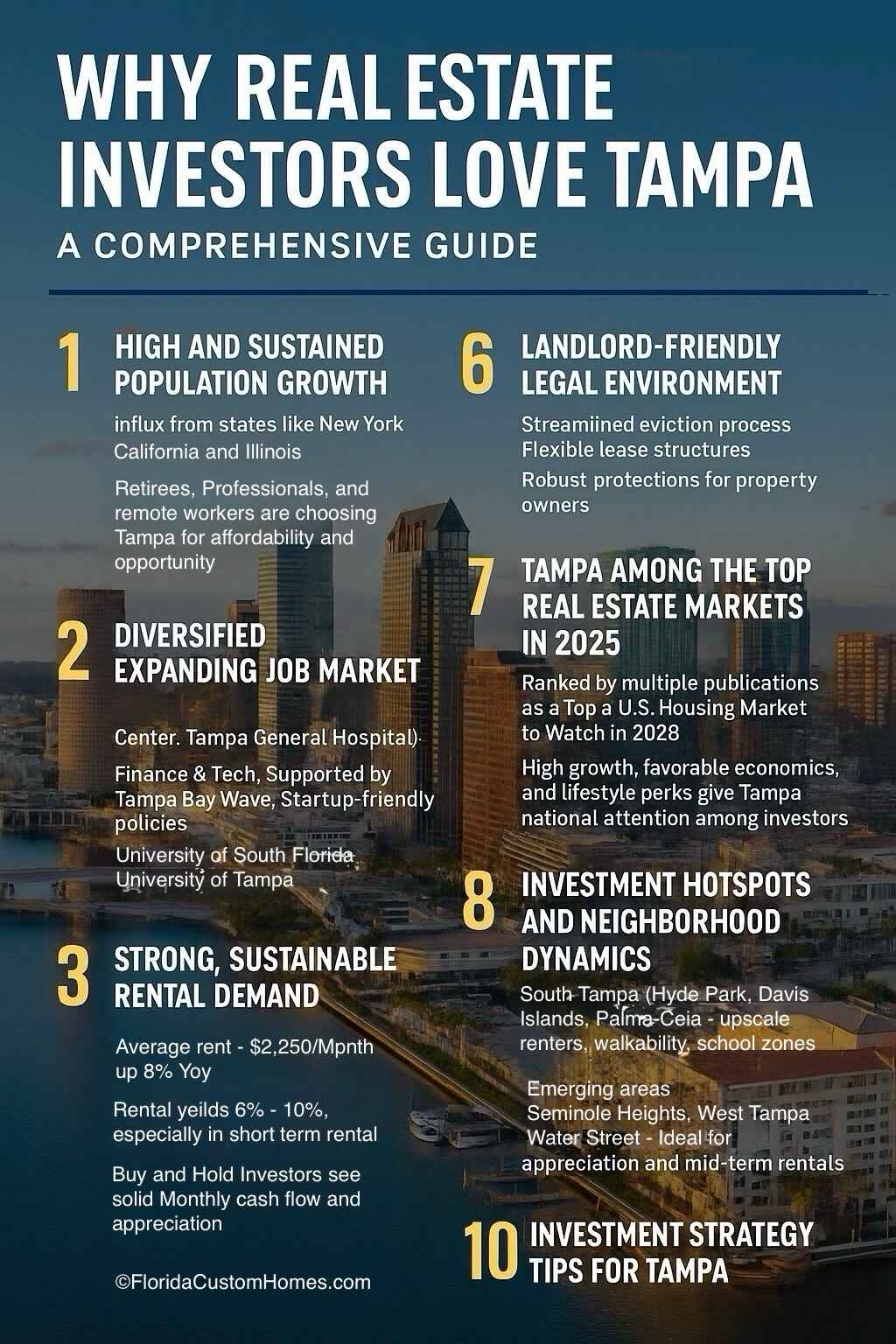
1. High and Sustained Population Growth

  • Tampa gained over 51,000 new residents between 2022 and 2023.
  • Influx from states like New York, California, and Illinois.
  • Retirees, professionals, and remote workers are choosing Tampa for its affordability and opportunity.

This consistent growth fuels housing demand—ideal for both homebuyers and investors.

2. Diversified, Expanding Job Market

  • Healthcare: Moffitt Cancer Center, Tampa General Hospital.
  • Finance & Tech: Supported by Tampa Bay Wave and startup-friendly policies.
  • Education: University of South Florida, University of Tampa.
  • Corporate Employers: Bloomin’ Brands, Mosaic, WellCare.

Diverse industries ensure long-term housing and rental demand stability.

3. Strong, Sustainable Rental Demand

  • Average rent: ~$2,250/month, up 8.5% YoY.
  • Rental yields: 6%–10%, especially in short-term rental zones.
  • Buy-and-hold investors are seeing solid monthly cash flow and appreciation.

4. Relative Affordability, Especially Among Florida Markets

Tampa is a value standout among Florida metros:

  • Median home price: $375,673 (lower than Miami, Naples).
  • Investors gain more property per dollar.
  • Great entry point for new or out-of-state investors.

5. Ongoing Infrastructure and Development Projects

  • $1.3B Howard Frankland Bridge replacement to ease traffic.
  • I-275 Express Lane expansion improves commute times.
  • Water Street Tampa: $3B WELL-certified mixed-use project adding 3,500 residences.
  • Tampa Riverwalk Expansion: Adding 6 miles of pedestrian space.

These projects increase livability—and long-term property values.

6. Landlord-Friendly Legal Environment

  • Streamlined eviction process.
  • Flexible lease structures.
  • Robust protections for property owners.

7. Tampa Among the Top Real Estate Markets in 2025

Ranked by multiple publications as a Top 5 U.S. Housing Market to Watch in 2025. High growth, favorable economics, and lifestyle perks give Tampa national attention among investors.

8. Investment Hotspots and Neighborhood Dynamics

  • South Tampa: Hyde Park, Davis Islands, Palma Ceia – upscale renters, walkability, school zones.
  • Emerging Areas: Seminole Heights, West Tampa, Water Street – ideal for appreciation and mid-term rentals.

9. Risks to Factor In

  • Climate risk: Flooding, hurricanes.
  • Insurance: Premiums can be high in coastal zones.
  • Property taxes: Must be factored into cash flow analysis.

Smart investors mitigate these by selecting resilient properties and proper coverage.

10. Investment Strategy Tips for Tampa

  1. Focus on micro-markets with growth potential.
  2. Work with local experts (agents, managers).
  3. Prioritize long-term value over short-term flips.
  4. Account for HOA, insurance, maintenance.
  5. Use remote investing platforms if out-of-state.

Why Tampa, Florida?

Tampa offers real estate investors a powerful mix of affordability, growth, stability, and demand. With rising infrastructure, national attention, and resilient economic foundations, it's an ideal market for both new and seasoned investors in 2025.

Thinking of investing in Tampa real estate? Let Scott Meadows and his expert team at Florida Custom Homes guide you to the best opportunities across Tampa and Gulf Coast Florida.

📞 Call Scott today: 239.220.1157
📧 Email: ScottMeadows3@gmail.com
🌐 Visit: www.FloridaCustomHomes.com

Sept. 2, 2025

Top Performing Real Estate Markets in Southwest Florida – Late 2025 Update

Top Performing Real Estate Markets in Southwest Florida Late 2025

Top Performing Real Estate Markets in Southwest Florida – Late 2025 Update

Author: Scott Meadows, Florida Custom Homes
Email: ScottMeadows3@gmail.com | Phone: 239.220.1157 | Website: FloridaCustomHomes.com

As 2025 winds down, the real estate landscape in Southwest Florida is shifting in dynamic ways. While some markets are cooling due to rising inventory and insurance concerns, others remain strong thanks to luxury demand, affordability, or desirable waterfront access. Whether you're a buyer looking for value, a seller seeking leverage, or an investor tracking growth, understanding which areas are thriving is essential.

Why Southwest Florida Real Estate Matters in 2025

From Naples to Punta Gorda, Southwest Florida continues to attract buyers from across the country for its lifestyle, climate, tax advantages, and waterfront living. But markets within this region are behaving very differently depending on price segment, location, and property type.

Based on current data and trends through Q3 2025, here are the regions performing best across the Gulf Coast corridor.

1. Naples: Resilience in the Ultra-Luxury Sector

Market Type: Luxury Seller’s Market

Naples remains Florida’s crown jewel for ultra-luxury buyers. With median prices in Port Royal surpassing $16.4 million and record-breaking private sales topping $225 million, the area continues to attract elite buyers looking for exclusivity and privacy. Naples is also considered a “Blue Zone” city, ranking high in lifestyle appeal for retirees and high-net-worth individuals.

  • Recent High Sale: $85M Bayfront listing sold in late July 2025
  • Buyer Profile: Billionaires, CEOs, foreign investors, hedge funds
  • Inventory: Still low for custom estates; high demand for teardown lots

2. Cape Coral: One of Florida’s Top Buyer’s Markets

Market Type: Buyer’s Market with Inventory Advantage

Cape Coral continues to make headlines in 2025 as one of Florida’s most favorable buyer’s markets. Zillow lists Cape Coral among the top 10 U.S. cities where buyers hold strong negotiating power. Inventory is up, and price corrections have made waterfront homes far more accessible than Naples or Marco Island.

  • Median Sale Price: ~$429,000 (down from 2022 peaks)
  • Key Features: Gulf-access canals, low flood-risk zones, new construction surge
  • Popular Areas: NW Cape (new construction), SE Cape (established waterfront)

3. Fort Myers: Consistent Growth with Investment Potential

Market Type: Balanced with Strong Waterfront Demand

Fort Myers offers a well-rounded market in 2025—new developments, historic charm, and waterfront investment potential. Downtown continues to gentrify while the Iona-McGregor area offers luxury riverfront opportunities. The city’s resilience post-Hurricane Ian has drawn attention from developers and investors alike.

  • Trend: Strong interest in elevated, hurricane-resilient new construction
  • Key Buyer Group: Out-of-state investors, young retirees, boaters
  • Outlook: Poised for continued appreciation as infrastructure rebounds

4. Punta Gorda: High Turnover and Mobility

Market Type: Fast-Moving Market

According to HouseCanary’s 2025 housing predictions, Punta Gorda has one of the highest listing turnover rates in the U.S. at 3.1%. The area benefits from a mix of affordability, boating access, and retiree appeal. Its small-town charm, marinas, and downtown restaurants create a lifestyle magnet for snowbirds and remote workers.

  • Affordability: More accessible than Collier and parts of Lee County
  • Key Neighborhoods: Burnt Store Isles, Punta Gorda Isles, Downtown PG

5. Charlotte & Lee Counties: Affordability and Opportunity

Market Type: Affordable and Active

With Collier County's Housing Affordability Index (HAI) well below 1.0, nearby Lee and Charlotte Counties offer much-needed relief. Fort Myers, Lehigh Acres, and Port Charlotte offer better affordability without sacrificing proximity to coastlines, highways, and hospitals.

  • HAI in Lee County: ~1.02 as of Q1 2025
  • Builder Activity: High in Lehigh Acres, NW Cape Coral, North Fort Myers
  • Investment Focus: Rental property demand increasing in inland areas

6. Non-Coastal Neighborhoods & Commercial Corridors

Market Type: Stable and Growing

While waterfront and luxury homes grab headlines, the true backbone of Southwest Florida’s 2025 market growth lies inland. Non-coastal areas like Estero, Golden Gate Estates, and south Cape Coral are benefiting from job growth and new commercial developments.

  • Notable Developments: The Grove in Cape Coral, expansion of I-75 corridor
  • Sectors to Watch: Industrial, medical, logistics, and hospitality real estate

Summary Table: Top Performing Areas in Southwest Florida (Late 2025)

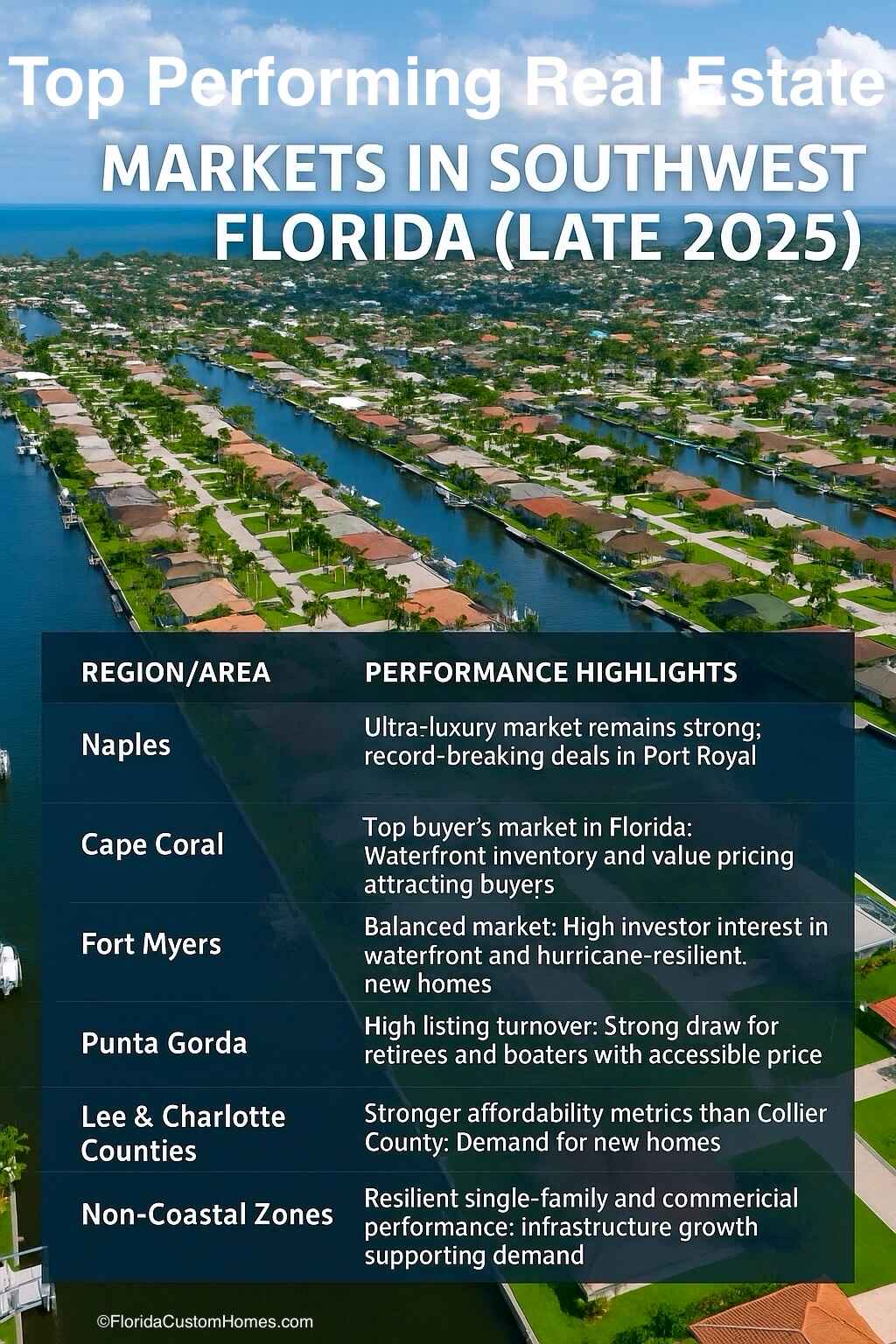
Region/Area Performance Highlights
Naples Ultra-luxury market remains strong; record-breaking deals in Port Royal and beachfront areas
Cape Coral Top buyer’s market in Florida; waterfront inventory and value pricing attracting buyers
Fort Myers Balanced market; high investor interest in waterfront and hurricane-resilient new homes
Punta Gorda High listing turnover; strong draw for retirees and boaters with accessible pricing
Lee & Charlotte Counties Stronger affordability metrics than Collier; demand for new homes remains high
Non-Coastal Zones Resilient single-family and commercial performance; infrastructure growth supporting demand

What This Means for Buyers, Sellers, and Investors

🏠 Buyers

Now is a favorable time to act in buyer-driven markets like Cape Coral and inland Lee County. You’ll benefit from pricing leverage and selection, especially if you’re open to new construction or off-water properties.

🏠 Sellers

If you're selling in Naples or Sarasota’s luxury tier, you may still command top dollar. In mid-range markets, price competitively and highlight upgrades, hurricane protection, or newer roofs/windows.

🏠 Investors

Look toward inland growth corridors, waterfront lots in Cape Coral, and properties in fast-moving markets like Punta Gorda. Long-term value creation hinges on location, hurricane resilience, and rental demand trends.

Ready to Make a Move in Southwest Florida?

Whether you're buying your dream home, investing in waterfront property, or selling a Southwest Florida estate, Scott Meadows & Team at Florida Custom Homes offers over 30 years of experience and specialized market insight.

📞 Call Today: 239.220.1157
📧 Email: ScottMeadows3@gmail.com
🌐 Website: FloridaCustomHomes.com

Sept. 2, 2025

Port Royal Naples Real Estate: America’s Crown Jewel for Ultra-Luxury Buyers in 2025–2026

Port Royal Naples Real Estate: America’s Crown Jewel for Ultra-Luxury Buyers in 2025–2026

Port Royal Naples Real Estate: America’s Crown Jewel for Ultra-Luxury Buyers in 2025–2026

By Scott Meadows, Florida Custom Homes
Your Expert on Luxury, Waterfront, and Hurricane-Resilient Properties in Southwest Florida

🏖️ Introduction: Port Royal’s Rise as the Pinnacle of Prestige

When it comes to ultra-luxury coastal real estate in the United States, no name commands more reverence in 2025 than Port Royal in Naples, Florida. With record-breaking home sales, limited inventory, and a reinvigorated sense of exclusivity, this coveted enclave has become a magnet for high-net-worth buyers seeking Gulf-front elegance, tax-friendly living, and architectural excellence.

From a $225 million beachfront compound sale to a recent $85 million bayfront transaction, Port Royal is setting new benchmarks for ultra-prime property performance. This article explores what’s fueling the demand, where prices are heading, and why savvy investors and international elites are all turning their gaze to this one-of-a-kind community.

🌴 What and Where is Port Royal?

Nestled at the southern tip of Naples, Florida, Port Royal is a master-planned, ultra-exclusive waterfront community with approximately 500 custom estates—each uniquely crafted, each anchored to either the Gulf of Mexico or Naples Bay.

Key Highlights:

  • Location: Southernmost Naples, FL
  • Style: British West Indies and Caribbean Colonial architecture
  • Vibe: Private, yachting, serene, and socially prestigious
  • Ownership Benefits: Access to the Port Royal Club (undergoing $100M rebuild, reopening summer 2026)

💰 Record-Breaking Sales Are Redefining Florida Real Estate

🏠 $225 Million Beachfront Sale – The New Gold Standard

In April 2025, a massive off-market compound along Gordon Drive sold for $225 million, setting the highest recorded residential sale in Florida history and second-highest in the U.S. overall.

  • Three Parcels: 2170, 2200, 2340 Gordon Drive
  • Gulf Frontage: Over 800 feet
  • Breakdown: $113.17M + $46.91M + $44.91M
  • Buyer: Undisclosed, speculated to be institutional

🌊 $85 Million Bayfront Home – A Landmark Non-Beachfront Sale

In the same quarter, billionaire David Hoffmann purchased a Naples Bay estate for $85 million, setting a new Collier County record for a non-Gulf-front property.

📊 Market Trends: Pricing, Inventory & Buyer Dynamics

Median Sale Prices in 2025

Month Median Price Year-over-Year Growth
June 2025 $16.4M +32%
July 2025 $16.5M +37.3%
  • Price per Sq Ft: ~$2,350 (up 36%)
  • Median List Price: $19.5M (down 6% YoY)
  • Zillow Home Value Average: ~$13.98M

Inventory, DOM, and Negotiability

  • Active Listings: 35–40
  • Days on Market: 181–230 days
  • Average Sale-to-List Ratio: ~89% (about 11% below asking)

🧭 What’s Driving the Market Surge in Port Royal?

  1. Scarcity: Only ~500 homes, no new land available
  2. Tax Migration: Florida’s no state income tax = major draw
  3. International Demand: From Canada, Europe, South America
  4. Club Renaissance: Port Royal Club’s $100M upgrade boosts value by 5–10%
  5. Architectural Prestige: ICF builds, hurricane-rated, ultra-modern designs

📈 Investment Outlook Through 2026

Property Sector Projected Annual Appreciation
General Port Royal 4–7%
Luxury Waterfront 6–9%
Club-Affiliated Estates +5–10% Premium
Vacant Buildable Lots High Double-Digit Potential

💡 Who’s Buying in Port Royal?

  • Billionaires & CEOs relocating from high-tax states
  • Legacy Investors: Trusts, private offices
  • Renovation Buyers: Rebuilding 1990s-era estates
  • International Buyers: Securing U.S. real estate assets

🌅 Port Royal vs Other Luxury Florida Markets

Location Port Royal Advantages
Palm Beach More laid-back, discreet, Gulf sunsets
Miami Beach Less density, more privacy
Sarasota Keys Prestige difference, deeper yacht access
Marco Island More mid-market by comparison

📍 Notable Streets in Port Royal

Street Highlights
Gordon Drive Gulf-front estates, sunsets, prestige
Rum Row Yacht access, bay views
Spyglass Lane Privacy, wide lots, heritage
Kingstown Dr Walkable, close to Port Royal Club

🔎 Final Thoughts: Port Royal in 2025–2026

Port Royal is more than an address—it’s a global statement of success and refined taste. With historic sales, limited supply, and the rising prestige of the Port Royal Club, this community is poised for sustained growth well into 2026 and beyond.

📞 Contact Scott Meadows Today

Scott Meadows
Florida Custom Homes
📱 239.220.1157
📧 ScottMeadows3@gmail.com
🌐 FloridaCustomHomes.com

Let’s turn your luxury vision into reality—confidentially, professionally, and with precision.

Sept. 2, 2025

What Is the National Housing Emergency and How Will It Impact Real Estate?

What is the National Housing Emergency?

What Is the National Housing Emergency and How Will It Impact Real Estate?

By Scott Meadows, Florida Custom Homes

With over 30 years of experience in Florida real estate and new construction, I specialize in helping homebuyers navigate changing markets—especially when policy shifts like this reshape the landscape.


Introduction: What’s the National Housing Emergency?

In September 2025, the Trump administration announced it was weighing a bold and unprecedented move: declaring a National Housing Emergency in response to soaring housing costs, severe inventory shortages, and rising interest rates that have locked many buyers out of the market. Read more about What's New on The National Housing Emergency...

Described as an “all hands on deck” effort by U.S. Treasury Secretary Scott Bessent, this initiative could dramatically reshape how housing is built, regulated, and financed across America. But what does this mean for homebuyers, builders, and local governments?

This article breaks it all down—covering what the emergency entails, the proposed solutions, potential legal and political challenges, and what buyers should expect in 2025–2026.


What Is Being Proposed?

The National Housing Emergency would be enacted using the 1976 National Emergencies Act, which grants the executive branch special authority to bypass Congress in times of crisis. While typically used for national security or public health threats, the administration is positioning the housing crisis as an economic emergency deserving the same urgent response.

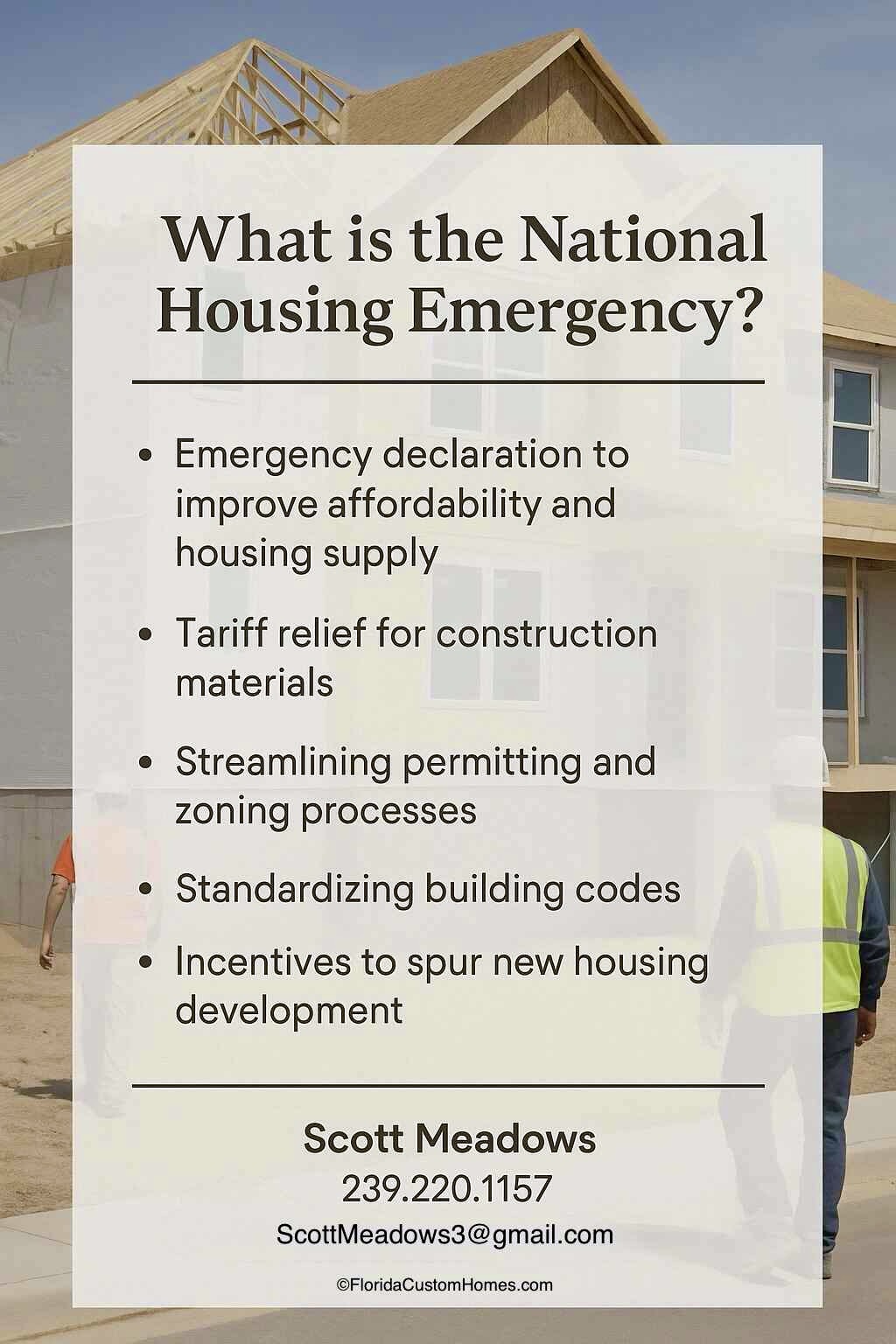
Here are the core components of the proposal:

  • Emergency declaration to activate executive powers and bypass bureaucratic delays
  • Tariff exemptions on critical building materials like steel, copper, and lumber to reduce construction costs
  • Streamlining local permitting and zoning to accelerate housing development nationwide
  • Standardizing building codes to encourage scalable and efficient development
  • Potential incentives to boost private-sector housing supply

Why Is This Happening Now?

As of late 2025, housing affordability has reached a crisis point:

  • Home prices remain historically high despite slower sales
  • Mortgage rates above 7% have dramatically reduced purchasing power
  • Inventory is severely constrained, particularly for entry-level homes
  • New home construction is facing material cost inflation and regulatory red tape

The administration sees this as not only an economic issue—but a political one. With midterm elections approaching, the housing crisis is now center stage, and the emergency declaration is expected to serve both practical and strategic purposes.


In-Depth Look: Policy Measures Under Consideration

1. Tariff Relief on Building Materials

To reduce the cost of construction, the administration is considering temporary suspension of tariffs on steel, copper, aluminum, and lumber. This could help builders control costs, speed up projects, and pass savings along to buyers—especially in high-growth regions like Florida, Texas, and the Sunbelt.

2. Zoning and Permitting Reform

One of the most ambitious elements involves federal intervention in local zoning and permitting processes. The goal is to eliminate barriers to high-density, multifamily, and affordable housing in areas that traditionally block such development through NIMBY (“Not In My Back Yard”) restrictions.

This could resemble prior proposals like the “Yes In My Backyard” (YIMBY) Act, but with far greater authority due to the emergency framework.

3. National Building Code Standardization

The plan may include creating a unified set of standards for building codes, safety regulations, and environmental assessments to remove regional disparities that delay projects. While controversial, this could streamline processes for national builders and make compliance easier for local governments.

4. Incentivizing Housing Supply Growth

To spur private-sector development, incentives such as tax breaks, grants, or fast-track approvals could be on the table. These would likely target developers who agree to build within affordability guidelines or contribute to mixed-income housing strategies.


Legal and Political Landscape

Executive Power Under Scrutiny

While the National Emergencies Act grants broad authority, its use in domestic real estate matters could trigger lawsuits. Legal experts note that courts could block elements they deem unconstitutional or in conflict with local jurisdiction rights.

Local Government Pushback

City councils and county planning boards may resist federal intrusion into land-use planning. Efforts to override local zoning laws—especially in high-income or suburban areas—will be met with political and legal resistance.

Congressional Oversight

Although emergency declarations can be issued unilaterally, Congress retains the power to end them via joint resolution. If the administration overreaches, bipartisan resistance could surface quickly—particularly from lawmakers representing states with strong local control traditions.


Implications for Homebuyers

If enacted, the National Housing Emergency could produce meaningful benefits for buyers in the short- and medium-term:

  • Lower construction costs → lower home prices, especially for new builds
  • Faster permitting → quicker inventory growth in hot markets
  • Standardized codes → more consistency and clarity for new home purchases
  • Possible increase in affordable housing → expanded access for first-time buyers

That said, the real estate market is complex. Buyers should continue to evaluate properties based on fundamentals: location, build quality, hurricane resilience, flood risk, and long-term property value potential.


Potential Risks and Downsides

  • Federal overreach into local zoning may alienate communities
  • Legal battles could delay or derail implementation
  • Unintended consequences if policies are rushed or poorly coordinated
  • Temporary tariff relief may not translate to sustained affordability

Additionally, many advocates fear that HUD program cuts currently being pursued by the same administration could undermine gains made through the emergency housing order. Programs supporting rental assistance and homelessness prevention are reportedly on the chopping block, raising concerns about equity and long-term impact.


Summary Table: National Housing Emergency Measures

Measure Description
Emergency Declaration Activate federal emergency powers for housing reform
Tariff Exemptions Reduce material costs for construction via tariff relief
Permitting & Zoning Reform Accelerate building timelines through streamlined processes
National Code Standardization Create unified building and safety codes
Supply Incentives Encourage new builds through tax breaks and regulatory relief

What Buyers Should Do Right Now

Whether or not the National Housing Emergency is declared, one thing is clear: the real estate landscape is changing fast. Buyers in Florida and other fast-growing regions should:

  • Work with a knowledgeable agent who understands local zoning and code compliance
  • Stay informed about policy shifts that affect permitting and pricing
  • Focus on homes with hurricane-resilient design and low-flood-risk locations
  • Secure financing early before potential interest rate hikes or regulatory changes

Final Thoughts

The National Housing Emergency proposal is bold, controversial, and still evolving. While it holds promise to ease affordability and jumpstart development, it comes with legal and political hurdles that will take months—if not years—to fully play out.

For now, smart buyers should pay close attention, prepare for both opportunity and volatility, and rely on expert guidance when navigating this shifting terrain.


About the Author

Scott Meadows is a seasoned Florida REALTOR® with 30+ years of experience helping homebuyers secure high-quality, hurricane-resilient homes in Southwest Florida. His firm, Florida Custom Homes, specializes in new construction, waterfront properties, and code-compliant real estate investments.

Contact Scott Meadows:
Phone: 239.220.1157
Email: ScottMeadows3@gmail.com
Website: www.FloridaCustomHomes.com

Sept. 1, 2025

Naples Florida Housing Market Shows Resilience in 2025: July Update & Analysis

Naples Real Estate 2025

Naples Florida Housing Market Shows Resilience in 2025: July Update & Analysis

Author: Scott Meadows, Florida Custom Homes | Contact: ScottMeadows3@gmail.com | 239.220.1157


Introduction: Naples Market Defies Expectations in 2025

Despite rising inventory and cooling prices in other areas of Southwest Florida, the Naples Florida housing market in 2025 is showing remarkable resilience. Recent data from July 2025 shows strong buyer activity, stable home prices, and continued interest in luxury properties—defying the broader national trend of real estate market slowdowns. This article explores what’s driving the strength of the Naples market, where trends are heading, and what it means for both buyers and sellers.


Naples Housing Market Overview – July 2025

The latest data from Downing-Frye and the Naples Area Board of REALTORS® paints a clear picture: the Naples real estate market remains active and attractive, particularly to well-capitalized buyers. Here are the key highlights from July 2025:

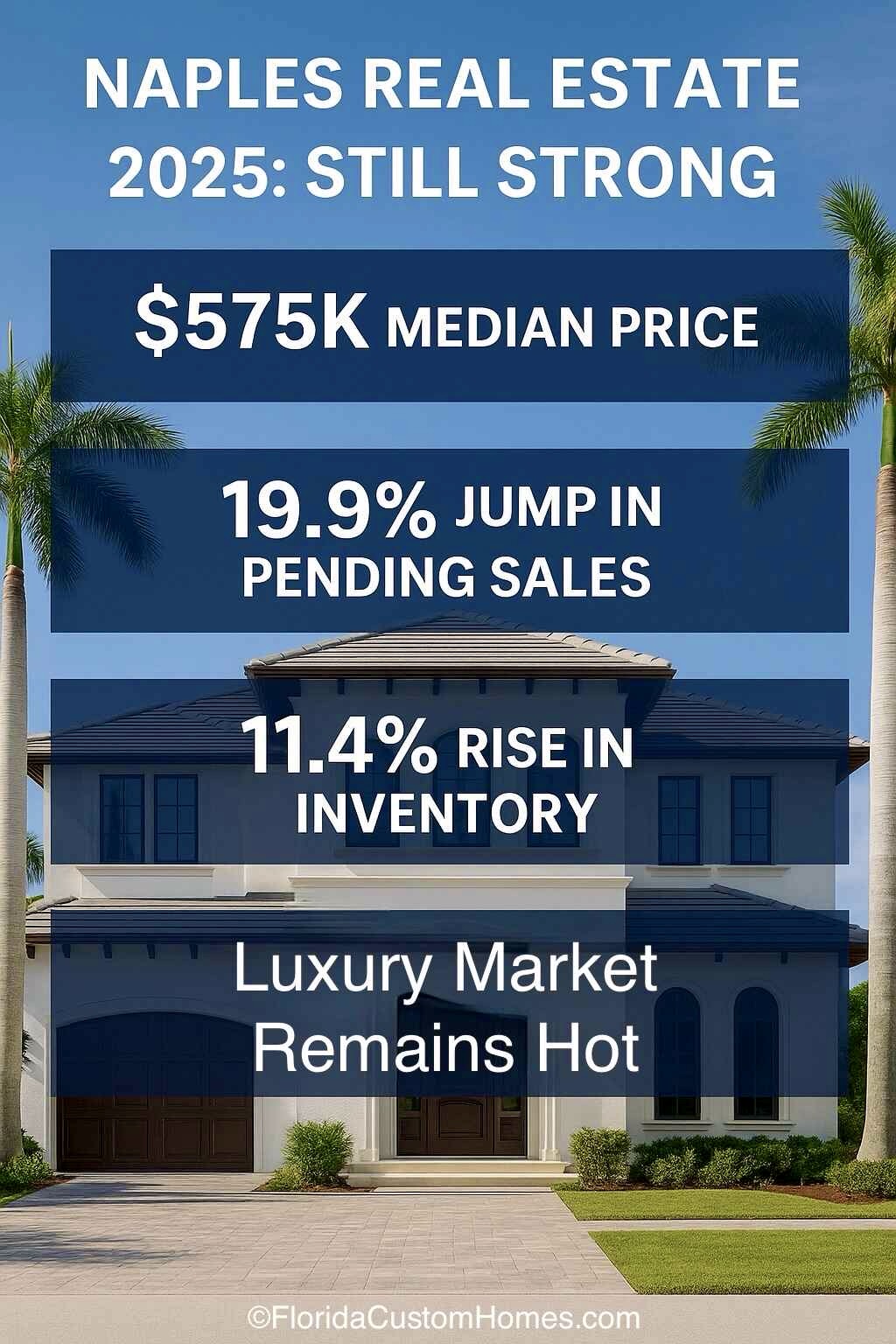
  • Pending sales: Up 19.9% year-over-year, with 807 new contracts signed.
  • Inventory: Up 11.4%, reaching 5,224 active listings.
  • Closed sales: Increased 2%, totaling 624 properties sold.
  • Median closed price: Slight dip to $575,000 (down 3% YoY).
  • Average days on market: Increased to 102 days, up 26% YoY.

While homes are taking longer to sell and prices have softened slightly, buyer demand remains robust, especially for properties in desirable locations.


Luxury Home Market in Naples: A Bright Spot

The luxury segment in Naples continues to outperform, proving that Naples remains a magnet for high-net-worth buyers. In July 2025 alone:

  • Nearly $598 million in luxury real estate was sold.
  • 147 properties closed above the $1 million mark.
  • 90% of top sales were west of U.S. 41, near the beach.
  • 50% of luxury homes sold were built within the past 4 years.
  • The top sale? A $10.5 million new construction home in Park Shore.

These numbers reflect the consistent appetite for new, modern, hurricane-resilient construction in elite neighborhoods like Port Royal, Aqualane Shores, Moorings, and Olde Naples.


Inventory Trends: More Choices for Buyers

Inventory levels have continued to rise in Naples, giving buyers more options than they’ve had in recent years. As of July:

  • Inventory increased by 11.4% YoY to 5,224 active listings.
  • Months’ supply of inventory: Approaching 10.7 months.
  • Average list-to-sold ratio: Most homes sold below asking price.

This expansion in inventory has shifted leverage slightly in favor of buyers, especially those who are patient and strategic with their offers.


Price Stability: Naples Outperforms the Region

While other parts of Southwest Florida have seen more pronounced price corrections, Naples has maintained strong price support. Here’s a comparison of median prices and YoY changes:

City Median Price Year-over-Year Change
Naples $570,000 0%
Bonita-Estero $495,000 -11.6%
Fort Myers $335,000 -8.2%

Naples is clearly outperforming its regional neighbors, thanks to its higher-income buyer base, luxury inventory, and long-term desirability.


What’s Driving Naples Housing Market Resilience?

Several key factors help explain why the Naples housing market remains strong in 2025:

1. Influx of Wealthy Buyers

Naples is increasingly considered the “Palm Beach of the Gulf Coast.” Ultra-wealthy individuals, especially from the Northeast and Midwest, are flocking to Naples for its tax benefits, low crime, beach proximity, and privacy. Many buyers fly in using private aviation hubs like Naples Municipal Airport.

2. Luxury New Construction

New builds—especially those compliant with modern Florida Building Codes—are highly attractive. Homes built post-Hurricane Irma or Ian are viewed as safer and more insurable, particularly those with elevated foundations, ICF walls, and impact-resistant windows.

3. Climate Resilience & Elevation

Compared to areas like Fort Myers Beach, Naples homes west of US-41 tend to sit on slightly higher ground and have better stormwater management systems. This adds perceived value and mitigates insurance challenges.

4. Lifestyle and Amenities

From golf and boating to fine dining and art galleries, Naples continues to offer unmatched lifestyle appeal. Coupled with world-class healthcare and gated-community living, it remains one of the most desirable coastal towns in the U.S.


Buyer's Market Signals (But Not a Crash)

Although Naples remains stable, signs of a shifting market are emerging:

  • Buyers are negotiating more aggressively.
  • More listings are lingering past 90+ days.
  • Sellers are increasingly offering concessions (e.g., rate buydowns).

Yet, there’s no crash on the horizon—just a normalization. Naples skipped the volatility seen elsewhere due to its high proportion of cash buyers (61%+) and limited exposure to speculative investments.


Who’s Buying in Naples Right Now?

Recent trends show a diverse range of buyer profiles:

  • Cash-rich retirees relocating full-time from colder states.
  • Second-home buyers investing in winter retreats.
  • High-net-worth investors hedging against inflation and market volatility.
  • Remote professionals prioritizing Florida’s lifestyle and no state income tax.

These buyer segments remain mostly unaffected by higher mortgage rates, which is why Naples hasn’t felt the sting of 7%+ interest rates like more finance-dependent markets.


Forecast for the Rest of 2025

Looking ahead to Q4 2025 and early 2026, the Naples real estate market is expected to remain steady:

  • Inventory may climb slightly, offering more selection.
  • Luxury demand will remain firm, especially in Park Shore, Moorings, and Olde Naples.
  • Price appreciation may flatten, but large corrections are unlikely barring major macroeconomic shifts.
  • If the Fed cuts interest rates, new demand could emerge from sidelined buyers.

The key takeaway? Naples is not crashing—it's balancing.


Work with a Naples Real Estate Expert

Are you exploring your options in the Naples housing market? Whether you're a buyer seeking a luxury coastal estate or a seller looking to maximize your property's value in this dynamic 2025 market, local expertise is essential.

📞 Contact Scott Meadows & Florida Custom Homes

Scott Meadows is a seasoned REALTOR® with over 30 years of experience in Southwest Florida’s luxury and new-construction markets. He specializes in:

  • Naples Hurricane-resilient homes
  • Naples New construction & ICF design
  • Naples Waterfront & elevated properties
  • Naples Buyer and seller representation
  • Naples Luxury Homes and Real Estate

📧 Email: ScottMeadows3@gmail.com
📱 Phone: (239) 220‑1157
🌐 Website: www.FloridaCustomHomes.com


For the latest updates on the Naples housing market, Southwest Florida real estate trends, and luxury home opportunities, follow our blog at FloridaCustomHomes.com.

Aug. 31, 2025

Lessons from Hurricane Ian: How Southwest Florida Is Building a More Resilient Future

Lessons from Hurricane Ian

Lessons from Hurricane Ian: How Southwest Florida Is Building a More Resilient Future

By Scott Meadows, Florida Custom Homes

When Hurricane Ian devastated Southwest Florida in September 2022, it inflicted nearly unimaginable damage—nearly $112 billion in total economic losses, thousands of homes destroyed, and lives upended. Yet in the storm’s ruins, a powerful narrative emerged: the warning that the future of Florida’s coastal communities hinges on resilience, not rebuilding what was broken.

This article explores how Southwest Florida has responded—with smarter codes, stronger construction, thoughtful planning, environmental defenses, cutting-edge communities, and programs designed to reinforce both infrastructure and equity. Together, these actions reflect a powerful paradigm shift: preparing for storms, not just dreading them.


1. Reinforcing Building Standards: Codes That Save Lives

Florida’s modern building codes have been tested and vindicated during Ian. Homes constructed after 2002—especially those built under the 7th Edition of the Florida Building Code (effective as of December 2020)—withstood wind and surge far better than older homes. In one Fort Myers neighborhood, a 2022-built home survived nearly unscathed while nearby pre‑2002 homes were destroyed.

Key lessons from FEMA's Mitigation Assessment Team (MAT) include:

  • Elevation Saves: Elevated homes suffered dramatically less flooding. Seventy‑percent of NFIP claims originated from non‑elevated buildings.:contentReference[oaicite:2]{index=2}
  • Newer is Better: Average insured damages for homes built post‑2010 were over two‑thirds lower than those for pre‑1980 homes.
  • Actual Structural Integrity: FEMA observed no wind‑related structural failures among post‑FBC homes.

In response, Florida continues to enhance code resilience. Developers are expecting stronger standards for wind loading, reinforced roof attachments, impact-resistant glazing, and flood elevation—especially in high‑wind zones.


2. Community-Level Resilience and Smart Planning

Beyond individual homes, Southwest Florida is building smarter neighborhoods. The planned solar town of Babcock Ranch exemplifies climate-conscious design: elevated 30 feet above sea level, powered by solar infrastructure, and equipped with underground utilities and advanced drainage. During Ian, Babcock Ranch remained powered and functional while surrounding towns were crippled.

Similarly, the net‑zero housing community Hunters Point in Cortez features metal straps, flood vents, and high-performance insulation. Homes here not only survived consecutive hurricanes—Ian and Idalia—but also earned insurance coverage thanks to their superior build.

These planned communities demonstrate how resilience and sustainability can coexist. Yet there's growing concern: such safe havens often cater to wealthier buyers, leaving lower-income residents of older housing regions more vulnerable.


3. Environmental Buffers: Nature as Infrastructure

Resilience isn’t just about concrete and codes—it’s also about restoring nature’s defenses. Recent high-resolution models estimated that mangrove forests reduced storm surge losses by $4.1 billion during Ian across southwest Florida.

Meanwhile, Florida Sea Grant is using UAV-based LiDAR and ground-penetrating radar to assess reef, beach, and shoreline changes—providing data that will inform future resilience planning along Fort Myers Beach, Sanibel, Naples, and Lovers Key.


4. Retrofit Programs & Incentives: Closing the Resilience Gap

To protect older homes, state programs now fund retrofits—impact windows, reinforced roofs, mitigation measures—for residents who can’t afford to rebuild. The “Hurricane Loss Mitigation Program” offers grants supported by the Florida Hurricane Catastrophe Trust Fund.

Additionally, the state’s “Hurricane Restoration Reimbursement Grant” assists homeowners and municipalities with coastal erosion repairs—helping restore dunes and shorelines damaged by Ian.


5. Infrastructure Resilience: Power, Planning & Recovery

Outdated infrastructure failed in Ian—but responses have been forward-looking. Utilities like FPL and LCEC are reinforcing grids, pre-positioning crews, and rebuilding stronger than before—leading to notably faster motion track times in recovery compared to storms like Charley.

Charlotte County’s published Long-Term Recovery Plan outlines a collaboratively designed roadmap for rebuilding—integrating economic growth, housing resilience, and disaster-readiness into post-Ian redevelopment efforts.

On the federal level, FEMA finalized a new rule requiring FEMA-funded projects to avoid floodplains or elevate buildings based on future flood projections. FEMA reports that every $1 invested in flood-resistant design now saves $11 in cleanup and damage costs—making resilient rebuilding a financial imperative, not just a safety one.


6. Emerging Technology: Smarter Assessment & Planning

Ian’s impact spurred new tech tools to aid rapid response. Researchers used multi-modal deep learning (including street-view imagery, wind speed, and building attributes) to assess structural damage after Ian with over 92% accuracy—streamlining recovery triage and planning.

Another forward-looking study proposes integrating urban “digital twins” with geospatial dashboards—allowing decision-makers to visualize flood risk and infrastructure vulnerability in real time, increasing transparency and ensuring equity.


7. What’s Been Achieved—and What’s Still Needed

Win-Win Outcomes:

  • New buildings and neighborhoods designed to withstand Category 4+ storms (Babcock Ranch, Hunters Point).
  • Retrofitting programs helping older homeowners weather future hurricanes.
  • Reinforced coastal zones and infrastructure reducing risk to critical services.
  • Stronger building codes and FEMA policies making resilience financially viable.
  • Real-time, tech-enabled tools supporting smarter response and equity-focused planning.

Yet challenges endure. Many low-income households still live in outdated, vulnerable homes. Planned resilient communities remain relatively expensive. And environmental defenses—mangroves, dunes, shoreline reinforcements—require continued protection and funding.

Still, the trajectory is encouraging: Southwest Florida is embracing resilience at every level—physical, economic, social, and ecological.


8. What This Means for Buyers, Builders & Communities

Whether you're looking to buy, build, or support your community’s recovery, here’s what matters now:

  • **Prioritize Code Compliance**: Seek homes built after 2002 or that have had significant structural retrofits. Look for wind mitigation features, elevated foundations, and impact-resistant materials.
  • **Champion Resilient Design**: Support developments like Babcock Ranch or Hunters Point that blend sustainability with hurricane resistance.
  • **Invest in Environmental Buffers**: Back or participate in local shoreline and mangrove restoration—these natural defenses reduce risk for everyone.
  • **Utilize Available Grants**: For older homes, explore retrofit grants and reimbursement programs to boost safety affordably.
  • **Engage in Recovery Planning**: Advocate for equitable recovery roadmaps—ensuring all communities, not just affluent ones, benefit from resilience investments.

Looking Ahead: Building Together Toward Resilience

Hurricane Ian was a wake-up call—but Southwest Florida is listening. Across the region, community leaders, engineers, policymakers, and residents are rewriting how we live by the coast. In new homes and old, in cloud dashboards and mangrove-lined shores, a more resilient Florida emerges—one prepared to stand strong amid storms, and to recover stronger still.

Are you considering buying, building, or investing in a hurricane-resilient future? Let’s work together to make resilience your blueprint—because the real storm-proofing begins long before the first gust of wind.

Want Help Finding or Building a Resilient Home in Southwest Florida?

Connect with Scott Meadows & Team. From wind-mitigation features and grant-supported retrofits to elevated new construction and resilient communities—we’ll help you stay safe—and smart—in Florida’s climate-challenged future.

📞 Phone: 239.220.1157
📧 Email: ScottMeadows3@gmail.com
🌐 Website: FloridaCustomHomes.com

Aug. 31, 2025

How Hurricane Ian Reshaped the Economy of Southwest Florida

Hurricane Ian economic impact on Southwest Florida

How Hurricane Ian Reshaped the Economy of Southwest Florida

By Scott Meadows, Florida Custom Homes

On September 28, 2022, Hurricane Ian tore across Southwest Florida as one of the most powerful and destructive storms in U.S. history. With maximum sustained winds of 155 mph and catastrophic storm surge, Ian left a devastating trail of loss in its wake—flattening communities like Fort Myers Beach, flooding Naples and Sanibel, and rendering thousands of homes uninhabitable.

But beyond the immediate human and physical toll, Ian left an even broader economic legacy. This article dives into the numbers, industries, and structural shifts that Hurricane Ian triggered across Southwest Florida—and what it means for recovery, housing, tourism, and real estate markets in 2025 and beyond.


Florida’s Most Expensive Hurricane—$112 Billion in Damage

According to NOAA, Hurricane Ian caused an estimated $112 billion in total damages, making it the costliest hurricane in Florida’s history and the third-most expensive in U.S. history—surpassing even Hurricane Andrew and rivaling Katrina and Harvey.

Of this staggering total:

  • $67 billion was attributed to insured losses, including homeowners, commercial, and flood claims
  • Roughly $12.6 billion was paid out to policyholders by FEMA's National Flood Insurance Program (NFIP)
  • $27 billion in lost economic output was tallied across Florida’s GDP

These losses weren’t isolated—they stretched across multiple economic pillars of Southwest Florida, including construction, tourism, housing, agriculture, and retail.


GDP & Statewide Economic Activity

Economists estimate Hurricane Ian shaved 1.5% to 2.0% off Florida’s GDP in Q3 2022. The affected counties—Lee, Charlotte, Collier, and Sarasota—represent nearly 15% of Florida’s economic output. The Perryman Group pegged the overall net economic loss for Florida at $27 billion in GDP and $62 billion in lost expenditures.

For comparison, this GDP hit is similar to a mild national recession. But the pain was regionalized—felt acutely in communities like Fort Myers, Cape Coral, Bonita Springs, and Punta Gorda, where small businesses shuttered, housing inventory was decimated, and entire neighborhoods required rebuilding from scratch.


Housing Market: A Tale of Destruction and Displacement

One of the most visible economic consequences of Hurricane Ian was the near-total destruction of thousands of homes. According to Lee County officials:

  • 5,369 structures were destroyed
  • 14,245 more structures suffered major damage
  • Entire communities—like Fort Myers Beach—saw 70%–80% of buildings compromised

This housing wipeout created immediate displacement and long-term affordability challenges. Thousands of residents, many uninsured or underinsured, were forced to relocate—either temporarily or permanently—putting pressure on surrounding housing markets.

Key Real Estate Impacts

  • Rental costs surged as supply shrank and demand soared
  • Homeowners insurance premiums rose by double digits in many ZIP codes
  • Builder demand surged—especially for hurricane-resistant new construction

However, rebuilding under stricter codes and elevated flood zones made reconstruction slower and costlier. Many investors and developers pivoted to elevated, storm-resilient housing—often pricing out local workers and retirees from coastal areas.


Tourism Takes a Hard Hit

Tourism is a lifeline for Southwest Florida. Towns like Sanibel, Captiva, Fort Myers Beach, and Naples rely on millions of visitors annually for tax revenue, hotel occupancy, and local spending. Ian devastated this industry:

  • Hotel bookings plummeted by over 60% in Q4 2022
  • Beaches, parks, and marinas closed for months due to debris and damage
  • Seasonal rentals were canceled en masse for winter 2022–2023

Lee County alone lost millions in tourist development tax revenue, straining municipal budgets for marketing and beach restoration. While 2024 saw a rebound in visitor numbers, many businesses—including restaurants, shell shops, and charter services—never reopened.


Insurance Fallout: Claims, Carriers & Premium Hikes

Hurricane Ian sent shockwaves through Florida’s insurance market. As of 2023:

  • Over 710,000 insurance claims were filed across Florida
  • More than $12.6 billion was paid out in flood insurance claims alone
  • Several regional insurers entered liquidation or pulled out of the state

The aftermath led to soaring homeowner’s premiums, especially in coastal ZIP codes and older homes built before 2002 codes. Buyers now routinely face:

  • Annual premiums above $6,000–$10,000
  • Mandatory flood coverage in high-risk zones—even for homes without prior flooding
  • Stricter underwriting and property inspections before policy issuance

New buyers are increasingly seeking hurricane-hardened homes with concrete block construction, impact glass, and elevated foundations to qualify for lower rates and insurance availability.


Agricultural Losses: Over $1 Billion in Damage

Southwest Florida is home to vast agricultural production—especially citrus, sugar, vegetable farms, and nurseries. Ian devastated these sectors:

  • Citrus industry: $247 million in losses
  • Vegetables & melons: $205 million in losses
  • Nursery & greenhouse crops: $195 million in losses

The storm not only destroyed fields and crops but also damaged irrigation, fencing, and storage facilities. For many farms, the long-term loss included missed harvests, labor shortages, and the cost of replanting entire groves.


Labor Disruption and Recovery Workforce

Hurricane Ian triggered a temporary surge in unemployment—rising from 2.5% to 2.7% in Florida in the storm’s aftermath. In Lee and Charlotte Counties, tourism and service industries saw the biggest short-term losses. However, the recovery created:

  • High demand for construction labor—particularly roofing, electrical, and HVAC
  • Increased reliance on migrant labor for cleanup and rebuild efforts
  • Staffing shortages in hospitality and restaurants due to housing displacement

Migrant crews, especially from Central America and the Caribbean, played a vital role in storm debris removal and structural repairs, though often without the protections or recognition of formal employment channels.


Federal & State Recovery Investment

In response to Ian’s devastation, state and federal governments launched substantial aid packages:

  • $100 million allocated by the Florida legislature for coastal erosion and beach restoration
  • $2 billion+ in FEMA assistance to homeowners and businesses
  • Expanded SBA low-interest disaster loans and housing relief grants

These funds supported infrastructure, rebuilding, and homeowner resilience—but could not fully offset the financial toll experienced by uninsured property owners or small businesses unable to reopen.


Looking Ahead: A Resilient Path Forward

As we move into 2025, Southwest Florida is rebuilding with resilience in mind. Real estate trends, insurance practices, and buyer expectations are shifting:

  • New home construction is focused on hurricane-resilient design: ICF, CBS, and elevated builds
  • Buyers prioritize homes built post-2002 or those that have been fully retrofitted
  • Municipalities invest in shoreline protections and stricter code enforcement

However, affordability remains a major concern—especially for working families and seniors on fixed incomes. As luxury homes rise from the rubble, the need for equitable, accessible housing solutions becomes increasingly urgent.


Work With a Real Estate Professional Who Understands Hurricane Resilience

As a REALTOR® with more than three decades of experience in Southwest Florida, I’ve seen firsthand how storms reshape the landscape—not just physically, but economically. If you’re considering buying or rebuilding in Cape Coral, Fort Myers, Naples, or Punta Gorda, it’s essential to make smart, storm-resilient choices.

I specialize in helping buyers find homes that meet modern code standards, provide protection from flood and wind risks, and offer long-term value in a changing climate. Let’s build a safer future, together.
🔍 Ready to Buy or Rebuild Smart in Florida?

Contact Scott Meadows & Team for expert guidance on storm-resilient real estate across Southwest Florida.

📞 Phone: 239.220.1157
📧 Email: ScottMeadows3@gmail.com
🌐 Website: FloridaCustomHomes.com

Aug. 31, 2025

Thousands of Pre-Code Homes Destroyed by Hurricane Ian: What Buyers Need to Know

Thousands of Pre-Code Homes Destroyed by Hurricane Ian

Thousands of Pre-Code Homes Destroyed by Hurricane Ian: What Buyers Need to Know

By Scott Meadows, Florida Custom Homes

When Hurricane Ian roared into Southwest Florida in September 2022, it didn’t just destroy buildings—it exposed the tragic vulnerabilities of older homes built before Florida adopted modern hurricane building codes in 2002. Entire coastal neighborhoods were leveled, especially in Fort Myers Beach, Pine Island, and Sanibel. But a pattern quickly emerged: while newer homes built under the Florida Building Code survived with minimal damage, many older homes were completely obliterated.

In this blog post, we’ll explore how many homes were lost during Ian, why pre-code homes failed, and how these lessons should shape your real estate decisions going forward.


What Is a Pre-Code Home?

A "pre-code" home typically refers to a home built before the introduction of the Florida Building Code (FBC) in 2002. This comprehensive statewide building code was created in response to the destruction caused by Hurricane Andrew in 1992 and includes stringent requirements for wind resistance, impact-rated windows, structural reinforcements, and elevation in flood-prone zones.

Homes built before 2002—especially those from the 1960s to 1980s—were often constructed under weaker local standards. Many lack reinforced roofs, impact windows, hurricane clips, or flood elevation protections, making them especially vulnerable in major hurricanes like Ian.


Hurricane Ian’s Path of Destruction

Hurricane Ian made landfall on Florida's southwest coast near Cayo Costa as a strong Category 4 storm with wind speeds nearing 155 mph and a storm surge that reached 12–18 feet in places. The areas hardest hit included:

  • Fort Myers Beach
  • Sanibel Island
  • Cape Coral
  • Matlacha and Pine Island
  • Naples and Bonita Springs

According to FEMA, the storm caused nearly $112 billion in damages, making it the costliest hurricane in Florida's history and the third-costliest in U.S. history.


How Many Homes Were Destroyed?

Let’s take a look at the numbers reported across Florida and specifically in Lee County, where the brunt of the storm was felt:

Location Total Homes Destroyed Est. % Pre-Code Estimated Pre-Code Homes Destroyed
Fort Myers Beach 900+ ~70% ≈ 630
Lee County (Total) 5,369 ~70% ≈ 3,758
Florida (Statewide) 5,000+ ~70% ≈ 3,500–3,800

While exact numbers of pre-code homes destroyed haven’t been published, the vast majority of damaged properties in the worst-hit areas were built prior to 2002. Given that **70% of housing stock in these regions was pre-code**, it’s safe to estimate that **at least 3,500–4,000 pre-code homes were lost** in Ian.


Why Did So Many Older Homes Fail?

The reasons are rooted in outdated construction practices and lack of retrofitting. Common weaknesses include:

1. Poor Roof-to-Wall Anchoring

Many pre-2002 homes rely on nails or light connectors. Modern code requires hurricane straps or clips that physically tie the roof to the walls and the foundation.

2. Low Elevation

Older slab-on-grade homes in flood zones were often built below today’s required base flood elevation (BFE), making them extremely vulnerable to storm surge.

3. Weak Windows and Doors

Non-impact windows and poorly secured doors are a major failure point. Once wind enters a structure, it creates internal pressure that can blow off roofs and walls.

4. Degraded Materials

Older homes may have structural rot, termite damage, or outdated materials that weaken under high wind stress.


Contrast with Modern Code Homes

Homes built to the Florida Building Code (2002+) or its later revisions (2007, 2017, 2020) performed far better during Hurricane Ian:

  • Minimal roof damage due to reinforced designs
  • Surge-resistant foundations for elevated homes
  • Impact-rated windows stayed intact even during flying debris impacts
  • Concrete block construction (CBS) held up to hurricane-force winds

One of the most striking examples occurred in Fort Myers Beach: a 2020-built elevated home remained fully intact while 18 older homes next to it, built before 1981, were completely wiped out.


Financial Implications

The difference between pre- and post-code construction isn’t just about safety—it’s about cost. According to post-Ian insurance data:

  • Average insured damage to pre-1980 homes: $164,891
  • Average for 1980–2001 homes: $112,740
  • Average for post-2002 homes: $48,091

Homes that met modern code standards suffered significantly less damage, leading to faster recovery, fewer insurance disputes, and a higher resale value post-storm.


Lessons for Today’s Homebuyers

Buying a home in Florida is about more than square footage and style—it's about safety and resilience. Whether you’re buying a waterfront property in Naples, an investment home in Cape Coral, or relocating to Fort Myers Beach, it’s essential to understand how a home was built.

Questions to Ask When Buying

  • What year was the home built?
  • Is it built to post-2002 Florida Building Code standards?
  • Has it been retrofitted with impact windows, roof anchors, or elevated systems?
  • Does it have a recent wind mitigation report?

If a home was built before 2002, it doesn't automatically mean it’s unsafe—but you’ll want to look closely at what improvements have been made and how well it’s prepared for storms.


How Scott Meadows & Team Can Help

With over 30 years of experience in Florida real estate, I specialize in helping clients identify resilient homes—whether that means elevated coastal construction, concrete block builds, or ICF (Insulated Concrete Form) systems. My team knows what to look for and how to protect your investment in today’s climate-challenged housing market.

We stay up-to-date on FEMA flood maps, state grants for retrofitting, and construction trends from Fort Myers to Punta Gorda and beyond. Whether you're building new or buying existing, we help ensure your next home isn’t part of the next disaster headline.


Rebuilding Smarter, Not Just Sooner

The data from Hurricane Ian is sobering but actionable. The message is clear: Florida’s modern building codes work. It’s time to retire the myth that “it’s just the cost of living in paradise.” Smart planning, informed buying, and hurricane-resilient construction are no longer optional—they’re essential.

Thousands of pre-code homes were lost during Ian. But your future home doesn’t have to be one of them.


Let’s Build a Resilient Future—Together

Are you thinking about relocating, investing, or upgrading your Florida home? Let’s talk. I’ll help you navigate flood zones, wind mitigation credits, building code compliance, and the right locations to invest with confidence.

🏠 Ready to Buy a Safer Florida Home?

Contact Scott Meadows & Team today to tour hurricane-resilient properties and explore new construction options throughout Southwest Florida.

📞 Phone: 239.220.1157
📧 Email: ScottMeadows3@gmail.com
🌐 Website: FloridaCustomHomes.com