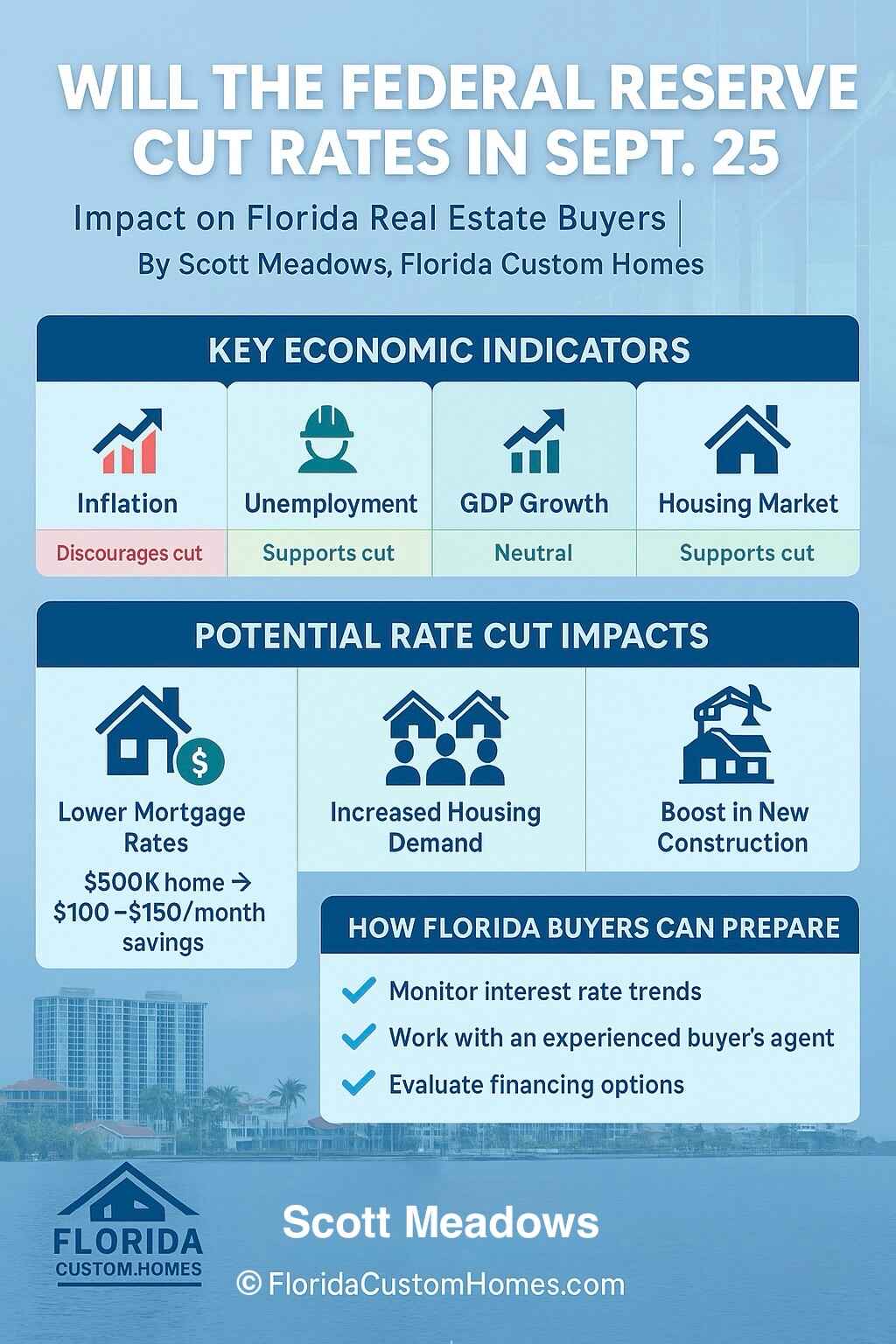
Will the Federal Reserve Cut Interest Rates in Mid-September 2025?
By Scott Meadows | Florida Custom Homes
The Federal Reserve’s interest rate decisions have a direct impact on the U.S. economy, including the housing market, consumer spending, and borrowing costs. With September 2025 approaching, homeowners, investors, and real estate professionals are closely watching economic indicators for clues about the Fed’s next move. In this article, we’ll break down the latest data, analyze key trends, and discuss what a potential rate cut could mean for Florida real estate buyers. Read more about Jerome Powell's August 2025 Jackson Hole Speech...
Understanding Federal Reserve Interest Rates
The Federal Funds Rate is the benchmark interest rate that banks charge each other for overnight loans. While this may sound abstract, it influences everything from mortgage rates to auto loans and business financing.
When the Fed raises rates, borrowing becomes more expensive, slowing economic activity and helping reduce inflation. Conversely, rate cuts make borrowing cheaper, stimulating spending and investment, including in real estate markets like Southwest Florida.
Why This Matters for Florida Homebuyers
- A 30-year fixed mortgage at 5.5% vs. 5.25% may seem small, but on a $500,000 home, it can mean a difference of $100–$150 per month.
- Lower rates can revive new construction sales, particularly in high-demand areas like Cape Coral, Fort Myers, Naples, and Punta Gorda.
- Investors looking at rental properties benefit from lower financing costs, potentially increasing cash flow and ROI.
Current Economic Context: Late 2025
| Indicator | Current Trend | Implication |
|---|---|---|
| Inflation (CPI) | Slowing from 4% to ~3.2% YoY | Indicates inflation pressure is moderating but still above target |
| Core PCE | ~3.1% | Fed-preferred measure shows cooling, but price stability is not fully achieved |
| Unemployment Rate | 3.9% (up from 3.5% in early 2025) | Labor market slightly softening, could allow room for a cut |
| GDP Growth | 2.1% annualized | Moderate growth supports measured policy decisions |
| Retail Sales / Consumer Spending | Slowing | Consumer caution may encourage Fed easing |
| Housing Market | Mortgage rates remain high; sales are cooling | Rate cuts could boost home sales and affordability |
Signs Pointing Toward a Potential Rate Cut
Several trends suggest that the Fed may consider lowering rates in September 2025, though no decision is guaranteed:
1. Inflation Is Moderating
Year-over-year CPI growth has slowed, signaling that prior rate hikes are starting to temper price pressures. The core PCE is gradually approaching the 2% target, a key Fed benchmark. Insight: If inflation continues to cool, the Fed has more flexibility to ease rates without risking a surge in prices.
2. Labor Market Shows Slight Weakening
While unemployment remains low, it has crept up slightly from historic lows earlier in the year. Wage growth is moderating, which reduces the risk of inflation being pushed by labor costs.
3. Economic Growth Is Steady but Not Overheating
GDP growth is positive but moderate, which means the economy can handle a small rate reduction without overheating. Slower consumer spending and a cooling housing market suggest that stimulus through lower rates may be appropriate.
Market Expectations and Futures
Financial markets are often ahead of official Fed announcements. Fed Funds Futures, which track investor expectations, indicate:
- ~30–40% probability of a 25-basis-point cut in September 2025
- Speculation of one or two additional cuts by late 2025, depending on inflation trends and economic growth
Risks That Could Delay a Rate Cut
- Inflation Resurgence: Energy prices, supply chain disruptions, or unexpected demand surges could push inflation higher.
- Global Economic Uncertainty: Geopolitical tensions, financial instability, or major disruptions could force the Fed to pause cuts.
- Policy Lag: Interest rate changes affect the economy with a 6–12 month delay, so the Fed must weigh past hikes before implementing new cuts.
What a September Rate Cut Would Mean for Florida Real Estate Buyers
- Lower Mortgage Rates: Rate cuts typically translate to reduced borrowing costs, which can improve affordability and expand purchasing power.
- Increased Housing Demand: Lower rates encourage both first-time buyers and investors to enter the market, potentially increasing competition in high-demand areas like Naples, Fort Myers, and Cape Coral.
- Positive Impact on New Construction: Developers may accelerate sales in new communities like Babcock Ranch, The Grove in Cape Coral, and North Port subdivisions. Rate cuts can make upgraded hurricane-resistant homes more accessible to buyers, who benefit from improved financing.
How Florida Buyers Can Prepare
- Monitor Interest Rate Trends: Stay informed through Fed announcements and economic data releases. Keep an eye on Fed Funds Futures and mortgage rate trends to time purchases strategically.
- Work With an Experienced Buyer’s Agent: A local real estate professional familiar with hurricane-resistant, waterfront, and new-construction homes can help identify properties with long-term value. Florida Custom Homes, led by Scott Meadows, specializes in identifying homes that meet current building codes and hurricane-ready standards.
- Evaluate Financing Options: Even a small rate reduction can make a significant difference in total mortgage costs. Explore fixed-rate and adjustable-rate mortgage options to determine the best fit for your financial goals.
Case Study: Cape Coral and Naples Housing Markets
Cape Coral:
Active waterfront and Gulf-access listings are cooling slightly due to higher mortgage rates. A 25-basis-point cut could reinvigorate buyers’ interest in hurricane-resistant homes with modern upgrades.
Naples:
Ultra-luxury estates, particularly in Port Royal, remain resilient due to high-net-worth buyers less sensitive to rate changes. Mid-market homes could see increased activity if mortgage rates decline following a Fed rate cut.
Summary Table: September 2025 Rate Cut Probability
| Factor | Trend | Effect on Fed Decision | Probability Contribution |
|---|---|---|---|
| Inflation (CPI/Core PCE) | Moderating but above target | Supports cautious cut | Moderate |
| Unemployment | Slightly increasing | Supports cut | Moderate |
| GDP Growth | Steady 2.1% | Neutral | Low |
| Housing Market | Cooling | Supports cut | Moderate |
| Consumer Spending | Slowing | Supports cut | Moderate |
| Market Expectations | Futures indicate ~30–40% | Signals likelihood | Moderate |
Overall Likelihood: Moderate — a 25-basis-point cut is plausible if trends continue, but the Fed remains data-driven and cautious.
Overall Likelihood: Moderate — a 25-basis-point cut is plausible if trends continue, but the Fed remains data-driven and cautious.
Final Thoughts
The Federal Reserve’s actions in September 2025 will be data-driven, carefully balancing inflation control with economic growth. While several indicators suggest a small rate cut is possible, uncertainty remains. Florida homebuyers, investors, and developers should:
- Monitor economic releases and Fed statements
- Work with experienced agents who understand local markets and hurricane-resistant construction
- Consider the impact of potential rate cuts on mortgage affordability and timing
Florida Custom Homes, led by Scott Meadows, offers expert guidance for buyers navigating a dynamic housing market. With over 30 years of experience in Southwest Florida, Scott helps clients identify homes that are compliant with modern hurricane codes, waterfront-ready, and financially sound investments.
📞 239.220.1157 | 📧 ScottMeadows3@gmail.com | 🌐 FloridaCustomHomes.com