Hurricane Ian Revealed the Dangers of Pre-Code Construction in Southwest Florida
By Scott Meadows, Florida Custom Homes
When Hurricane Ian made landfall on September 28, 2022, it wasn’t just one of the costliest storms in U.S. history—it was a stark reminder of how vulnerable older homes in Southwest Florida remain in the face of powerful hurricanes. With wind gusts exceeding 155 mph and catastrophic storm surge battering coastal communities like Fort Myers Beach, Sanibel Island, and Cape Coral, the destruction was widespread. But not all homes were affected equally.
As post-storm assessments rolled in, one fact became crystal clear: homes built before Florida's modern building codes were disproportionately destroyed.
Understanding the Evolution of Florida's Hurricane Building Codes
Florida's commitment to wind- and flood-resistant construction began in earnest after Hurricane Andrew in 1992. That Category 5 storm devastated South Florida and exposed the shortcomings of existing building practices. In response, Florida lawmakers implemented a series of reforms, culminating in the Florida Building Code (FBC) in 2002. This code established stringent wind-resistance standards, elevation requirements, and stricter enforcement.
Key highlights of the FBC and FEMA requirements include:
- Wind-load design: Reinforced roofing systems, hurricane straps, and impact-rated windows
- Elevation standards: Homes in flood zones must be built above base flood elevation (BFE)
- HVHZ compliance: High-Velocity Hurricane Zone standards for coastal counties
Despite these improvements, many homes along Florida's southwest coast—including large portions of Fort Myers Beach, Pine Island, and Naples—were built long before these protections became mandatory.
How Hurricane Ian Targeted Older Construction
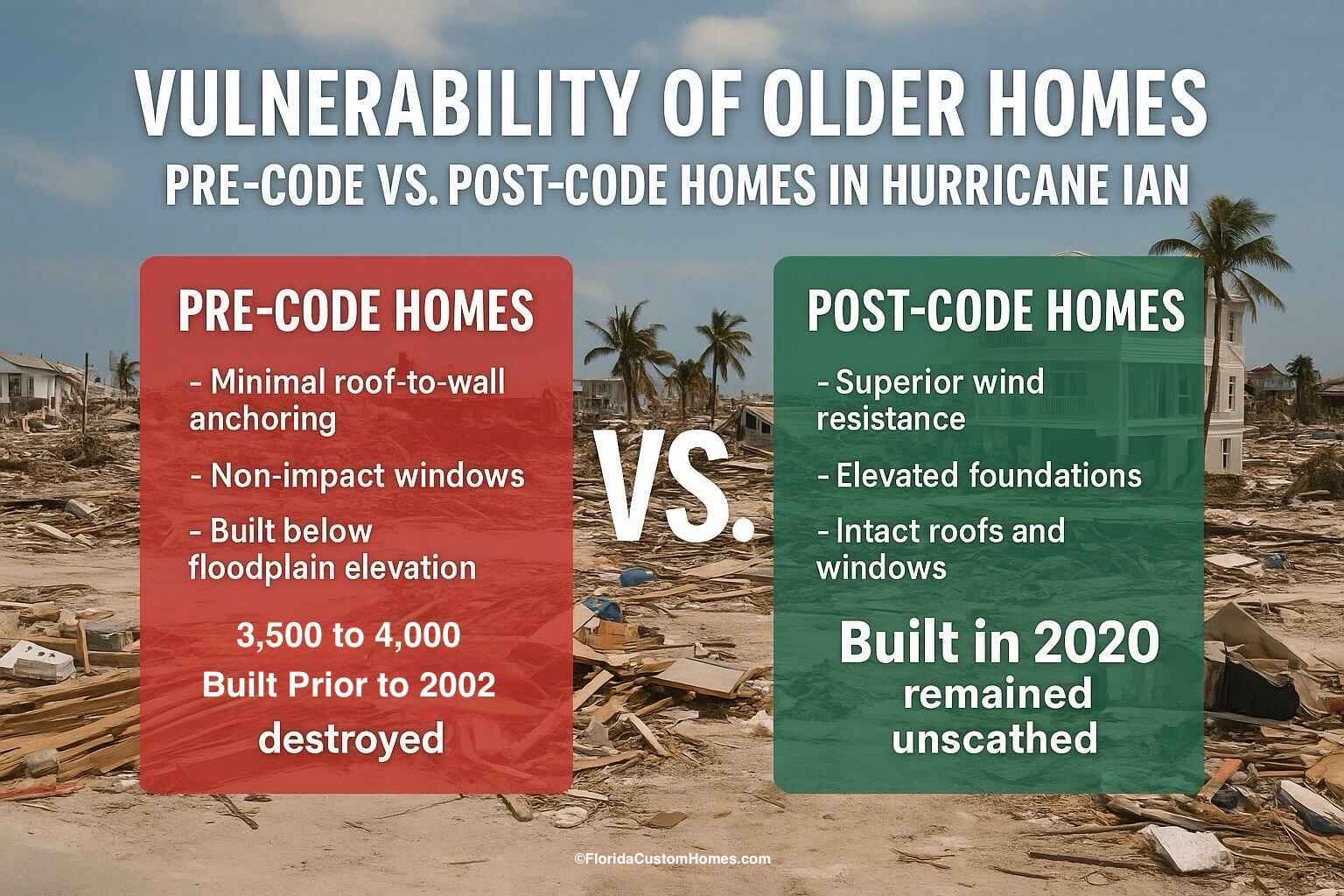
According to a FEMA Mitigation Assessment Team report, Ian caused widespread destruction in counties where older housing stock is common. In fact, roughly 70% of homes in the hardest-hit counties were built before 2002. That means they were constructed under weaker pre-FBC standards or no formal statewide code at all.
Let’s break down the performance of these older homes versus newer code-compliant construction:
📉 Pre-2002 Homes
- Commonly built with standard shingles, non-impact windows, and minimal roof-to-wall anchoring
- Many were slab-on-grade or built below floodplain elevation
- Widespread roof loss, structural collapse, and storm surge inundation
📈 Post-2002 Code-Built Homes
- Demonstrated superior wind resistance with minor cosmetic damage
- Elevated foundations reduced flood impact
- Survived with roofs intact, windows unbroken, and interiors dry
As an example, in Fort Myers Beach—a community with thousands of older homes—entire blocks were flattened. But a recently built elevated home withstood the storm almost untouched while 18 neighboring pre-1980 homes were swept away.
Statistical Evidence: Code Compliance Saves Homes
Here are some staggering statistics that show how devastating Hurricane Ian was for older homes:
| Construction Era | Average Insured Damage | Primary Cause |
|---|---|---|
| Pre-1980 | $164,891 | Roof loss, structural failure |
| 1980–2001 | $112,740 | Flooding, moderate wind damage |
| Post-2002 (FBC era) | $48,091 | Minor wind and water intrusion |
Additionally, FEMA found that no post-FBC homes experienced wind-related structural failure in their field assessments—proof that these modern building standards work when enforced and followed.
Real-World Case Study: Fort Myers Beach
Fort Myers Beach was ground zero for some of Ian’s worst destruction. The town’s charming beach cottages, many built in the 1960s and ’70s, simply couldn’t stand up to the combination of 12+ feet of storm surge and 150+ mph winds.
In contrast, modern homes built with elevated foundations, concrete block construction, and impact-rated glass not only survived—but in some cases remained habitable. One builder reported that a luxury home built in 2021 using ICF (Insulated Concrete Forms) had zero structural damage after the storm.
This isn’t coincidence—it’s the code doing its job.
Why Code Enforcement and Retrofitting Matter
It’s not just about when a home was built—it’s also about what updates have been made since. Unfortunately, many homeowners in coastal areas never retrofit their older properties. Without hurricane clips, roof upgrades, or impact windows, these homes become liabilities in major storms.
Homeowners can improve survivability by:
- Installing impact-rated doors and windows
- Using secondary water barriers on roofs
- Elevating HVAC and electric systems above BFE
- Reinforcing roof-to-wall connections
In many cases, these upgrades also result in lower insurance premiums and may be eligible for grant funding under Florida’s My Safe Florida Home program.
Implications for Buyers and Investors
If you're planning to buy a home in Southwest Florida, age and code compliance should be top of mind.
Whether it's Cape Coral, Naples, Estero, or Bonita Springs, ask these questions during the buying process:
- Was the home built after 2002? If not, has it been retrofitted?
- What wind speed zone was the home designed for?
- Is it elevated above base flood elevation (BFE)?
- Has it passed a wind mitigation inspection?
Homes with these resilient features tend to retain value better after storms and recover faster. Plus, your insurance premiums could be significantly lower than a non-compliant home just down the street.
Building Forward: A Resilient Future for Florida
In the aftermath of Ian, Florida lawmakers and municipalities are taking steps to harden coastal infrastructure and incentivize resilient construction. Expect increased pressure on building departments to enforce codes strictly and a growing demand for hurricane-resistant home features.
Buyers, builders, and policymakers now face a critical choice: rebuild the way we’ve always done it—or use storms like Ian as a turning point toward long-term safety and sustainability.
It’s clear that building to code isn’t just smart—it’s life-saving.
Looking to Buy a Hurricane-Resilient Home in Florida?
Whether you're relocating, investing, or upgrading to a newer construction, I specialize in identifying properties that meet or exceed Florida’s latest hurricane safety standards. From storm-rated windows and concrete block construction to ICF homes and elevated foundations—I’ll help you find a home that’s built to withstand what Florida weather brings.
🔍 Ready to Find a Hurricane-Resilient Home?
Contact Scott Meadows & Team today for expert guidance on buying smart and safe in Florida.
📞 Phone: 239.220.1157
📧 Email: ScottMeadows3@gmail.com
🌐 Website: FloridaCustomHomes.com