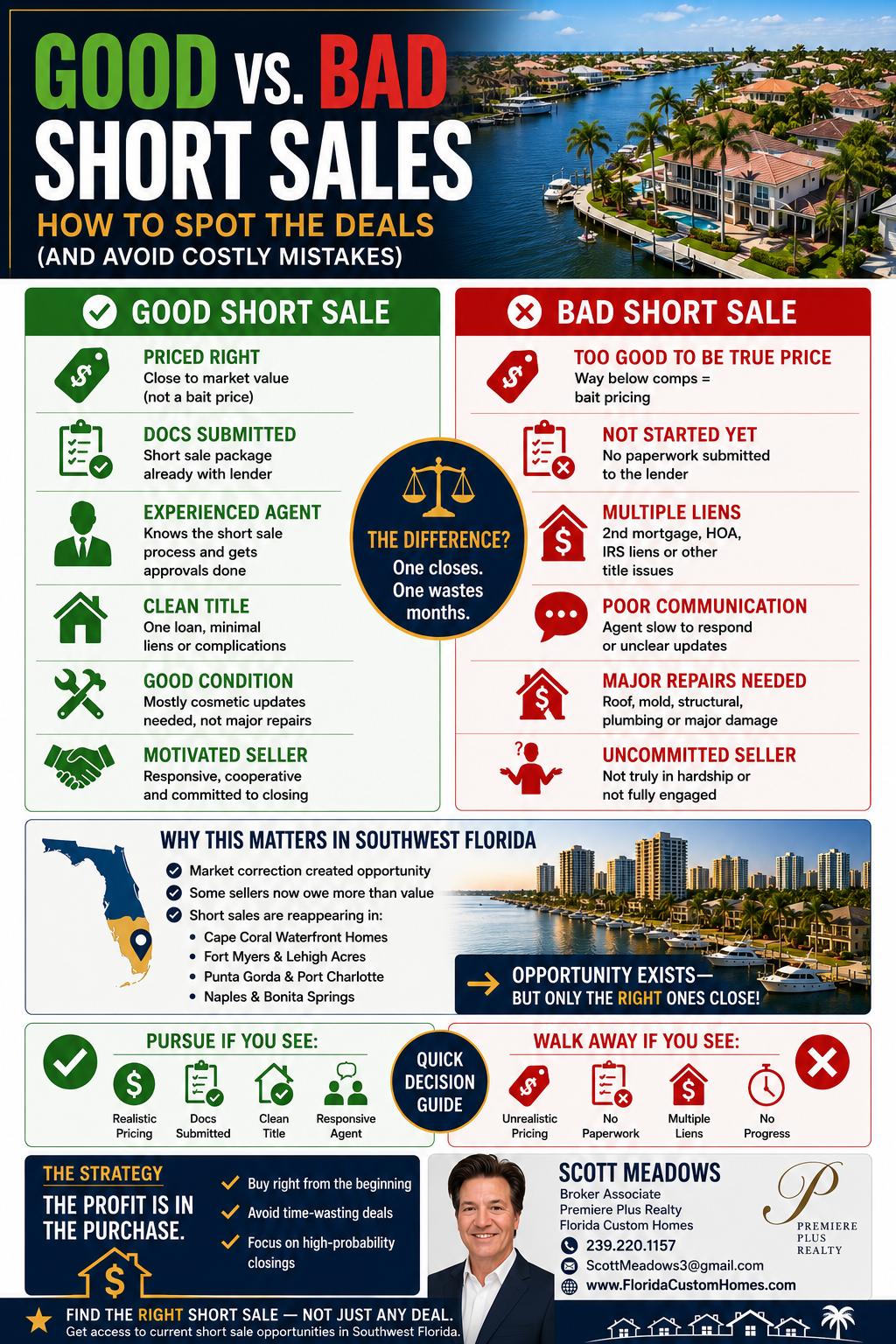
Good vs. Bad Short Sales in Southwest Florida: How to Spot the Deals and Avoid the Time Wasters
If you’ve been searching for value in today’s Southwest Florida real estate market—whether in Naples, Cape Coral, Fort Myers, Marco Island, Bonita Springs, Estero, Punta Gorda, or Fort Myers Beach—you may come across properties labeled “Short Sale – Subject to Lender Approval.”
At first glance, these listings can look like incredible opportunities. Sometimes they are. Other times, they can become months of frustration that never close.
Understanding the difference between a good short sale and a bad short sale is one of the most important skills a buyer can develop, especially in a shifting real estate market where some sellers may owe more than their home is currently worth.
Table of Contents
- What Is a Short Sale?
- What Makes a Good Short Sale?
- What Makes a Bad Short Sale?
- Why This Matters in Southwest Florida
- The Buyer Advantage
- Quick Rule of Thumb
- Final Thoughts
- Need Help Finding the Right Short Sale?
What Is a Short Sale?
A short sale occurs when a homeowner sells a property for less than the amount owed on the mortgage, and the lender agrees to accept that reduced payoff in order to avoid foreclosure.
Unlike a traditional sale, the seller is not the only decision maker. Even if the seller accepts your offer, the lender must still review and approve the sale.
That means buyers are not just negotiating with a seller. They are also dealing with the bank, the lender’s valuation process, possible lien holders, and a longer approval timeline.
What Makes a Good Short Sale?
Not all short sales are created equal. The best ones share a few important characteristics that improve the odds of closing successfully.
1. Realistic Pricing
A good short sale is usually priced close to current market value or slightly below comparable sales.
It should not be dramatically underpriced just to attract attention. If the price looks far below market value, there is a strong chance the bank will counter much higher after reviewing the property’s value.
2. Experienced Listing Agent
The listing agent matters tremendously in a short sale. An experienced short sale agent understands lender requirements, documentation, communication timelines, and how to keep the transaction moving.
Look for listing remarks such as:
- Short sale package submitted
- Bank engaged
- Experienced short sale negotiator involved
- Subject to lender approval
3. Complete Short Sale Package Submitted
A strong short sale usually has the seller’s paperwork already submitted to the lender. This may include the hardship letter, financial statements, authorization forms, tax documents, and supporting documentation.
If the short sale package has not been submitted, the process may not have truly started yet.
4. Simple Lien Structure
The cleanest short sales usually involve one mortgage and no major title complications.
Short sales become more difficult when there are:
- Second mortgages
- Home equity lines of credit
- HOA liens
- IRS liens
- Judgments or other title issues
Every lien holder may need to approve the sale, which can delay or derail the transaction.
5. Reasonable Property Condition
Most short sales are sold as-is. A good short sale is usually a property that needs cosmetic improvements or normal updating, not one with severe structural damage, major roof issues, mold, or extensive deferred maintenance.
The better the condition, the easier it is to defend the value to the lender and keep the buyer committed through the approval process.
6. Motivated and Cooperative Seller
Even though the lender must approve the final sale, the seller still has to cooperate. A good short sale involves a seller who is responsive, organized, and committed to completing the process.
If the seller delays paperwork or is not fully committed, the deal can stall quickly.
What Makes a Bad Short Sale?
A bad short sale can tie up a buyer’s time for months and still never close. These are the warning signs to watch for.
1. Unrealistically Low Pricing
If a short sale is priced far below comparable properties, it may be a bait price designed to generate multiple offers.
The problem is that the lender may not approve that low price. After the bank completes its valuation, the buyer may receive a counteroffer much closer to market value.
2. Short Sale Not Started
If the seller has not submitted the required documents, the transaction is starting from the beginning.
Statements like “waiting on seller paperwork” or “short sale package has not been submitted yet” are major red flags.
3. Multiple Liens or Complicated Title
Multiple lien holders can make a short sale much harder to close. A second mortgage, HOA lien, tax lien, or judgment can create additional negotiations and delays.
In some cases, one lien holder can prevent the entire transaction from moving forward.
4. Poor Communication
Communication is critical in a short sale. If the listing agent is vague, slow to respond, or unable to provide clear updates, the buyer may be entering a frustrating process.
A lack of communication is one of the most common reasons buyers lose patience and walk away.
5. Poor Property Condition
Short sales are often sold as-is, which means buyers need to be realistic about repairs.
A property with major roof damage, water intrusion, mold, electrical problems, plumbing issues, or structural concerns may not be worth the wait unless the price fully reflects the risk.
6. Seller Is Not Truly in Hardship
The lender usually needs to see a legitimate hardship before approving a short sale. If the seller is not truly in financial distress or is simply testing the market, the lender may deny the request.
7. Long Days on Market With No Progress
A short sale that has been sitting for months with no clear updates may be stalled because of lender issues, title problems, unrealistic pricing, or missing documentation.
Long days on market alone do not always mean the deal is bad, but it should trigger deeper questions.
Why This Matters in Southwest Florida
Southwest Florida has experienced major real estate shifts over the past several years. Many buyers entered the market during periods of rapid price appreciation, especially in waterfront, luxury, new construction, and high-demand coastal areas.
When prices adjust, some homeowners may find themselves owing more than their home is currently worth. That can create short sale situations, particularly for sellers facing financial hardship, increased insurance costs, higher interest rates, HOA fee increases, or other financial pressure.
Short sales may appear in markets such as:
- Cape Coral waterfront homes
- Fort Myers single-family homes
- Lehigh Acres homes
- Port Charlotte properties
- Punta Gorda homes
- Select Naples and Bonita Springs properties
For the right buyer, a short sale can represent an opportunity. But it must be evaluated carefully.
The Buyer Advantage
The biggest advantage for buyers is that many people do not have the patience or knowledge to pursue a short sale correctly.
Some buyers walk away because the approval process takes too long. Others avoid short sales entirely because they do not understand them. That can reduce competition for buyers who are patient, prepared, and properly represented.
However, the buyer must understand that a short sale is not guaranteed. The lender can approve, reject, or counter the offer.
A strong buyer should be prepared with:
- Proof of funds or a strong pre-approval letter
- Realistic expectations about timing
- Flexibility during the lender approval process
- A clear understanding that the property is likely being sold as-is
- An agent who understands how to evaluate short sale risk
Quick Rule of Thumb
Pursue the short sale if you see:
- Realistic pricing
- Short sale package already submitted
- Responsive listing agent
- Clean or simple lien structure
- Reasonable property condition
- Motivated seller
Proceed cautiously or walk away if you see:
- Unrealistically low pricing
- No paperwork submitted
- Multiple liens or title issues
- Poor communication
- Major property damage
- Uncooperative seller
- No progress after months on market
Final Thoughts: The Profit Is in the Purchase
Short sales can be excellent opportunities, but they are not automatically good deals.
The key is knowing how to separate legitimate opportunities from listings that are unlikely to close.
In today’s Southwest Florida real estate market, buyers who understand short sales may be able to find value, negotiate effectively, and purchase property with built-in equity potential.
As I often say, the profit is in the purchase. Buying right from the beginning can make all the difference.
Need Help Finding the Right Short Sale?
With more than 35 years of real estate and negotiation experience in Southwest Florida, I help buyers identify real opportunities, avoid problem properties, and structure offers that have the best chance of closing.
Whether you are searching for a short sale, waterfront home, luxury property, golf course home, beachfront condo, or new construction home, having the right guidance can protect your time, money, and negotiating position.
Scott Meadows
Broker Associate | Premiere Plus Realty
Florida Custom Homes
Phone: 239.220.1157
Email: ScottMeadows3@gmail.com
Don’t just find a deal. Find the right deal.