Florida Homestead Exemption: A Complete Guide for Homeowners in 2025
By Scott Meadows | Florida Custom Homes
Owning a home in Florida comes with many benefits, and one of the most valuable is the Florida Homestead Exemption. This property tax relief program can save homeowners thousands of dollars each year, protect your primary residence from market fluctuations, and provide additional exemptions for seniors, veterans, and people with disabilities. Whether you are a first-time Florida homebuyer or a seasoned investor, understanding the Homestead Exemption is essential to maximize your savings and safeguard your property.
In this comprehensive guide, we will break down everything you need to know about Florida’s Homestead Exemption, including eligibility requirements, application deadlines, the “Save Our Homes” assessment cap, portability benefits, senior exemptions, and tips to optimize your property tax savings.
What is the Florida Homestead Exemption?
The Florida Homestead Exemption is a state-mandated property tax benefit available to homeowners who use their property as their primary residence. This exemption reduces the taxable value of a home, which in turn lowers the annual property tax bill.
Key Features:
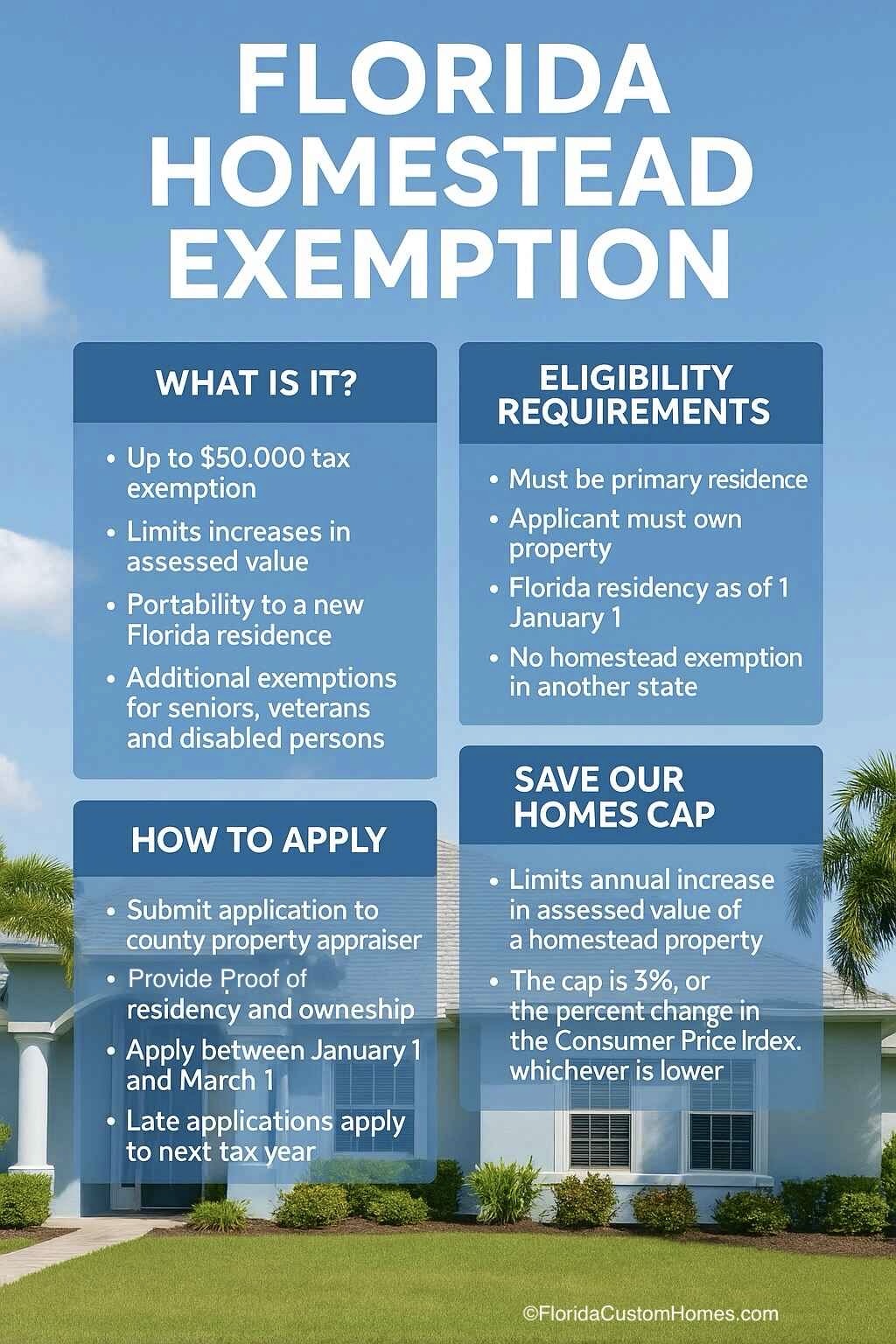
- Up to $50,000 Tax Reduction: The exemption can reduce the taxable value of a home by up to $50,000. The first $25,000 applies to all property taxes, including school district taxes. The second $25,000 applies to non-school taxes for assessed values between $50,000 and $75,000.
- Save Our Homes (SOH) Cap: Limits the annual increase in your home's assessed value to 3% or the percentage change in the Consumer Price Index (CPI), whichever is lower.
- Portability: Allows you to transfer your accumulated SOH benefit to a new homestead within Florida, potentially saving thousands in property taxes.
- Additional Exemptions: Seniors, veterans, and people with disabilities may qualify for further tax relief.
Why the Homestead Exemption Matters
Florida’s property taxes can be significant, especially in areas with high real estate values like Cape Coral, Naples, Fort Myers, and Marco Island. The Homestead Exemption allows homeowners to reduce their annual tax liability, often by thousands of dollars.
For example, a home assessed at $300,000 may qualify for a $50,000 exemption. Without the exemption, property taxes could be calculated on the full $300,000, but with the exemption, the taxable value drops to $250,000, providing immediate financial relief.
The exemption also provides long-term stability. With the SOH cap, your taxable value cannot increase by more than 3% per year or the change in the Consumer Price Index (CPI), whichever is lower. This protects homeowners from large spikes in property taxes during periods of rapid property appreciation.
Eligibility Requirements
To qualify for the Homestead Exemption, homeowners must meet several requirements:
- Primary Residence: The property must be your permanent and primary residence in Florida.
- Ownership: You must own the home or hold equitable title.
- Residency Date: You must be a permanent Florida resident as of January 1 of the tax year.
- No Other Homestead Exemption: You cannot claim a homestead exemption in another state or county.
- Proof of Residency: Common documents include a Florida driver’s license, vehicle registration, voter registration, or a Declaration of Domicile.
How to Apply for the Florida Homestead Exemption
Applying for the Homestead Exemption is straightforward but time-sensitive.
Step 1: Gather Required Documents
- Proof of Florida residency (driver’s license, voter registration, or Declaration of Domicile)
- Proof of ownership (property deed or equitable title documentation)
- Social Security Number of the homeowner
Step 2: Complete the Application Form
Use Form DR-501, available through your county property appraiser’s office or online portal.
Step 3: Submit by Deadline
Applications must be submitted between January 1 and March 1 of the tax year. Late applications are accepted, but the exemption will apply starting the following tax year.
Step 4: Confirmation
The property appraiser will review your application and notify you if the exemption is approved. Approved exemptions are automatically applied to your annual property tax bill.
Tip: Even if your property was previously exempt, you must reapply if you move, sell, or refinance your home to ensure the exemption continues on your new primary residence.
Save Our Homes (SOH) Cap
The Save Our Homes (SOH) cap limits how much your property's assessed value can increase each year for tax purposes:
- The cap is the lower of 3% or the annual change in the Consumer Price Index (CPI).
- This protection prevents homeowners from being taxed on the full market appreciation of their home each year.
- For example, if your home’s market value increases by 10% in one year, your assessed value for property taxes will only increase by 3% under SOH rules.
Portability: Transferring Homestead Benefits
Portability allows you to transfer your SOH benefits when moving to a new Florida home:
- Establish a new homestead and file for a homestead exemption.
- Submit Form DR-501T to transfer your assessment difference.
- You must establish your new homestead within three years of leaving the previous home.
- The maximum SOH benefit transfer is $500,000.
Additional Exemptions for Seniors, Veterans, and Disabled Homeowners
Florida offers additional property tax relief for qualifying groups:
- Seniors (Age 65+): May qualify for extra exemption, subject to income limits.
- Veterans: Disabled veterans may qualify for additional or full property tax exemptions.
- Persons with Disabilities: Totally and permanently disabled homeowners may be eligible for further exemptions.
Amendment 5: Inflation Adjustment
Effective January 2025, Florida’s Homestead Exemption adjusts annually based on the Consumer Price Index (CPI) for the second $25,000 exemption. This keeps your property tax relief aligned with inflation.
Common Questions About Florida’s Homestead Exemption
- Can I claim homestead exemption on a vacation home? No.
- Do I need to reapply every year? No, unless you move or refinance.
- Can I combine homestead exemption with other tax breaks? Yes, subject to limits.
- How does it affect my property taxes if I sell? Exemption ends, but portability may apply.
- What if I miss the March 1 deadline? Late applications are applied next tax year.
County-Specific Considerations
- Lee County (Cape Coral, Fort Myers): Lee County Property Appraiser
- Collier County (Naples, Marco Island): Collier County Property Appraiser
- Charlotte County (Port Charlotte, Punta Gorda): Charlotte County Property Appraiser
Tips for Maximizing Your Homestead Exemption Benefits
- Apply early.
- Verify residency documents.
- Check for additional exemptions.
- Plan portability if moving within Florida.
- Stay informed about changes to laws and exemptions.
Why Homeowners Should Prioritize Homestead Exemption
The Homestead Exemption is more than a tax break; it is a financial safety net. It lowers taxable value, limits annual increases, and provides stability in Florida’s dynamic real estate market.
Conclusion
The Florida Homestead Exemption is an essential tool for every homeowner. By taking advantage of this program, you can save thousands annually, protect your primary residence, and enjoy greater financial security.
Contact Scott Meadows | Florida Custom Homes
Phone: 239-220-1157
Email: ScottMeadows3@gmail.com
Website: www.FloridaCustomHomes.com