Federal Reserve September 2025 Rate Cut: Implications for Homebuyers and the Stock Market
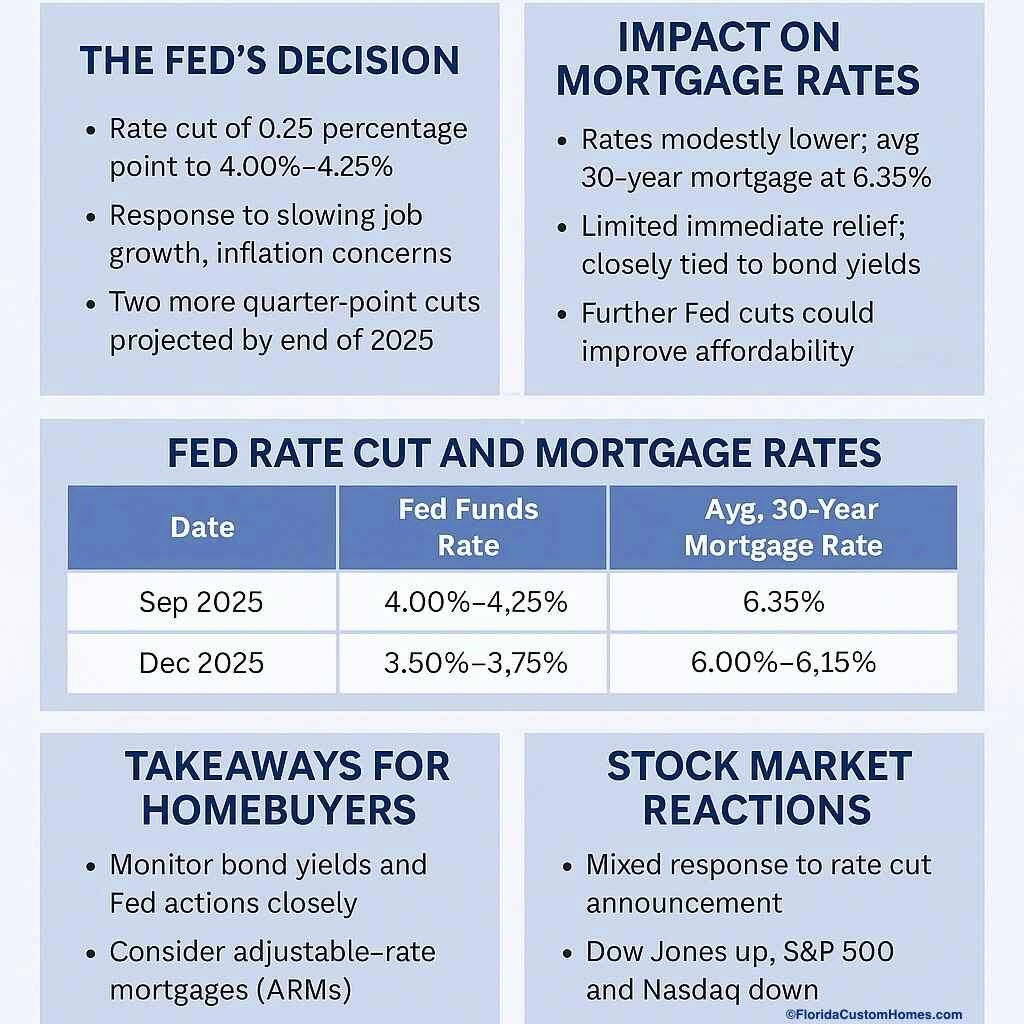
On September 17, 2025, the U.S. Federal Reserve executed its first interest rate cut of the year, lowering the federal funds rate by 25 basis points to a range of 4.00%–4.25%. This action marks a notable shift in monetary policy, reflecting growing concerns over the slowing labor market, economic growth moderation, and persistent inflation pressures. The Fed’s decision is sending ripples across the housing market, mortgage rates, and the stock market, signaling both opportunities and challenges for homebuyers and investors nationwide.
Understanding the Fed's Strategic Decision
The Federal Reserve's rate cut is a response to several intertwined economic factors:
- Labor Market Trends: Job gains have slowed significantly in recent months, while certain sectors, particularly manufacturing and services, show signs of reduced hiring. This deceleration signals potential risks to consumer spending, which fuels the broader economy.
- Inflation Pressures: While inflation remains above the Fed's 2% target, price growth has moderated from the peaks of 2024. The Fed must balance stimulating growth without triggering renewed inflationary pressures.
- Global Economic Considerations: International economic uncertainty, including fluctuations in commodity prices and geopolitical tensions, has influenced the Fed’s cautious approach to policy adjustments.
Fed Chair Jerome Powell described the rate cut as a “risk-management decision,” emphasizing the need to support employment while monitoring inflationary trends. The Fed’s forward guidance indicates the potential for two additional quarter-point cuts by the end of 2025, contingent on economic data. This gradual easing strategy seeks to provide stability without destabilizing financial markets.
How the Fed Rate Cut Affects Mortgage Rates
For homebuyers and homeowners, the rate cut carries important implications:
- Modest Immediate Effect: While the federal funds rate impacts short-term borrowing, mortgage rates, especially 30-year fixed rates, are largely influenced by long-term Treasury yields. Following the Fed announcement, 30-year fixed mortgage rates decreased slightly to approximately 6.35%–6.40%.
- Refinancing Opportunities: Homeowners with adjustable-rate mortgages (ARMs) or higher fixed rates may see savings by refinancing, particularly if subsequent Fed cuts materialize. Recent reports indicate a surge in refinance applications by nearly 60%.
- Timing Strategies: Buyers contemplating a new home purchase should consider market timing. Waiting for further rate cuts could lower borrowing costs, but there is risk of rising home prices in certain markets, offsetting potential savings.
Regional Housing Market Implications
Impact varies by region:
- Southwest Florida: Areas like Naples, Fort Myers, and Cape Coral could see increased buyer activity as affordability improves slightly with marginal rate reductions.
- Northeast Markets: Urban centers such as New York and Boston may remain high-priced, and small rate decreases might not materially change affordability pressures.
- Midwest and South: Markets like Dallas, Charlotte, and Atlanta may experience a modest boost in demand as lower rates improve financing feasibility for first-time buyers.
Mortgage Rate and Fed Rate Cut Correlation Table
| Date | Fed Funds Rate | Average 30-Year Fixed Mortgage Rate | Market Commentary |
|---|---|---|---|
| Aug 2025 | 4.25%–4.50% | 6.50% | Rising mortgage rates slowed refinancing activity. |
| Sep 17, 2025 | 4.00%–4.25% | 6.35% | Small decline in mortgage rates; refinance applications increase. |
| Projected Dec 2025 | 3.50%–3.75% | 6.00%–6.15% (estimated) | Further easing may support homebuyer affordability. |
Stock Market Reactions
The stock market reacted with mixed sentiment to the Fed’s announcement:
- Dow Jones Industrial Average: Rose 0.56% to 46,014, indicating optimism in traditional, blue-chip sectors.
- S&P 500: Declined slightly by 0.10%, reflecting cautious sentiment across a broader mix of companies.
- Nasdaq Composite: Fell 0.33%, pressured by technology and semiconductor stocks, including Nvidia and Broadcom.
- Russell 2000: Small-cap stocks gained 0.2%, suggesting optimism among smaller enterprises.
Investors are navigating a delicate balance: while rate cuts can stimulate economic growth and corporate earnings, uncertainties regarding the labor market, inflation, and geopolitical events temper enthusiasm. Certain sectors, including tech and AI-driven companies, face volatility, whereas utilities and consumer staples benefit from a lower-cost borrowing environment.
Investor and Homebuyer Takeaways
Key strategies for stakeholders include:
- Homebuyers: Monitor mortgage rates, regional housing trends, and inventory availability. Consider locking in rates or exploring ARMs if waiting for further cuts poses market risks.
- Homeowners: Evaluate refinancing options, particularly if holding high-rate mortgages. Even small reductions can translate to significant savings over a multi-year loan term.
- Investors: Diversify portfolios to mitigate sector-specific volatility. Pay attention to Fed communications and bond market trends to anticipate broader market moves.
- Policymakers: Maintain central bank independence to ensure credibility. Carefully balance employment support with inflation control to avoid long-term economic instability.
Historical Perspective: Fed Rate Cuts and Housing Market Trends
Historically, Fed rate cuts have had mixed effects on housing markets:
- 2001–2003: Multiple cuts following the dot-com crash helped stabilize mortgage rates, supporting housing recovery.
- 2008–2010: Aggressive cuts during the global financial crisis lowered borrowing costs, but housing demand remained constrained due to tighter credit and high unemployment.
- 2019–2020: Rate cuts leading into the COVID-19 pandemic temporarily lowered mortgage rates, spurring refinance activity despite economic uncertainty.
These examples highlight that while lower rates generally support affordability, other macroeconomic conditions—including employment, credit availability, and inflation expectations—play a critical role in shaping market outcomes.
Global Considerations
The Fed’s actions also resonate globally:
- Currency Valuation: Lower U.S. rates can weaken the dollar, impacting import/export dynamics and foreign investment in U.S. assets.
- International Bond Markets: Lower rates in the U.S. may drive foreign capital into U.S. Treasuries or equities, influencing asset prices.
- Geopolitical Tensions: Global uncertainty can magnify domestic market reactions to Fed policy, affecting both housing and stock market trends.
Conclusion
The Federal Reserve's September 2025 rate cut signals a strategic shift toward supporting employment while carefully monitoring inflation. For homebuyers, the immediate impact on mortgage rates is modest, but forward guidance and projected additional cuts offer potential opportunities for savings and increased affordability. For investors, mixed stock market reactions reflect both optimism and caution, emphasizing the need for diversification and careful market monitoring.
Homeowners, prospective buyers, and investors should stay informed of economic indicators, regional market conditions, and Fed communications to make strategic decisions. While rate cuts can provide relief, they are just one piece of the broader economic puzzle, including housing supply, regional demand, and global economic trends.
By understanding the nuances of Fed policy, mortgage rate dynamics, and stock market implications, stakeholders can make informed decisions to navigate the evolving financial landscape of late 2025.