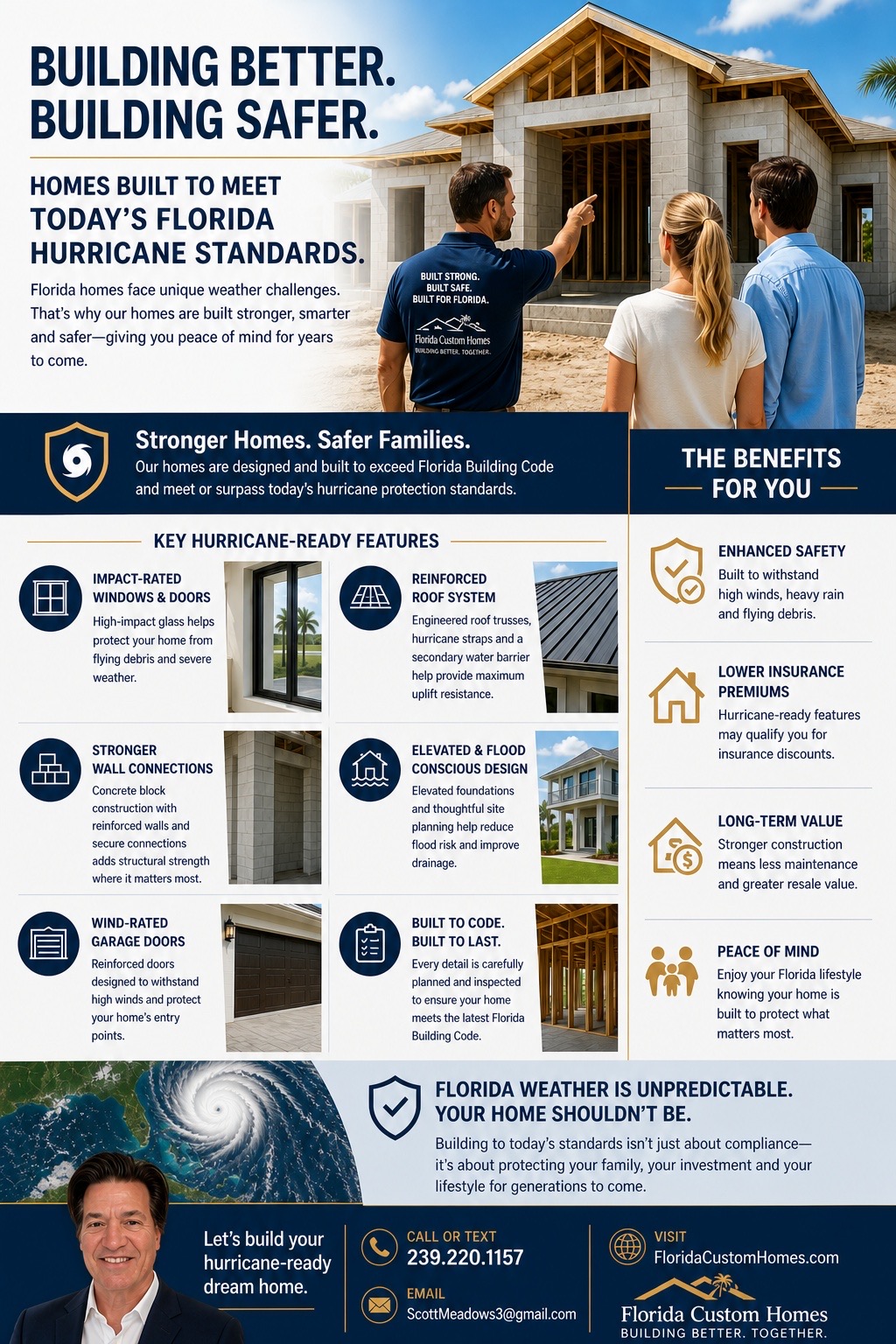
Building Better. Building Safer: Why Hurricane-Resistant Homes Are the Smartest Investment in Southwest Florida
Meta Description: Learn why hurricane-resistant homes built to today’s Florida building standards offer stronger protection, better long-term value, potential insurance benefits, and peace of mind for Southwest Florida buyers.
Table of Contents
- Florida Living Requires Smarter Construction
- What Today’s Florida Hurricane Standards Mean
- Key Hurricane-Ready Features
- Benefits for Florida Homebuyers
- Why This Matters in Today’s Real Estate Market
- New Construction vs. Older Homes
- Smart Buyer Checklist
- Work With Scott Meadows
Florida Living Requires Smarter Construction
Living in Southwest Florida offers one of the most desirable lifestyles in the country: waterfront living, boating access, sunshine, beaches, golf communities, luxury homes, and year-round outdoor living. But Florida ownership also comes with a major responsibility: choosing a home that is built to handle the realities of hurricane season, heavy rain, high winds, flooding, and changing insurance requirements.
Today’s Florida homebuyers are no longer shopping based on location and appearance alone. More buyers are asking detailed questions about roof systems, impact windows, elevation, flood zones, insurance costs, construction materials, and storm resilience. In markets like Cape Coral, Naples, Fort Myers, Bonita Springs, Marco Island, and Southwest Florida, hurricane-resistant construction has become one of the most important long-term value factors in real estate.
Homes built to today’s Florida hurricane standards are designed to be stronger, safer, and more durable. They offer buyers greater confidence, improved protection, and potentially better resale appeal over time.
What Does “Built to Today’s Florida Hurricane Standards” Really Mean?
Florida has some of the strongest residential building standards in the United States. These standards were strengthened after major storms exposed weaknesses in older construction. Modern Florida homes are engineered with multiple layers of protection intended to reduce wind damage, water intrusion, roof failure, and structural vulnerability.
For buyers, this means newer homes and properly upgraded homes may offer a major advantage over older properties that have not been improved. A home built to current hurricane standards may include impact-rated openings, stronger roof attachments, reinforced wall systems, improved drainage, elevated design, and wind-rated garage doors.
These features are not simply cosmetic upgrades. They are major structural and safety components that can affect property protection, insurance eligibility, maintenance costs, and long-term value.
Key Hurricane-Ready Features Every Florida Buyer Should Understand
1. Impact-Rated Windows and Doors
Impact-rated windows and doors are among the most important hurricane-resistant features in a Florida home. These systems are designed to resist flying debris and help protect the building envelope during extreme wind events.
When a window or door fails during a storm, wind pressure can enter the home and increase the risk of roof and structural damage. Impact-rated glass helps reduce that risk while also improving everyday security, noise reduction, and convenience because homeowners do not need to install shutters before every storm.
For buyers comparing homes, impact windows and doors can be a major advantage. They may also help with wind mitigation credits depending on the property, insurer, and documentation available.
2. Reinforced Roof Systems
The roof is one of the most important parts of a hurricane-ready home. Modern Florida roof systems may include engineered trusses, hurricane straps, improved fasteners, secondary water barriers, and durable roofing materials such as tile or standing seam metal.
A reinforced roof system helps protect against uplift, wind-driven rain, and water intrusion. This is especially important in coastal and waterfront communities where wind exposure may be higher.
Buyers should always review roof age, roof material, permit history, insurance documentation, and wind mitigation reports before purchasing a Florida property.
3. Stronger Wall Connections
Concrete block construction is common in many Florida homes because it offers strength and durability. However, the quality of the structural connections is just as important as the wall material itself.
Modern hurricane-resistant homes are built with stronger connections between the foundation, walls, and roof system. These connections help the structure perform as one unified system during high-wind events.
For buyers, this means looking beyond surface finishes and asking how the home was actually built. A beautiful home with weak structural components may not offer the same long-term protection as a properly engineered storm-resistant property.
4. Elevated and Flood-Conscious Design
In Florida, wind is only part of the risk. Flooding, storm surge, and heavy rainfall can also create major property damage. That is why elevation and drainage matter.
Homes built with flood-conscious design may include elevated foundations, improved grading, proper drainage, stormwater planning, and site positioning that helps reduce water intrusion risk.
Buyers should review the property’s FEMA flood zone, elevation certificate, flood insurance requirements, drainage conditions, and history of water intrusion. This is especially important for waterfront homes, canal-front homes, beachfront condos, and low-lying neighborhoods.
5. Wind-Rated Garage Doors and Entry Points
Garage doors are often one of the most vulnerable areas of a home during high-wind events. A failed garage door can allow wind pressure into the structure and increase the chance of major damage.
Wind-rated garage doors are designed with reinforced panels, stronger tracks, and pressure-tested systems. For Florida buyers, this is an important feature that should not be overlooked.
Entry doors, sliding glass doors, and large window openings should also be evaluated for storm protection, especially in luxury homes with expansive glass and waterfront views.
Benefits for Florida Homebuyers
Enhanced Safety
Homes built to stronger hurricane standards are designed to better protect families during severe weather. Features such as impact glass, reinforced roofs, elevated foundations, and stronger wall systems help reduce vulnerability during storms.
Potential Insurance Advantages
Insurance remains one of the biggest concerns for Florida homeowners. Hurricane-ready features may help buyers qualify for certain wind mitigation credits or more favorable insurance consideration, depending on the home and insurer.
Buyers should request a wind mitigation inspection, review insurance quotes early, and compare how different construction features affect annual ownership costs.
Long-Term Value
Storm-resistant homes may hold value better because future buyers are likely to continue prioritizing safety, insurance, flood protection, and durability. As buyer awareness increases, homes with strong construction features may stand out in competitive markets.
Peace of Mind
Perhaps the biggest benefit is peace of mind. A hurricane-ready home allows owners to enjoy the Florida lifestyle with greater confidence, knowing the property was designed with safety and resilience in mind.
Why Hurricane-Ready Construction Matters in Today’s Real Estate Market
The Southwest Florida real estate market has changed. Buyers are more educated, more cautious, and more focused on total ownership costs. They are not only asking about price, square footage, and location. They are also asking about roof age, flood zones, elevation, insurance, impact protection, and storm history.
This is especially true in coastal and waterfront markets such as Southwest Florida real estate, where hurricane risk and insurance costs are directly connected to buyer confidence.
Homes that already include hurricane-resistant features may have a marketing advantage. Sellers with upgraded homes should clearly highlight impact windows, newer roofs, elevation improvements, flood mitigation, storm-rated doors, and wind mitigation documentation.
New Construction vs. Older Florida Homes
Older homes can offer excellent locations, mature landscaping, larger lots, and established neighborhoods. However, many older homes were built before today’s stricter hurricane standards. Unless they have been substantially upgraded, they may lack modern storm protection.
New construction homes often provide major advantages, including current code compliance, modern roof systems, stronger structural connections, impact-rated openings, energy efficiency, and updated flood-conscious design.
This does not mean every newer home is automatically better or every older home should be avoided. It means buyers need to evaluate the details. A well-renovated older home with impact windows, a newer roof, upgraded electrical and plumbing, and proper flood protection may be an excellent choice. The key is knowing what to look for.
Smart Buyer Checklist for Hurricane-Ready Homes
- Confirm the home’s FEMA flood zone.
- Request an elevation certificate if available.
- Review roof age, material, permits, and condition.
- Ask whether windows and doors are impact-rated.
- Check for wind-rated garage doors.
- Review the wind mitigation report.
- Get insurance quotes early in the buying process.
- Inspect drainage, grading, gutters, and stormwater flow.
- Ask about prior flooding or water intrusion.
- Work with a local real estate professional who understands Florida construction and storm-related property issues.
Work With Scott Meadows
Buying in Florida requires more than finding a beautiful home. It requires understanding construction quality, insurance concerns, flood zones, roof systems, storm protection, and long-term resale value.
If you are considering buying or selling a home in Southwest Florida, work with a local real estate professional who understands the market, the weather, and the property features that matter most.
Scott Meadows
Broker Associate | Premiere Plus Realty
Phone: 239.220.1157
Email: ScottMeadows3@gmail.com
Website: FloridaCustomHomes.com